The myth of the neutral beginning
Complaints about media bias usually assume a fall: once the press was fair, now it is not. The documents say otherwise. The American press was partisan before America existed; the country's press freedom was won in 1735 by a printer whose paper existed specifically to attack the governor, and objectivity, when it finally arrived, was a twentieth-century business decision. This is the origin story in its own words.
1735: the jury that legalized attacking the government
John Peter Zenger printed the New-York Weekly Journal, an opposition paper built to torment the colonial governor William Cosby. Cosby jailed him for seditious libel. Under the law of the day, truth was no defense; printing criticism was the crime. Zenger's lawyer, the aging Philadelphian Andrew Hamilton, asked the jury to ignore that law, and told them what was actually on trial:
Primary source 01 / 06
The question before the Court and you, Gentlemen of the jury, is not of small or private concern. It is not the cause of one poor printer, nor of New York alone, which you are now trying. No! It may in its consequence affect every free man that lives under a British government on the main of America. It is the best cause. It is the cause of liberty.
Primary source 02 / 06
every man who prefers freedom to a life of slavery will bless and honor you as men who have baffled the attempt of tyranny, and by an impartial and uncorrupt verdict have laid a noble foundation for securing to ourselves, our posterity, and our neighbors, that to which nature and the laws of our country have given us a right to liberty of both exposing and opposing arbitrary power (in these parts of the world at least) by speaking and writing truth.
The jury took a short recess and acquitted. Note what American press freedom was founded on: not a right to report neutrally, but a right to expose and oppose power. The founding document of the free press is a defense of an attack paper.
1787: Jefferson, newspapers' greatest fan
Fifty years later, with the Constitution being drafted, Thomas Jefferson wrote from Paris the most flattering thing any statesman has ever said about the press:
Primary source 03 / 06
The basis of our governments being the opinion of the people, the very first object should be to keep that right; and were it left to me to decide whether we should have a government without newspapers, or newspapers without a government, I should not hesitate a moment to prefer the latter. But I should mean that every man should receive those papers and be capable of reading them.
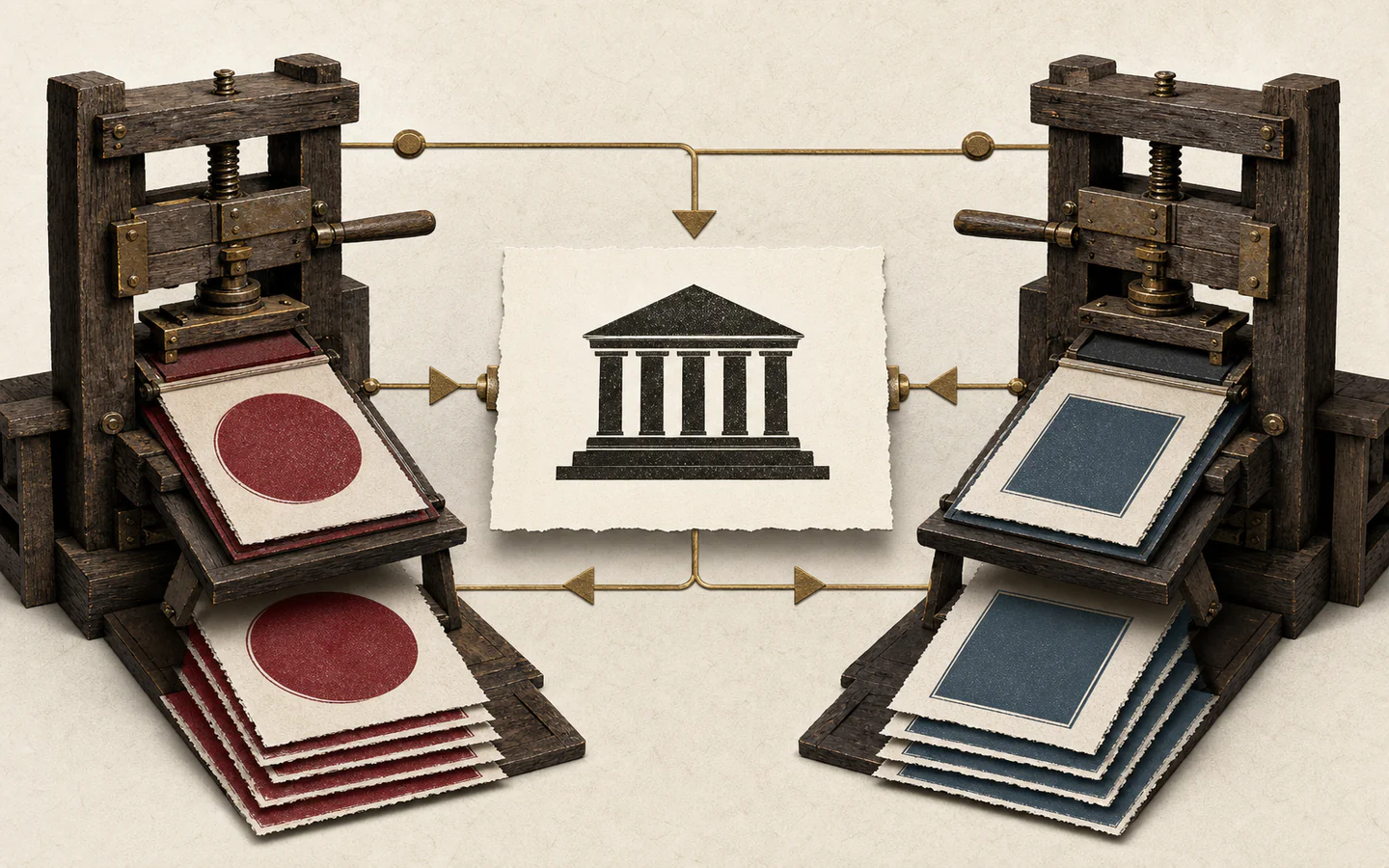
Everyone quotes the first half. The second half, the condition that every citizen actually read and be able to judge, is the part history tested. Within five years, Jefferson himself was secretly funding a partisan paper. His State Department put the poet Philip Freneau on the payroll while Freneau's National Gazette attacked the Washington administration Jefferson served in; Alexander Hamilton's allies bankrolled the rival Gazette of the United States. The nation's first press ecosystem was two party organs firing at each other, staffed by government money.
1807: Jefferson, newspapers' angriest reader
Twenty years of being on the receiving end changed his tone. As a sitting president answering a young man's question about how to run a newspaper, Jefferson produced the bitterest press review ever written by a head of state:
Primary source 04 / 06
Nothing can now be believed which is seen in a newspaper. Truth itself becomes suspicious by being put into that polluted vehicle.
Primary source 05 / 06
I will add, that the man who never looks into a newspaper is better informed than he who reads them; inasmuch as he who knows nothing is nearer to truth than he whose mind is filled with falsehoods & errors.
Then, half joking, he proposed a redesign. It may be the first media-literacy framework in American history:
Primary source 06 / 06
Perhaps an editor might begin a reformation in some such way as this. Divide his paper into 4 chapters, heading the 1st, Truths. 2d, Probabilities. 3d, Possibilities. 4th, Lies.
Label the claims by how well they are established, and let the reader see the sorting. Jefferson never got his four-chapter newspaper. But separating the corroborated record from each side's claims is a two-century-old idea, and it is the exact rule our daily brief runs on: facts stated plainly only when multiple outlets agree, single-source claims attributed by name.
What the founding era settles
Two things were true at once in 1800, and both are still true. The press was scurrilous, party-funded, and routinely wrong, and the same founders who raged at it kept protecting it, because the alternative was letting power grade its own homework. Partisanship is not a modern corruption of American journalism. It is the factory setting. What changed across the next two centuries was the business model, and that story runs through a sunken battleship and a federal fairness rule.