What is the attention economy?
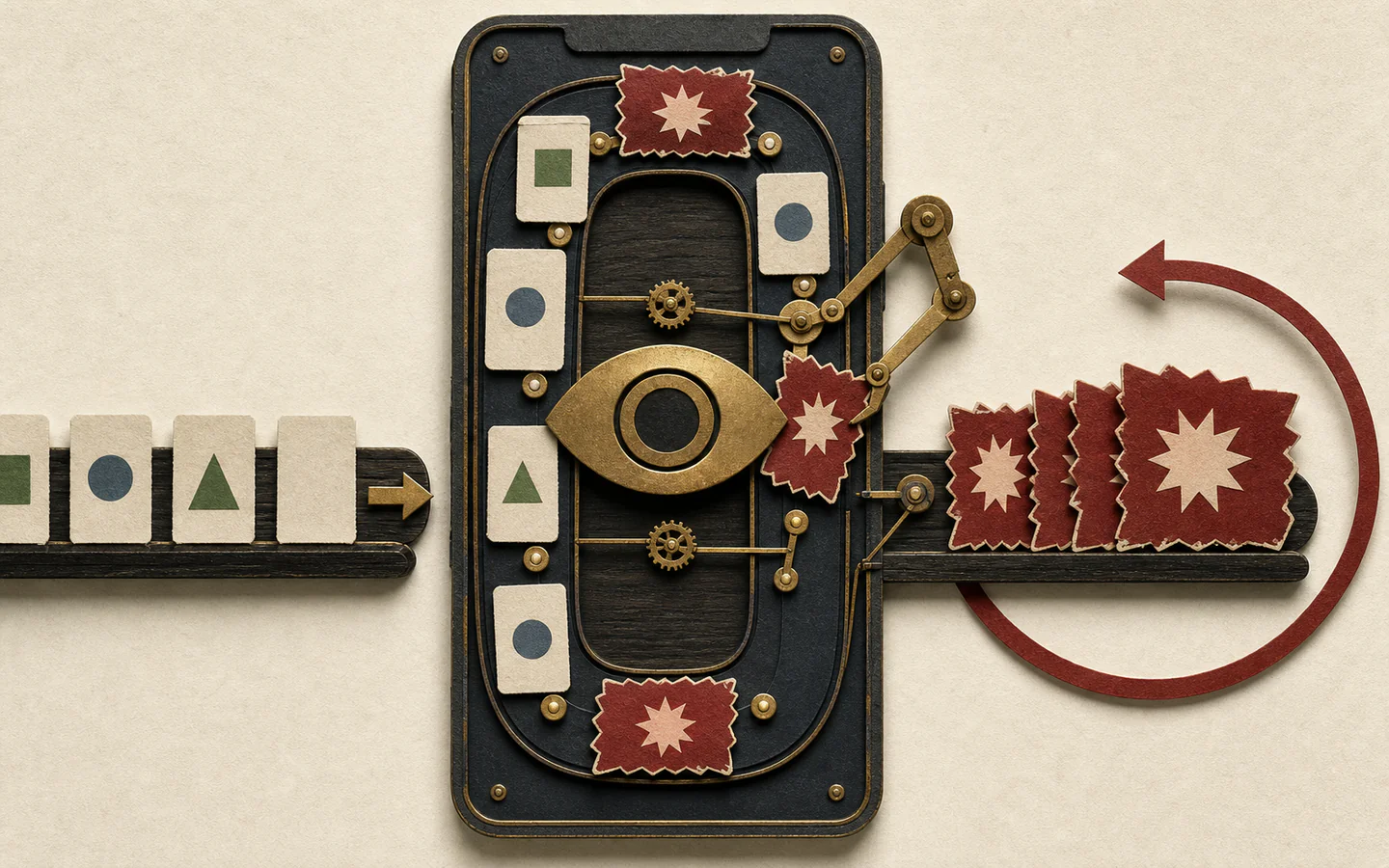
The attention economy is the market in which platforms compete for one scarce resource, your attention, and sell it to advertisers. Because the supply is fixed and the demand is not, the software that ranks a feed is rewarded for whatever keeps you scrolling. In June 2019, the design ethicist Tristan Harris, who studied at the Stanford Persuasive Technology Lab and worked at Google, told a U.S. Senate subcommittee how much was already at stake:
Primary source 01 / 06
technology shapes where 2 billion people place their attention on a daily basis shaping what we believe is true, our relationships, our social comparison and the development of children.
He stated the argument bluntly:
Primary source 02 / 06
I want to argue today that persuasive technology is a massively underestimated and powerful force shaping the world and that it has taken control of the pen of human history and will drive us to catastrophe if we don't take it back.
Why the feed rewards what it does
Harris traced the behavior to a single design pressure. Advertising pays for attention, attention is finite, so every product competes to capture a little more of it:
Primary source 03 / 06
Because in an attention economy, there's only so much attention and the advertising business model always wants more. So, it becomes a race to the bottom of the brain stem.
First the hooks were crude: pull-to-refresh rewards, infinite scroll, follower counts. As the competition intensified, Harris testified, it moved into the ranking system itself, where a model calculates which post will hold you next:
Primary source 04 / 06
the next step of the attention economy is to compete on algorithms. Instead of splitting the atom, it splits our nervous system by calculating the perfect thing that will keep us there longer, the perfect YouTube video to autoplay or news feed post to show next.
The target is time spent, not truth served. A ranking model does not ask whether a story is important or fair. It predicts what will keep you there, and the news that wins is chosen on that basis, not on the news you would be better off having read.
The editor you cannot see
For most of the last century the gatekeeper was a person deciding what ran. The filter bubble chapter followed that job as it passed to software, and agenda-setting showed that what the press emphasizes becomes what the public thinks about. The attention economy names the software's motive. It is paid for engagement, and engagement is not accuracy and not importance.
Harris described the relationship between the system and the person using it as a difference in power. The platform knows far more about you than you know about it:
Primary source 05 / 06
Persuasion is about an asymmetry of power.
That imbalance has an endpoint. If a machine can predict what will move you, it moves closer to being able to manufacture it. Harris told the senators where the escalation runs:
Primary source 06 / 06
As this progression continues the asymmetry only grows until you get deep fakes which are checkmate on the limits of the human mind and the basis of our trust.
The next chapter follows that power into the ranking systems now deciding what billions of people see. The act ends at the point Harris named, where the machine can fabricate the evidence itself.