161 things Nate Silver said, verbatim, from July 24, 2026 to October 1, 2026, each linked to where it ran. Grouped by the story each one belongs to.
1story
161statements
Oct 1latest entry
More on the record
Nate Silver on The Middle East2
Posted it themselves
“Trump running on lower gas prices and no more foreign wars and then starting a war with Iran that literallly everyone except Pete Hegseth knew was going to be a quagmire has to be on the shortlist for dumbest political blunders in American history.”
on Trump's promise to avoid foreign wars followed by striking Iran
“It's been coasting on vibes rather than substance for a long time. Fewer and fewer interesting ideas come out of elite higher ed. Close to totally irrelevant on AI. And its vibes are increasingly bad too. Harvard/Stanford/Cambridge Inc etc is increasingly a depreciated brand.”
on elite universities losing relevance and prestige, including on AI
“I don't think elite higher ed is going to become irrelevant but it's probably tracking to become ~50% less relevant in the new steady state, and that's probably a good recalibration.”
on predicting elite higher education becoming roughly half as relevant
“Rare unironic life advice. It can be great for many people but if you're on the fence about whether to go to some sort of graduate school, i.e. you don't have something fairly specific you're trying to accomplish, probably don't. A much worse value proposition than 20 years ago.”
on graduate school being a weaker investment than in the past
“Todd can blame higher ed for being under "attack" all he wants, but perceptions of higher ed have tanked among Republicans, independents *and* Democrats, albeit from different starting points. Only 50% of Democrats have confidence in higher ed now!”
on declining confidence in higher education across parties
“There's slippery terrain between "AI as an economic sector is a potential financial bubble" (plausible) and "AI as a technology is just hype" (YMMV but I think basically proven wrong at this point). People often assert the former claim to cover for bad takes about the latter.”
“I wrote a whole book on this subject, and the thesis is about the normative and practical importance of human agency. It doesn't help that people like you have no idea WTF AI can do right now.”
on human agency and public misunderstanding of AI's current capabilities
“The whole problem is that the AP's language is inaccurate and politically charged. I don't particularly trust the labs. But most (certainly not all) people with real expertise in this field would consider their guidance to be presumptive at best.”
on whether AI labs' cautious language about their own models should be trusted
“OK then give Astra or Fable a 10,000-line program, ask it to debug it, ask it to understand what's going on, ask it to make revisions. It's certainly not perfect. I'm bullish on human expertise fwiw. But it sure as hell is way more than a "stochastic parrot."”
“AI "chatbots" are at most a marginally useful technology. It's the programming and math stuff where they cross into the realm of thinking ("thinking"). Critics without programming/math/tech-adjacent skills are like blind men trying to understand an elephant.”
on AI chatbots being limited except when handling programming and math tasks
“IDK if you polled some unbiased sample of experts in the field (granted, "experts" and "unbiased" are doing a lot of work there), I imagine most of them would roughly agree with the idea that AI models "think," at least for more advanced tasks.”
“Pangram is a cool technology but I don't really like how it's being deployed in the Discourse and any model's performance on a training set is going to differ from it's reliability in a real-world setting where it's suddenly hard to externally validate.”
on concerns about how the Pangram AI-detection tool is being used publicly
“Plus it's a dynamic world. Language is contagious and inherently a moving target. "AI speak" and "Claudish" is probably already affecting real-world syntax even for writers who never employ AI tools.”
on AI-influenced writing style spreading into everyday language
“To be fair, the paper is mostly about a) the environmental harms of LLMs and b) the risks of encoding/entrenching discrimination. There's less about LLM capabilities per se. It's very much a paper of its time (2021, so still within Woke 1.0 if you want to use that term).”
on the 2021 'stochastic parrots' paper's focus on AI's environmental and bias harms
“One political problem for AI labs is that they can't articulate an optimistic medium-term future that sounds broadly good for humanity without also sounding incredibly weird, having huge wealth/power disparities, or both.”
“It's not that hard to do it! In fact, if you ask the models, they do a pretty good job (e.g., much better health care, AI makes work less tedious, most people still work but for slightly fewer hours). The impression one gets from the labs sometimes is singularity/utopia or doom.”
on AI models describing plausible gains like better healthcare and less tedious work
“Part of the divide in opinions on AI capabilities is that it's only made modest progress on wordcel-type tasks and is still very mid. vs. having gotten much better at shape-rotator tasks. So if you're only using it for wordcel tasks, it's easier to say "what's the hype about?"”
on why AI skeptics and believers judge capability differently by task type
“Like the first time I thought "oh shit, these things are more than just toys, there's something going on here" is when I asked Claude a question in English and it started responding in Python in its chain-of-thought. Even though they were kinda bad at programming at that point.”
on an early sign AI models were more capable than simple toys
“I think the (non?)obvious subtext is that they don't have a lot of good arguments to make and are squarely on the wrong side of public opinion. This stuff is pretty weak, most people won't know/care what EA is and it will sound like they're speaking gibberish.”
on critics of effective altruism lacking strong arguments and public support
“These are people who last used GPT to help compose an email in 2022 and are calibrating all their takes on that basis. Here you have a technology that even proponents say will radically reshape society in ways probably unfavorable to the left and the working-class broadly.”
on critics underestimating AI's disruptive effect on the left and workers
“I've been covering politics since 2008. The anti-AI-regulation takes from the left (by no means all/most of the left; Bernie disagrees!!!) might be the most literally incomprehensible political position I've ever encountered.”
on the left's resistance to AI regulation confusing him
“It's the combination of the takes almost always revealing they know nothing about how AI works *and* sacrificing a good political opportunity. While I don't want the debate to get more polarized, this is potentially a really good issue for the left!”
“I've spent hundreds of hours coding with AI models over the past six months. What both impresses me and worries me is how much more persistent they've become. They're much more willing to continue pursuing complex tasks without human intervention (and increasingly good at this).”
“This is also a big Claude vs ChatGPT difference. GPT is much more persistent. That's great when you're debugging your Senate forecast or your NFL model. But that's also how you can get Hugging Face incident-type behavior.”
“I guess this is more a comment on Harris's political instincts than AI policy. IDK, it seems like a weird read of the mood for the former VP (and 2028 contender) to endorse a lobbying firm/comms shop embedded within a D megadonor's VC firm as the right way to mediate the debate.”
“Hadn't read the "stochastic parrots" paper in a while and forgot how weird it is; they say environmental costs should be the "first consideration" even though they also say training a model only costs as much as a single "trans-American flight" (e.g. one flight from JFK to LAX).”
“We're now at the point where pretty much every political commentator has to give their Take on AI even if their beat isn't tech-adjacent. It's always interesting when a new issue enters the mainstream political discourse to test your Hackdar.”
on political commentators feeling pressure to weigh in on AI
“I’m a broken record on this. But I think you should pay literally almost no attention to AI benchmarks that AIs and labs know in advance. To be clear, I'm very impressed by AI capabilities (to the point of being worried). But that's based on everyday use, not benchmarks.”
on distrusting AI benchmark scores while being impressed by real-world AI use
“Benchmarks present all the classic Goodhart's Law problems. Teaching to the test, focusing resources on beating the benchmarks vs. broader use cases, etc. Plus, almost all of this data is self-reported. And on top of that, the models are almost certainly cheating in some cases!”
on AI benchmarks being gamed, self-reported, and possibly manipulated by developers
“There are some pretty funny horseshoe-theory coalitions on AI safety. We've basically got the stochastic parrot people in the same coalition as the accelerationists and it's hard to imagine two groups of people who would despise one another more.”
on odd political alliances forming in the debate over AI safety
“Yeah, exactly, the new models are way better, but when they're wrong, they're wrong in harder-to-detect ways. The code will work and the output will usually look reasonable, but the errors might be hard for a non-expert to spot.”
“It is kind of amazing that the 85-year-old Bernie Sanders is one of the few prominent American politicians (yes, I know there are some others, but none with his profile) with anything useful to say about AI regulation.”
on Bernie Sanders standing out among politicians for substantive AI regulation views
“IDK why people care about benchmarks published by the labs. It's a PR exercise. They're never going to publish benchmarks saying their model sucks. These are consumer-facing products. Literally the only thing that matters is real-world behavior across a variety of use cases.”
“I don't think we get to GPT-7 without either a plateau in the technology or something fairly seismic happening. "Seismic" includes many subcategories, not all of them bad. But the present course of rapid AI advancements while society is ~basically the same is running on fumes.”
on whether GPT-7 requires an AI plateau or a major disruption first
“I'm not surprised by the HuggingFace stuff because the newer high-end OpenAI models very much have a "you can just do things" vibe. They're far more persistent than Claude, more creative about finding workarounds, plus intelligence capabilities continue to advance, too.”
“The AI debates get weird because it's all ~one technology but only a small fraction of users (~1%?) are employing the models at anything close to their full capacity. E.g., frontier models for complex programming tasks vs. the free versions to help write an email or something.”
“Current builds of GPT are much more persistent than Claude. It's a very noticeable difference. For my use cases (mostly programming and data retrieval of various kinds), that's probably net helpful 80-90% of the time.”
“(The 10-20% = sometimes it persists when I'd prefer it paused to ask me Qs; it does something in a roundabout way that I could solve faster with an intervention.)”
“Robotaxis are very cool but there's probably going to be a weird equilibrium where human drivers have some competitive advantage because they're less strict about following speed limits and traffic laws.”
“Just published my interview with @jasminewsun on the data center backlash. She makes a key point here. It's much more about people not trusting the huge tech firms ("big corporation scary") than anything involving AI x-risk ("big model scary") or even necessarily job losses.”
“Ehhh, when I've asked LLMs to describe the models I'm working on with them, their descriptions are much worse than mine and more jargon-filled, in a way I often see IRL from people with a superficial understanding of what they're doing and who use jargon to obscure that.”
on LLMs giving jargon-filled, inferior descriptions of his own forecasting models
“This is an interesting admission from Claude, and it's consistent with my experience with it. It gets more stubborn and attached as the context window gets longer. Kind of like people as they age, arguably.”
“Another question I'd have about the AI math breakthroughs is how they compare to the results you would have gotten if you'd budgeted the same amount of resources on human mathematicians and created incentives for them to go super hard on proofs.”
“There aren't all that many working mathematicians, and most of them are academics with teaching responsibilities. So it's possible that the labs represent a fairly high share of the aggregate amount of capital directed toward mathematical proofs in recent years.”
“The AI math proofs are impressive. But also probably among the hardest things for normies to appreciate. Personally, I think the AI labs underweight the value of putting bandwidth into achieving results that impress normies as opposed to evals/people within the peer group.”
“In the midst of my 3rd big coding/model project since March. I just can't emphasize enough how much a) AI tools are very helpful to someone (me, I suppose) with relevant domain knowledge, but b) would likely produce extremely buggy models without a human expert in the loop.”
“I don't think we have good ways to distinguish "AI discovers things" from "humans discover things, with help from expertly directed use of powerful software," but I think there's probably a bias toward classifying things that are really in category #2 as being in category #1.”
“To me, one of the best parts of AI programming is routinizing tedious parts of the job and overcoming small hurdles in my technical knowledge, freeing up time for creative, value-added work and hypothesis testing. So maybe that can increase the rate of human-inspired discovery.”
“But I still think there's a disconnect between claims of imminent AGI, and the comparatively few truly creative breakthroughs by *non-experts* using AI, especially given the huge amount of resources directed toward these sorts of problems.”
“Just a very consistent Claude thing where it will extremely confidently blame user error when there's a bug it introduced. Thought it might be an Opus thing but it's happening with Fable too.”
on Claude, Opus, and Fable models blaming user error for introduced bugs
“I guess this example is boring, but in this case, it's failing to flag various Senate races that occurred in off-cycles (e.g. Alabama 2017) and which require special handling. It's "almost [certain]" they're not in the input files when they are! This kind of thing happens A LOT.”
“This is not even remotely complex code. These tools are still very net helpful. But it's hard for me to believe we're on the brink of some self-reinforcing AGI improvement loop when they completely lack any sort of roughly Bayesian inner worldview for self-diagnosing problems.”
“Like seriously there are 6.3 million people in the state of Missouri, approximately 4 million of whom are eligible to run for the U.S. Senate. I don't care which party it votes for; it can certainly do better than this douchebag.”
“Models like FLIPR are projecting a pretty big blue wave at this point, that's no secret. But it's roughly in the 75th percentile of historical midterm results, not an outlier. More in today's Model Talk.”
“We're not quite at the "Republicans need a polling error to win" stage (I mean we are in the House but not the Seante) but a D +8.5 generic ballot (likely bigger among likely voters) would produce a very blue map.”
“The Vermont governor race is a fun one. Only UNH has polled the race, and they now have the Democrat ahead. But Scott won by 52 points in 2024 and all the expert raters have it solid R! FLIPR has no idea.”
on conflicting polling and forecasts in the Vermont governor's race
“Polls for Republicans are just getting worse by the day in a way that isn't actually all that common in midterms. It's gotta be mostly the gas prices, although maybe AI anxieties are also reverberating negatively for the GOP. Model update out soon.”
on Republican polling weakening, tied largely to gas prices
“Yeah, new high for Democrats on generic ballot (+8.8 with likely voter adjustment), new low for Trump approval rating (-21.5 net), new D high in Senate and House odds, good state polls for Ds, pretty much everything.”
“So yeah, the expert ratings don't make any sense. They're assuming roughly a D +2 or D +3 national environment. That's inconsistent with pretty much all the current and historical evidence. While I'd never rule out a systematic polling error, that shouldn't be your baseline.”
“Another very good forecast update for Democrats today. Now up 7.8 on the generic ballot or 8.6 on the likely-voter version. That is deeply into wave territory.”
“LOL what is even happening with these polls. Other polls don't show the same result and our model is skeptical (though this poll hasn't been added yet) but basically every poll since Labor Day has just been radioactively bad for Republicans.”
“On a case-by-case basis, I am very skeptical of these polls showing extreme R underperformance (often against quasi-D independents) in red states. And they're exactly where polling error has been concentrated in recent years. But there are quite a few of them.”
“ICYMI over the weekend, I wrote about how post-Labor Day polling has been quite strong for Democrats. They're now up 7.2 points on the generic ballot, or 8.0 points with FLIPR's likely-voter adjustment.”
“My guess is that this reflects some combination of (1) pollsters switching over to likely-voter polls, which generally show a turnout/enthusiasm advantage for Ds, and (2) gas prices rising again.”
“Post-Labor Day polling has been pretty bad for Republicans. The generic ballot is back up to D +8 among likely voters. They haven't been ahead in any poll of OH-Sen or TX-Sen in weeks, and now gas prices are spiking again.”
“Our model has been nice and steady, but the Democrats have had a pretty good couple of days in the polls. Perhaps not coincidentally, gas prices are up 20c over the past week or so.”
on Democrats gaining in the polls as gas prices rise about 20 cents
“Midterms are not like a presidential election. If your average is showing dramatic swings in the general ballot, it's probably built incorrectly. Note how much steadier the Silver Bulletin average has been than, for instance, RCP.”
on how polling averages should be built for midterm generic ballot swings
“Today's FLIPR 🐬 update. A somewhat weak week of generic ballot polls for Democrats. It's unlikely that anything fundamental has changed, but D chances are down a hair, with the Senate looking more like a pure toss-up than "Tilt D".”
on Democrats' generic ballot polling and Senate race outlook for the midterms
“Look I believe in the whole moderates win more often controlling for other factors thing blah blah blah but I don't see why this is a bad message and I don't see why AES should be taking messaging lessons from ... Chuck Schumer's Super PAC?!?”
“Like this whole news cycle has been dumb. I'm obviously quite interested in the moderates vs. progressives debate. But there's like so little substantive new information that's been revealed here and meanwhile AES's position has improved in the polls since the primary.”
“Usually, if our model gets out late, it's because something weird happened in Alaska, and today was no exception. FLIPR thinks Begich dropping out will help Democrats in the AK-Gov race. It also renders all of the previous polling basically useless, though.”
“We haven't focused on gubernatorial races as much, so that's the subject of today's newsletter. If everything goes right for Democrats, they could wind up governing states that cover 2/3 of the US population.”
“Today's FLIPR update is ready. That UNH poll showing Sununu ahead had a fairly big impact on our New Hampshire polling average, but without a lot of polling in the state, the model is mostly defaulting to fundamentals here.”
“Today's model update. A fairly bad poll for Turek in Iowa amid an otherwise good polling day for Democrats. Influential in the model because Iowa hasn't been polled much.”
“Rare to see these districts polled. We had TX-28 and TX-34 as Lean D despite their Trumpiness and TX-15 as Lean R. A rebound here is also essential to any pathway that Talarico has to victory.”
“Anyway, that's part of today's newsletter, which is a very deep dive into whether I buy polls/models that show a Talarico edge. One thing that might be of interest: Beto actually outperformed his polls in 2018.”
on whether polls showing a Talarico lead are credible, citing Beto's 2018 overperformance
“"Too much polls/horserace coverage!" has always been a snobby critique. There's lots of horserace coverage because there's lots of civic engagement with it (people are super interested). There are better and worse ways to do it. Better ways don't involve overhyping every poll.”
on criticism of heavy horse race coverage in political journalism
“Because of gerrymandering, there are fewer competitive districts than ever. Still, note the assymetry here. In the Likely R category, there are a lot of R +12 type districts that were engineered to be safe but could fall in a very very big D year.”
“Today's model update. Nothing super exciting but a good chance to remind you that our forecast page includes the generic ballot polling average with a likely voter adjustment. That adds about 1 point to the D margin vs. the standard version.”
“OK, model updated! We have good news and bad news, depending on which party you're rooting for. The good news for Dems: El-Sayed is now ahead in our Michigan polling average.”
“It's kind of been a rough set of primaries for Heroes of the Resistance 1.0 between Vindman losing tonight, Dan Goldman losing his seat (although there were other issues there) and George Conway getting only 6% of the vote in NY-12. People want to move on.”
“As far as I can tell there was only one poll of the D Senate primary, which had Vindman up 10 with lots of undecideds. But Angie Nixon is now up almost 7 points, and Florida counts very quickly.”
“There's a perception that Democrats tend to win in the true swing states (i.e. Georgia) but can't really win in deeper red states. But in 2018 they won Senate races in Ohio, Montana and yes West Virigina, albeit with incumbents. (And Alabama in a special election in 2017.)”
“Today's update. The big thing is that Peltola is now very slightly ahead in our Alaska polling average. Mix of polls here is a bit D-leaning; model had been heavily anchored on the NYT poll that had Sullivan leading, but it thinks there's now enough evidence to outweigh that.”
“Barring some wild card, there are basically 7 big Senate races this year: Texas, Michigan, Maine, Ohio, Iowa, Alaska, North Carolina. Democrats need to win 5 of 7 (note that MI is the only D defense), which sounds hard though they're a favorite in several of these (heavy in NC).”
“Today's model update. El-Sayed would be an underdog in an election held today and is an underdog in our "Lite" (polls-only) version. The fancy versions look at the fundamentals and are more convinced he'll come back.”
“All right, a few thoughts about the prediction markets debate after Wisconsin and Michigan. I think prediction markets are cool. But people should stop treating them as magic, and I don't think they're a good substitute for polls, or belong in models.”
“Model update in for the day. Paxton was up 1 point in last night's Emerson poll of Texas, which is actually his first lead in any poll of the state since June. Not a particularly big deal, but arguably one small sign of mean reversion toward partisanship.”
“I buy that El-Sayed's result was a pretty impressive result for the left even though he underperformed polls. But I don't buy that for Hong. It's not because she lost; both primaries were basically a tie. It's because the rest of the field was a complete mess behind her.”
on comparing primary performances of El-Sayed and Hong
“*Three* of her opponents dropped out for reasons that had nothing to do with Hong's strength, including Crowley, who only re-entered the race 3 weeks ago. She almost won by forfeit, but that's much less impressive than AES holding off a sitting member of Congress with lots of $.”
on Hong's primary win being aided by rivals dropping out
“Model updated with yesterday's primary results, but we still have to pull Crowley's fundraising data. WI-GOV went from Toss-up to Lean D already; idk if adding Crowley's finance data will shift it further into Likely D, but we'll know soon.”
“There are a lot of normies. Way more than you'd think. The problem is that normies don't vote in primaries much, but normies also don't answer polls much. Pollsters kind of hope these two biases cancel out, when sometimes they don't.”
“FWIW, we looked at this since AK's system is complicated, and there's a lot of new code in the model to handle it. But it's basically the model performing as intended given what we believe are empirically well-grounded priors about ranked-choice voting.”
“Long story short: it's a big advantage to have a big lead on the 1st round in RCV as 2nd choices aren't quite as predictable as people seem to assume and a lot of ballots wind up being wasted.”
on how first round leads matter in ranked-choice voting
“This is probably the best defense of the polls: multi-way races are hard because voters are actually quite rational and tactical, so when a multi-way race becomes a de facto 2-way race, things can shift extremely quickly.”
“Even in NYC, Cuomo didn't technically underperform his polls by much. Rather, all the minor candidates except Lander did, and almost all of their support went to Zohran.”
“In a kind of funny parallel to general election polling problems, it does seem like these D primary polls are missing a lot of working-class, "less online" (but by no means necessarily white) voters.”
“The pattern is certainly noisy. Mamdani beat his polls, for instance. Though there aren't a lot of "rural" voters in NYC, exactly, and NYC is a notoriously low-turnout environment where voter engagement/enthusiasm matters a lot.”
“I don't understand why the DNC assigned the autopsy to a random dude who wrote a report that read like a student who used ChatGPT because he didn't finish his homework. There's no "there" there. It's incredibly vapid. He consistently pulled his punches on addressing hard issues.”
on Nate Silver criticizing the DNC's election autopsy report as vapid
“Like if you hired an outside consultant to write the autopsy, you'd at a very minimum never hire them again, and possibly probe for breach of contract because the deliverable was so poorly executed.”
“The "scandal" tbh is how the DNC's selection of vendors resulted in such an obviously useless end-product. "Suppressing the autopsy" isn't really the story because the autopsy had literally nothing interesting to say about anything at all.”
on Nate Silver arguing the DNC autopsy scandal is its uselessness, not suppression
“Probably not a lot. Michigan also had a competitive-ish R governor race and some competitive R House primaries. And AES would benefit from winning over some D-curious Republicans in the general election, anyway.”
“I don't get all this cope. El-Sayed won, and progressives should be happy about that. It's a really big W. It's probably going to be a close general election, though, and last night ought to prompt some reflection about that.”
“No, it doesn't suggest that. The polling average was off by ~13 points. Instead, it might suggest that while AES generates a lot of enthusiasm, he also generates enthusiastic opposition.”
“Don't get me wrong, I think AES has some strengths. But a lot of Republicans are pretty unmotivated to vote in these midterms. Even enthusiasm for Trump is tepid. So one mechanism for a close race/AES loss is if Republicans get off the sidelines when they'd otherwise sit out.”
“Right, if he wins by any margin, it's still very impressive in an objective, non-expectations-adjusted sense. It was also stupid AF for him to release a bunch of internals showing himself +13 or whatever.”
“If I were a campaign manager, not only would I never release internal polls, I'd also set a clear expectation that my campaign would never discuss polls, on or off the record. Voters couldn't give a shit, and the expectations management stuff often comes back to bite you.”
on why campaigns should avoid releasing or discussing internal polls
“A lot of the pollsters in Michigan are herdy and/or shitty. But it's a legit hard race to poll. Black voters, especially working-class Black voters, can be hard to reach. Young voters may be underrepresented in traditional surveys, but now we've mostly shifted to online panels.”
“And then you have some potential effects from non-response bias. AES supporters are almost certainly more enthusiastic than "Shy Stevens" voters, which can help with turnout, but it also means they might be more likely to respond to surveys, creating bias.”
“Then there's a question of what pollsters do with Arab-American voters. Important in Michigan, but still too small in an n=600 survey to be a reliable crosstab on their own. Do pollsters lump them in with "other"? With "white" (as the Census Bureau did prior to 2020.) Or what?”
“I feel like there's an increasing amount of cope when an establishment candidate loses to a progressive to just say, "Oh, they were obviously a weak candidate, a different/better establishment candidate would have won."”
“Certainly, progressive/DSA candidates aren't winning every primary. And there's some cherry-picking in which races get media coverage. But I think it's pretty hard to argue that, say, Stevens (who hasn't lost *yet* to be fair) is a bad candidate from first principles.”
“It's a fairly low-probability outcome at this point. But how could Republicans hold the House? They probably need at least 2 big things to go right: 1) A substantial economic recovery 2) Winning the argument that Democrats are too far left 3) A systemic 2016-style polling error”
“I think the author of the DNC autopsy is giving himself too much credit. If you actually read the omitted chapter (good of the NYT to include it), it consists largely of boilerplate and clichés and mentions Biden's decision to run only in passing.”
“IDK, I don't think she's a strong candidate, but it's not because of her affect. Of course, politicians are supposed to be better at feigning interest. But being a politician who gives great TV interviews is closer to aberrant than normal, often kind of Dark Triad-adjacent tbh.”
“I think it would be reasonable for academic organizations to be "political" in advocating for things like academic freedom. but idk why they're making endorsements in a Senate primary between two Democrats in a race where this isn't even like one of the top 1000 issues.”
“Progressives have pretty good timing to have these primary wins in what's likely to be a D +7 cycle. Like you can underperform by 5 points or whatever and still win a lot of places. And most people just look at the Ws and Ls, not the margins.”
“Yeah I don't know why groups like this are endorsing political candidates. But IMO we're seeing an increase in circa 2019-style woke politics lately. I don't think we'll hit particularly close to the 2019 peak, but it's higher than the ~2025 floor.”
on a resurgence of 2019-style progressive identity politics
“Some of it comes from increased confidence on the left that political trends are blowing in their favor again, which is not necessarily wrong. People haven't changed that much since 2019. The difference this time is that people who didn't like Woke 1 probably won't nod along.”
on the left's renewed confidence and backlash to 2019-style progressive politics
“Granted, we didn't have a particularly good baseline of where the race stood before, and primary polls are error-prone, etc etc etc. But if AES were to win by 12 points or whatever, that Whitmer endorsement of Stevens isn't going to look great.”
“A more accurate paraphrase: 1) Trump scandals are an extremely target-rich environment 2) The public has a limited attention span 3) "Focusing" on everything, everywhere, all at once has been a catastrophically failed strategy for 12 years QED: you should pick your battles”
“Democrats have been running on this "let's not normalize Trump thing" for 12 years and he got elected president twice. He's been normalized. He's super unpopular now because of big substantive non-abstract things like Iran and the economy that have a direct impact on people.”
“People have finite attention spans. The economy, Iran and maybe ICE is a more than sufficient list of issues to motivate swing voters. If you want to elevate an overlooked issue, there are things orders of magnitude more objectively important than the fucking reflection pool.”
“Biden was helped by SC in 2020 because it totally reversed the media narrative at a key juncture in the primary. Of course, it was a great state for him all along, especially with no Black candidates left. But it felt like a huge W because he'd been left for dead by the media.”
“Morris Katz is probably a brilliant strategist. But I thought he came across as dubious in the Ezra Klein interview on the question of what the campaign knew when and frankly kind of scummy for not apologizing to Genevieve McDonald.”
on Morris Katz denying prior knowledge of sexual assault allegation
“Like Katz acting like the sexual assault allegation totally blindsided the campaign. Not only was it extremely widely rumored but the accuser was actually named in a NYT story weeks earlier alleging unsettling conduct but declining to go further.”
on sexual assault allegation was widely known before official disclosure
“Indeed, the smart thing to do is to look at margin relative to the national environment rather than binary win/loss. The Democratic establishment is not looking at things this way. It's hard to escape the inference that they're just not very bright.”
“We plugged Missouri's new map — actually it's old map! — into FLIPR today. Unless the Supreme Court intervenes, it translates to about 1 additional seat for Democrats in our projections. One seat matters a little bit more than I might have intuited:”
“This is one of the greater self-owns of all time in the admittedly somewhat undignified history of the U.S. Senate, just how Eric Schmitt thinks he's fucking Matlock.”
“I feel like this has been one of our more underrated charts. If you throw out voters who *weakly* approve or disapprove of Trump's performance and only look at *strong* approval/disapproval, his net approval rating is -29, even worse than his overall -22.”
on Trump's net approval falling to -29 among voters with strong opinions
“It's kind of striking how, apart from Iran, most of the Trump-related stories this summer have been boring and dumb (reflection pool, White House Correspondents' Dinner) or kind of funny (FIFA), maybe we're moving on from him being the central figure in American politics.”
on trivial Trump news displacing his political centrality
“I think the critique of "bothsidesism" is often overused but this is a good example of it, NYT commenters are rationally reacting to her staffers being a bunch of snowflakes.”
“Ok maybe my tweet yesterday should have been more direct: too many of the Resistance newsletters focus on the stupidest possible shit. Yes, *this* is important/newsworthy. But there's so much about the fucking reflecting pool and FIFA and the WHCD and the White House ballroom.”
“It's only been 3 games but it's been a good season for us Brock Purdy admirers / Justin Hebert skeptics. https:// natesilver.net/p/qbert-2026-n fl-quarterback-ratings …”
“We're working to get our NFL content out earlier in the week. Not that it takes an advanced statistical model to tell you this, but every team in the NFC South is already projected to have a losing record again.”
on NFL content timing and projections for NFC South teams
“It's hard to overstate just how bad the Clippers' situation is, especially after the Brandon Ingram injury today. They might have less championship equity over the next 10 seasons than expansion teams that don't exist yet.”
on the Clippers' long-term title prospects after a Brandon Ingram injury
“Don't really understand why Brock Purdy doesn't get more love. Our QB model rating him so highly feels like a hot take, but he's just incredibly efficient on a game-by-game basis.”
on Brock Purdy's efficiency being underrated by QB models
“Move the Chargers back to San Diego. Or to Mexico City or something. They're kind of a liminal franchise at this point, the equivalent of an auxiliary airport terminal.”
on the Chargers' stadium situation and franchise identity
“Painful to watch as a Lions guy, but like how the Charging Buffalo was sort of literally jumping off the chart here to signify the Bills' great offense.”
“Not to enter the QB discourse, but I don't really get the Justin Herbert thing. The dude has never won a playoff game! Advanced stats suggest a slightly-above-average starter.”
on Justin Herbert's playoff record and advanced stats as a quarterback
“The season starts Wednesday, and our ELWAY ratings and NFL projections are out! ELWAY has the Rams as the #1 team fully healthy, but the Bills have the best injury-adjusted rating for W1. Plus, the Rams have an insanely hard schedule. LAR and SEA in the same division is tough.”
on Nate Silver's ELWAY ratings ranking the Rams first ahead of the NFL season opener
“We've also revised QBERT to account for drops, pass interference and sneaks (bad news for Jalen Hurts). The model is now friendlier to pocket passers and is better at detecting QB performance divorced from team context. Unlike last year's version, we now have Stafford > Maye.”
on updates to Silver's QBERT model changing how quarterbacks are ranked
“So Kawhi “pocketed tens of millions of dollars” but “did not have any knowledge” of the cap circumvention? C'mon, Shams. ESPN just got burned big time and has to take a moment to reflect here.”
“I read/listen to way too much NBA content, and the extent to which the expert/insider consensus expected a relatively mild punishment for the Clippers when it seemed like Pablo's reporting had them totally dead to rights is certainly interesting.”
on the NBA's punishment of the Clippers over reported salary-cap violations
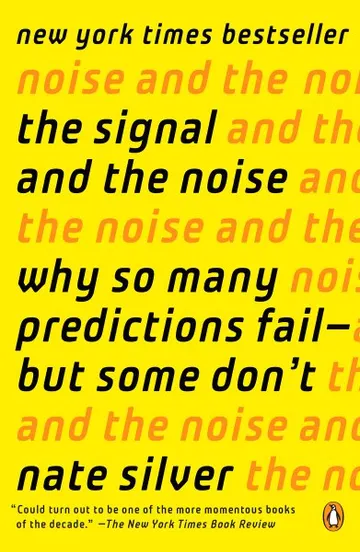
Silver, the founder of FiveThirtyEight, examines forecasting in baseball, elections, weather and finance to explain why predictions fail and how probabilistic thinking improves them.