What is confirmation bias?
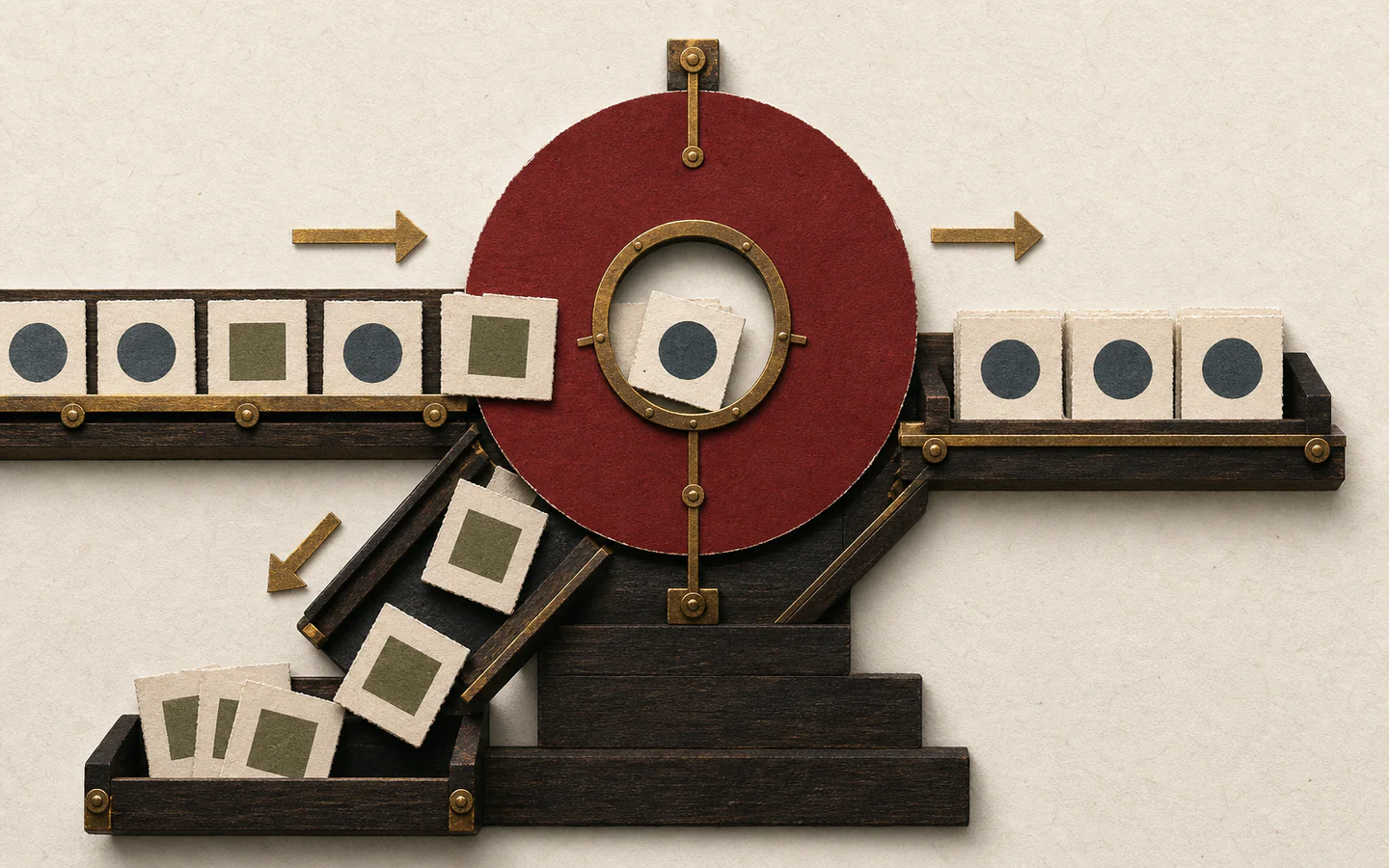
Confirmation bias is the tendency to seek, notice, remember, and accept evidence that supports what you already believe, and to skip, doubt, or explain away evidence that does not. Francis Bacon described it precisely in 1620; when Peter Wason finally measured it in 1960, only 6 of his 29 subjects reached the right rule without first announcing a wrong one. It is not stupidity and it is not dishonesty. It runs in smart, honest people, silently, which is what makes it dangerous.
1620: Bacon writes the definition
Francis Bacon spent his career trying to invent the scientific method. The obstacle, he decided, was not ignorance. It was the mind's own habits, which he called idols. One of them should sound familiar.
Primary source 01 / 10
The human understanding when it has once adopted an opinion (either as being the received opinion or as being agreeable to itself) draws all things else to support and agree with it. And though there be a greater number and weight of instances to be found on the other side, yet these it either neglects and despises, or else by some distinction sets aside and rejects; in order that by this great and pernicious predetermination the authority of its former conclusions may remain inviolate.
That is the complete modern definition, written when Shakespeare's colleagues were still alive. Bacon even supplied the perfect illustration, a story about survivorship of the evidence:
Primary source 02 / 10
And therefore it was a good answer that was made by one who when they showed him hanging in a temple a picture of those who had paid their vows as having escaped shipwreck, and would have him say whether he did not now acknowledge the power of the gods,—“Aye,” asked he again, “but where are they painted that were drowned after their vows?”
The believers who drowned never made it into the picture. The evidence room only stocks confirmations. Bacon then went one step further and named the fix, three centuries before Karl Popper built a philosophy of science on it:
Primary source 03 / 10
it is the peculiar and perpetual error of the human intellect to be more moved and excited by affirmatives than by negatives; whereas it ought properly to hold itself indifferently disposed towards both alike. Indeed in the establishment of any true axiom, the negative instance is the more forcible of the two.
Two thousand years earlier, a war correspondent noticed it first
Bacon was not even first. The earliest clean description of motivated evidence-handling comes from Thucydides, an exiled Athenian general writing the history of his own war around 400 BC. Explaining why a city talked itself into a doomed revolt, he shrugged:
Primary source 04 / 10
their judgment was based more upon blind wishing than upon any sound prevision; for it is a habit of mankind to entrust to careless hope what they long for, and to use sovereign reason to thrust aside what they do not fancy.
A habit of mankind. Not of Athenians, not of the gullible. Of mankind. Twenty-four centuries of history since have not produced a counterexample.
1960: Wason puts it in a lab
For all that pedigree, nobody had measured the thing. In 1960 the psychologist Peter Wason gave 29 university students a deceptively simple game. He showed them the number sequence 2, 4, 6 and asked them to figure out his rule by proposing their own sequences, which he would mark as fitting the rule or not. The actual rule was embarrassingly broad: any ascending numbers. Almost nobody found it, because almost nobody tried to prove themselves wrong. Subjects invented a rule, generated sequence after sequence that fit it, collected yes after yes, and announced the wrong answer with confidence.
Primary source 05 / 10
Six out of 29 subjects reached the correct conclusion without previous incorrect ones, 13 reached one incorrect conclusion, nine reached two or more incorrect conclusions, and one reached no conclusion.
Primary source 06 / 10
the reinforcement of these subjects’ rules by their confirming instances blocked the notion that there might be any alternative.
Read that twice. Every yes made the wrong answer feel more right. Wason's closing lines are the ones that should hang in every newsroom and every group chat:
Primary source 07 / 10
The results show that very few intelligent young adults spontaneously test their beliefs in a situation which does not appear to be of a “scientific” nature.
Primary source 08 / 10
In their crudest form such inferences are apparent in the selection of facts to justify prejudices.
What it does to people who run the world
This is not a bias of undergraduates. Walter Lippmann, watching the Versailles peace conference remake the world in 1919, described the French premier Georges Clemenceau processing intelligence reports about postwar Germany:
Primary source 09 / 10
Did he see the Germans of 1919, or the German type as he had learned to see it since 1871? He saw the type, and among the reports that came to him from Germany, he took to heart those reports, and, it seems, those only, which fitted the type that was in his mind.
Why this is the first chapter of a media bias guide
Because the news you distrust least is the news that agrees with you, and now you know why. Confirmation bias is the reader's half of every media bias story: outlets select and frame (their half), and your mind ratifies whatever fits (and attacks whatever doesn't). Bacon's rule for scientists is a workable rule for readers: the story your mind seizes on with peculiar satisfaction is exactly the one to double-check.
Primary source 10 / 10
And generally let every student of nature take this as a rule,—that whatever his mind seizes and dwells upon with peculiar satisfaction is to be held in suspicion, and that so much the more care is to be taken in dealing with such questions to keep the understanding even and clear.