
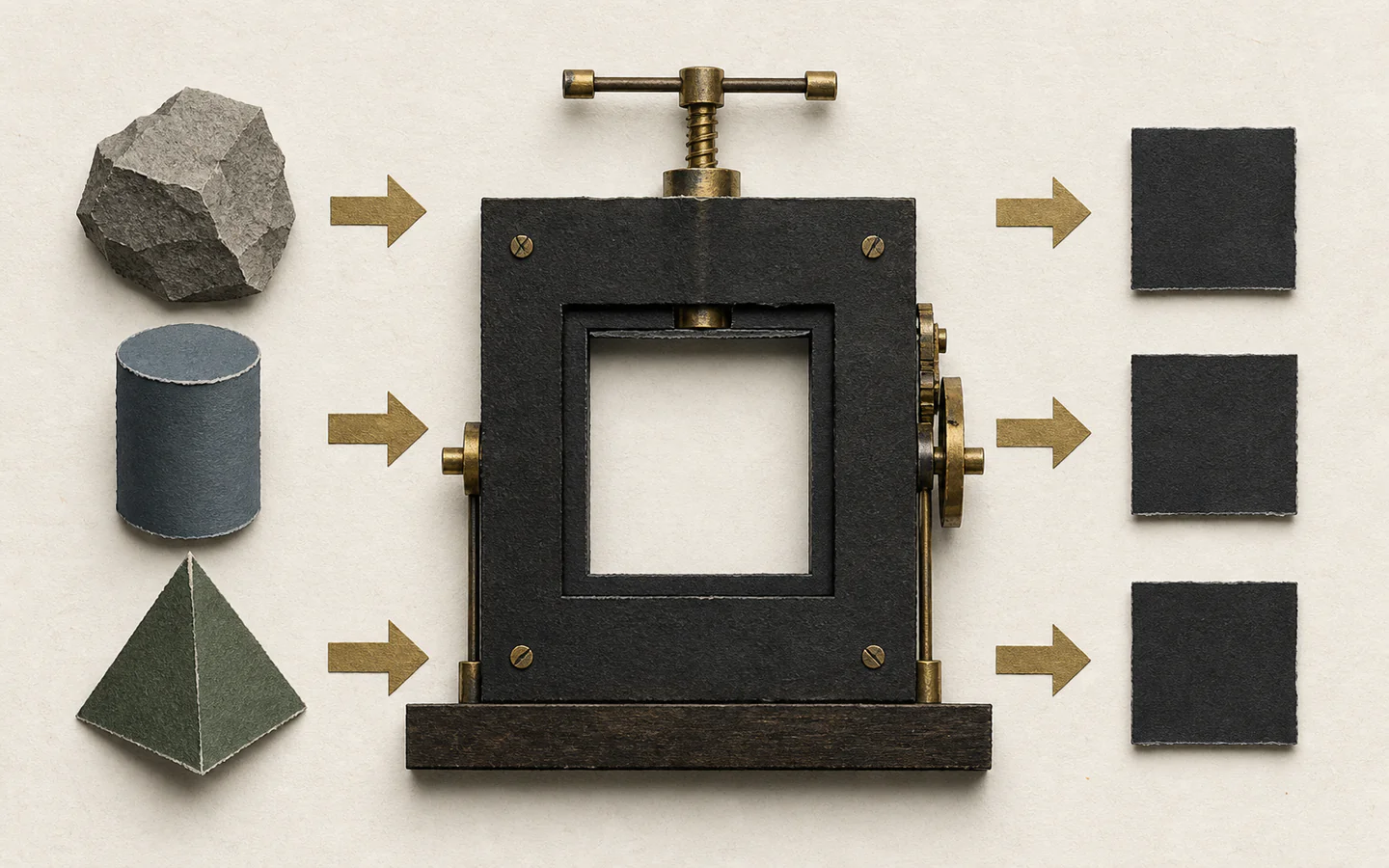
The book that saw the feed coming
In 1922 Walter Lippmann, a journalist who had just watched wartime propaganda work at industrial scale, published Public Opinion, the book that modern media criticism still runs on. It borrowed a printer's word, stereotype, and gave it its modern meaning: the picture in your head that arrives before the facts do, put there by your culture and your news. He wrote the core claim in one sentence:
Primary source 01 / 08
For the most part we do not first see, and then define, we define first and then see. In the great blooming, buzzing confusion of the outer world we pick out what our culture has already defined for us, and we tend to perceive that which we have picked out in the form stereotyped for us by our culture.
The pseudo-environment
Lippmann's model has one moving part. Between you and reality sits a layer of representations: the news you read, the pictures you have absorbed, the types you have learned. He called it the pseudo-environment, and his point was not that it is a lie. His point was that it is unavoidable, and that you act on it rather than on the world.
Primary source 02 / 08
For the real environment is altogether too big, too complex, and too fleeting for direct acquaintance. We are not equipped to deal with so much subtlety, so much variety, so many permutations and combinations. And although we have to act in that environment, we have to reconstruct it on a simpler model before we can manage with it.
Primary source 03 / 08
It is the insertion between man and his environment of a pseudo-environment. To that pseudo-environment his behavior is a response.
Then the metaphor that should be printed on every phone lock screen. The problem is not needing a map. Everyone needs a map. The problem is who drew yours:
Primary source 04 / 08
To traverse the world men must have maps of the world. Their persistent difficulty is to secure maps on which their own need, or someone else's need, has not sketched in the coast of Bohemia.
Told about the world before we see it
Primary source 05 / 08
We are told about the world before we see it. We imagine most things before we experience them. And those preconceptions, unless education has made us acutely aware, govern deeply the whole process of perception.
Who does the telling? In 1922, the newspaper. In 2026, the feed. Either way, the pictures arrive before the facts do, which is why what the press chooses to cover and how it frames what it covers are not cosmetic issues. They are the supply chain of the pictures in your head.
Why correcting a stereotype feels like an attack
The book's sharpest chapter explains why stereotypes do not die on contact with contrary facts. They are not just shortcuts. They are load-bearing walls of identity:
Primary source 06 / 08
A pattern of stereotypes is not neutral. It is not merely a way of substituting order for the great blooming, buzzing confusion of reality. It is not merely a short cut. It is all these things and something more. It is the guarantee of our self-respect; it is the projection upon the world of our own sense of our own value, our own position and our own rights.
Primary source 07 / 08
No wonder, then, that any disturbance of the stereotypes seems like an attack upon the foundations of the universe. It is an attack upon the foundations of _our_ universe, and, where big things are at stake, we do not readily admit that there is any distinction between our universe and the universe.
Written eighty years before anyone said identity-protective cognition, and it is the same finding the brain scanners eventually confirmed. Lippmann's political conclusion is the one this whole guide inherits:
Primary source 08 / 08
democracy in its original form never seriously faced the problem which arises because the pictures inside people's heads do not automatically correspond with the world outside.
There is no unmediated news diet, no view from nowhere, no outlet that hands you the world instead of a picture of it. The workable move is Lippmann's own: become acutely aware of the pictures, compare several, and never mistake your universe for the universe. Ten pictures of the same day, side by side, is one practical way to do that every morning.