Where bias actually lives
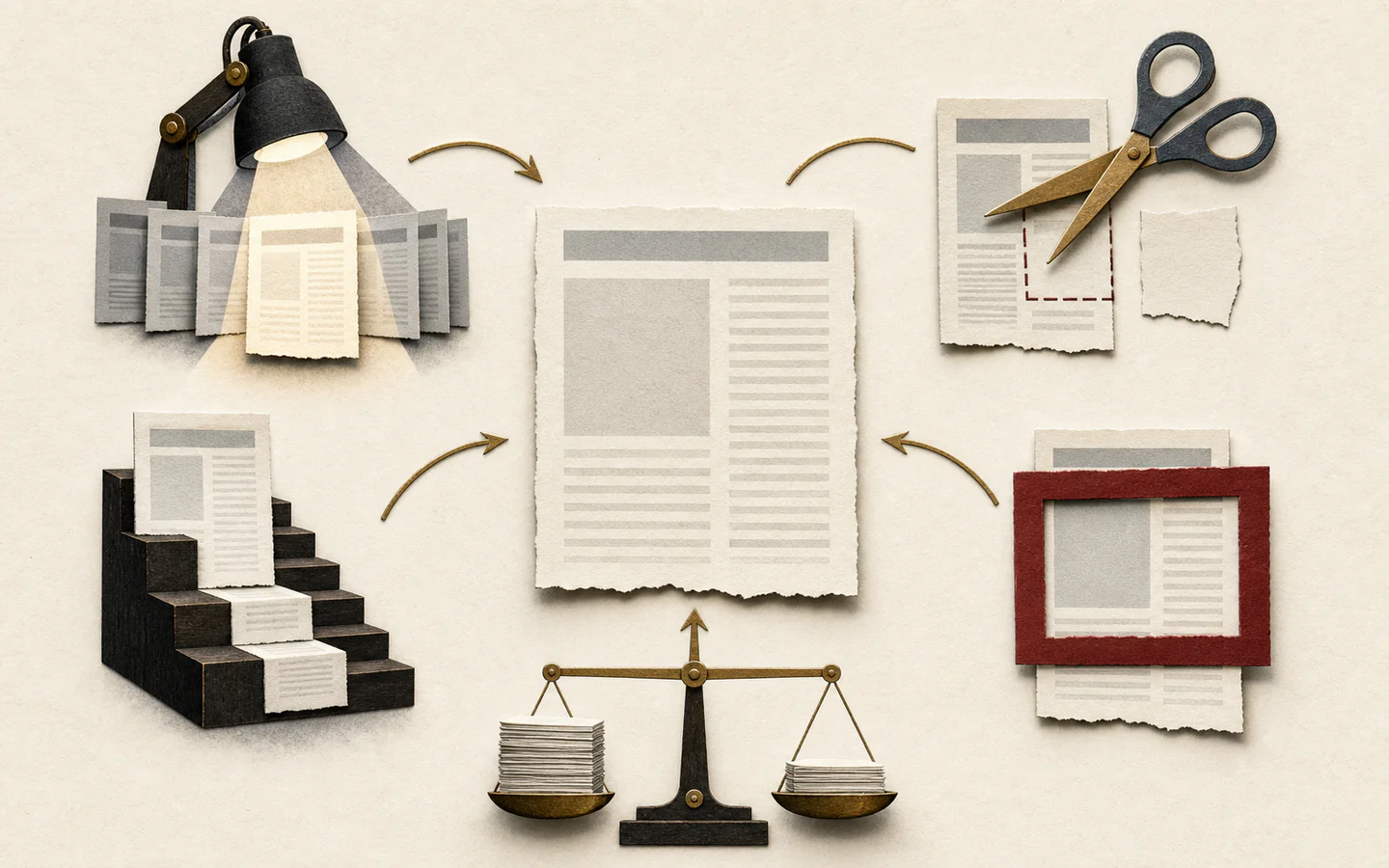
The five durable types of media bias are selection, omission, framing, placement, and false balance. Fabricated stories exist, but they are rare and career-ending; the everyday forms are all upstream of the facts: decisions about which true things to tell, how prominently, and in which words. Each type has a founding document, written between 1920 and 1993, and the 1949 study that founded gatekeeping research watched one wire editor reject roughly nine-tenths of everything the wires sent him.
1. Selection: the gatekeeper
Walter Lippmann described the job before anyone studied it, in the cleanest statement of what news selection is that exists:
Primary source 01 / 08
The news of the day as it reaches the newspaper office is an incredible medley of fact, propaganda, rumor, suspicion, clues, hopes, and fears, and the task of selecting and ordering that news is one of the truly sacred and priestly offices in a democracy. For the newspaper is in all literalness the bible of democracy, the book out of which a people determines its conduct.
In 1949 a researcher, David Manning White, finally watched a priest at work. He persuaded a middle-aged wire editor at a small midwestern paper, codenamed Mr. Gates, to keep every piece of wire copy he rejected for one week and write the reason on it. Mr. Gates rejected roughly nine-tenths of everything the wires sent, and the reasons were not a formula: one rejection slip read "He's too Red", another just "Never use this". White's conclusion, in the study that founded gatekeeping research, was that news selection is highly subjective, resting on the gatekeeper's own experiences, attitudes, and expectations, so a community ends up hearing as fact the events its newsmen believe to be true. Selection bias needs no conspiracy, just a person with a spike and a worldview. Multiply Mr. Gates by every editor, producer, and ranking algorithm between an event and your eyes.
2. Omission: the nine-tenths
Omission is selection's shadow: the bias in what never runs. Mr. Gates's trash pile, nine-tenths of the day's available news, is the part of the paper no reader ever gets to evaluate. It is the hardest bias to catch because you cannot see what is not there; it only becomes visible by comparison across outlets, which is why our brief keeps a running list of stories only one side covers. Lippmann rated it the worst of the sins:
Primary source 02 / 08
It may be bad to suppress a particular opinion, but the really deadly thing is to suppress the news.
3. Framing: the chosen angle
Once a story is in, someone decides what it is a story about. That is framing, and its canonical definition is Robert Entman's:
Primary source 03 / 08
To frame is to select some aspects of a perceived reality and make them more salient in a communicating text, in such a way as to promote a particular problem definition, causal interpretation, moral evaluation, and/or treatment recommendation for the item described.
Primary source 04 / 08
Frames call attention to some aspects of reality while obscuring other elements, which might lead audiences to have different reactions.
Problem, cause, moral, remedy. Run any charged story through those four slots and you can usually reconstruct the outlet's frame in a minute. Comparing frames across ten worldviews on the same event is literally what our daily brief renders in a table. Entman also supplied this page's most important sentence, the one that explains why following all the rules does not produce neutrality:
Primary source 05 / 08
Journalists may follow the rules for "objective" reporting and yet convey a dominant framing of the news text that prevents most audience members from making a balanced assessment of a situation.
4. Placement: the architecture of importance
The same fact lands differently as a lead story versus a paragraph-nineteen mention. Entman named the levers:
Primary source 06 / 08
Texts can make bits of information more salient by placement o r repetition, or by associating them with culturally familiar symbols.
Placement is agenda-setting at the scale of a single page: the outlet cannot tell you what to think, but the layout tells you what deserves your attention, and it works.
5. False balance, and the ritual of objectivity
The last type is a bias created by trying to look unbiased: giving two sides equal footing when the evidence is not equal, or hiding a judgment behind procedure. In 1972 the sociologist Gaye Tuchman spent time inside newsrooms asking what journalists actually mean by objectivity, and concluded it functioned less as a method than as armor:
Primary source 07 / 08
Attacked for a controversial presentation of "facts," newspapermen invoke their objectivity almost the way a Mediterranean peasant might wear a clove of garlic around his neck to ward off evil spirits.
Primary source 08 / 08
In all these examples, objectivity refers to routine procedures which may be exemplifed as formal attributes (quotation marks, levels of significance, legal precedents, X-rays) and which protect the professional from mistakes and from his critics.
Quoting both sides, using quotation marks, citing a document: real safeguards, and also rituals that can certify a slanted story as fair. The lesson of all five types is the same. Bias is not a stain on the news you can filter out. It is the sum of unavoidable choices, which means the reader's only real defense is seeing the choices, plural, side by side.