What is false balance?
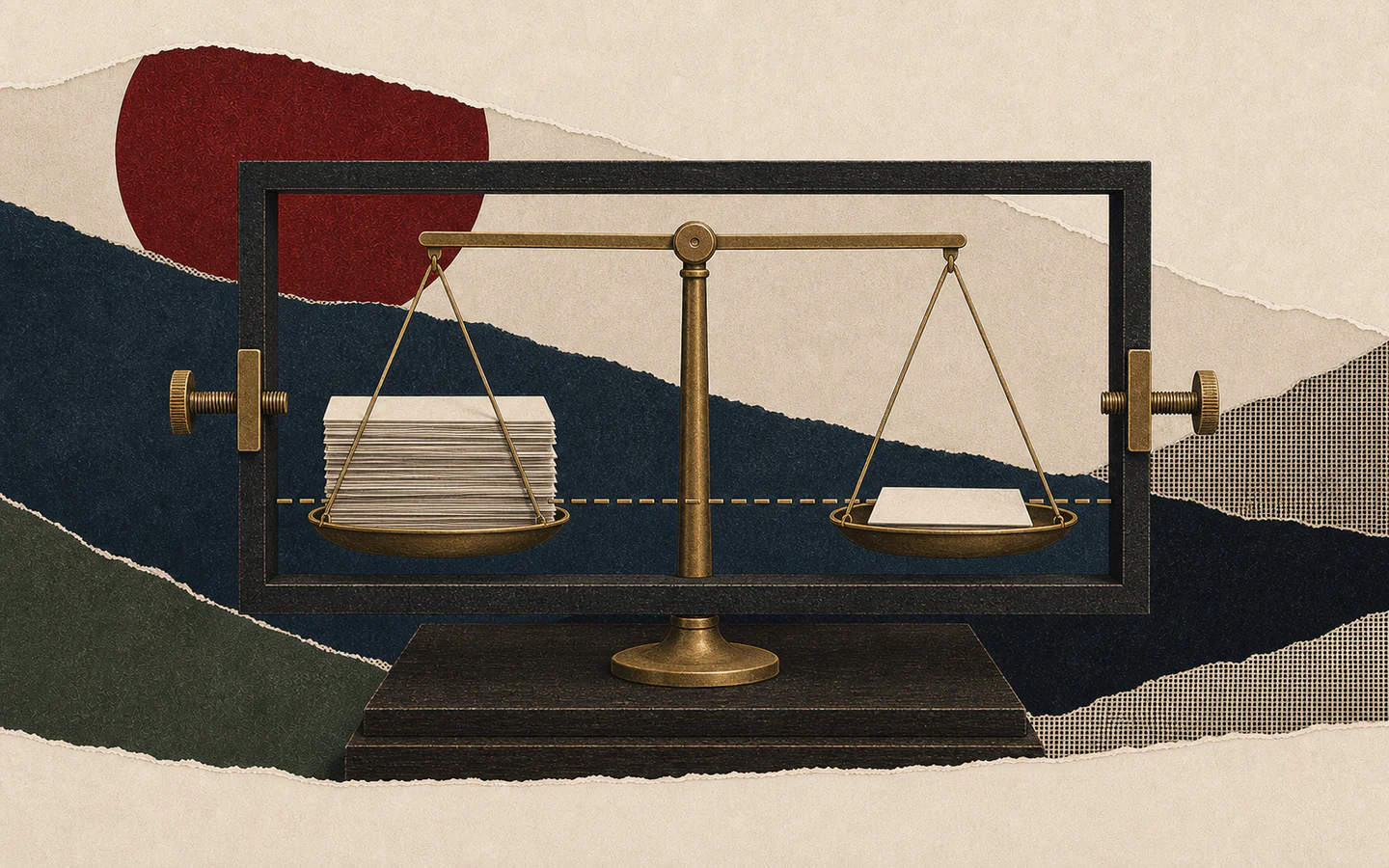
False balance, also called bothsidesism or false equivalence, is the practice of presenting two positions as evenly matched when the weight of evidence behind them is not. It is bias produced by the effort to look unbiased. The clearest measurement comes from a 2004 study of how four major American newspapers covered global warming between 1988 and 2002. In 52.65% of that coverage, the reporting gave the scientific consensus and a small group of skeptics roughly equal attention, which the researchers argued was not neutrality but distortion. Their name for it became the paper's title: balance as bias.
The norm underneath the problem is old, and for most stories it is sound. When a dispute is political or moral, a reporter who airs the competing arguments is doing the job. Balance is supposed to be a safeguard:
Primary source 01 / 05
Balance aims for neutrality. It requires that reporters present the views of legitimate spokespersons of the conflicting sides in any significant dispute, and provide both sides with roughly equal attention.
Where fairness turns into distortion
The safeguard fails on a specific kind of question: one where the sides are not evenly supported by evidence. The journalist Ross Gelbspan named the failure precisely, and the study quoted him at length:
Primary source 02 / 05
The professional canon of journalistic fairness requires reporters who write about a controversy to present competing points of view. When the issue is of a political or social nature, fairness—presenting the most compelling arguments of both sides with equal weight—is a fundamental check on biased reporting. But this canon causes problems when it is applied to issues of science. It seems to demand that journalists present competing points of views on a scientific question as though they had equal scientific weight, when actually they do not.
Give a fringe view equal footing with a settled one and the format itself carries a false message, before a single word is slanted. The reader is told, by the layout, that the matter is unresolved.
2004: the study that measured it
Maxwell Boykoff and Jules Boykoff content-analyzed climate coverage in the New York Times, Washington Post, Los Angeles Times, and Wall Street Journal across fourteen years. By the time they wrote, the scientific bodies that review the research had reached broad agreement that human activity was warming the planet. Following the balance norm, the papers did not report it that way:
Primary source 03 / 05
In fact, when it comes to coverage of global warming, balanced reporting can actually be a form of informational bias.
Primary source 04 / 05
We found that in the majority (52.65%) of coverage in the US prestige press, balanced accounts prevailed; these accounts gave "roughly equal attention" to the view that humans were contributing to global warming, and the other view that exclusively natural fluctuations could explain the earth's temperature increase. This supports the hypothesis that journalistic balance can often lead to a form of informational bias.
Read what that 52.65% means. On a question where the research had largely converged, most coverage staged a debate between two sides, as if the science were a coin toss. The skeptics were a small minority of the research. On the page, they were half the story, and a careful reader came away more uncertain than the evidence warranted.
Balance as bias
The study's conclusion is the sentence every assignment editor should keep in view:
Primary source 05 / 05
In the end, adherence to the norm of balanced reporting leads to informationally biased coverage of global warming. This bias, hidden behind the veil of journalistic balance, creates both discursive and real political space for the US government to shirk responsibility and delay action regarding global warming.
Why this is not only a climate story
Climate was the clearest case because the evidence was measurable, but the mechanism runs anywhere the weight of proof is lopsided: vaccines and autism, the shape of the earth, whether a documented election result was fraudulent. The fix is not to abandon fairness. It is to weight the sides by the evidence instead of splitting them down the middle, and to tell the reader where the weight sits. This is the failure mode of the objectivity ritual described in the types of media bias, and it is why balance and accuracy are not the same measurement. When the brief lays ten worldviews next to each other, it is not claiming they are equally supported. It shows you who said what, and leaves the weighing to you, with the evidence in view.