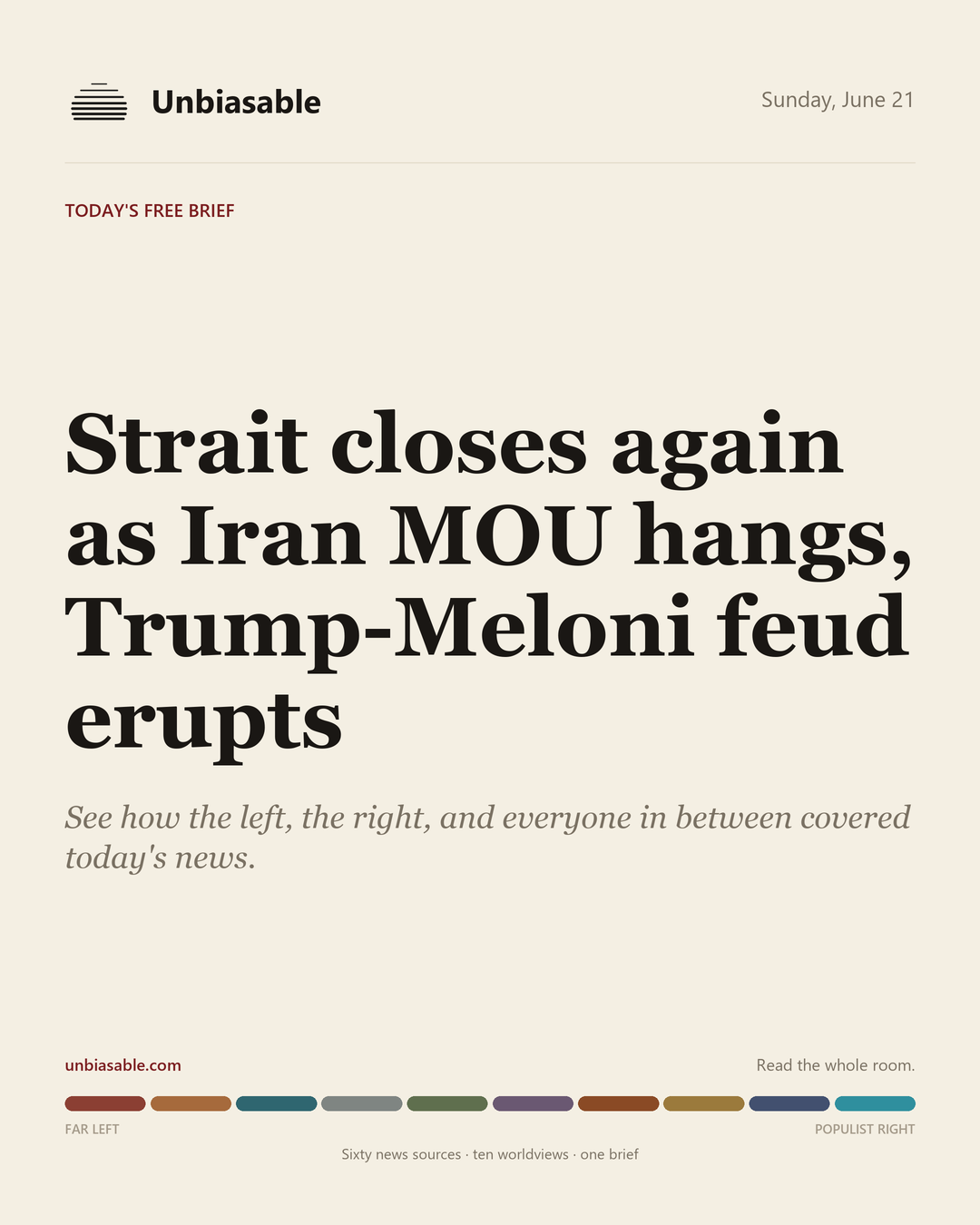
Iran re-closed the Strait of Hormuz hours after the second round of US-Iran Switzerland talks, citing US violations in Lebanon. No memorandum has been signed; the conflict is in its 114th day. [79]›
02
Trump deepened his public fight with Italian PM Giorgia Meloni at the G7, calling her criticisms of him "unprovoked and senseless." The rupture with a once-reliable European ally is now open. [48]
03
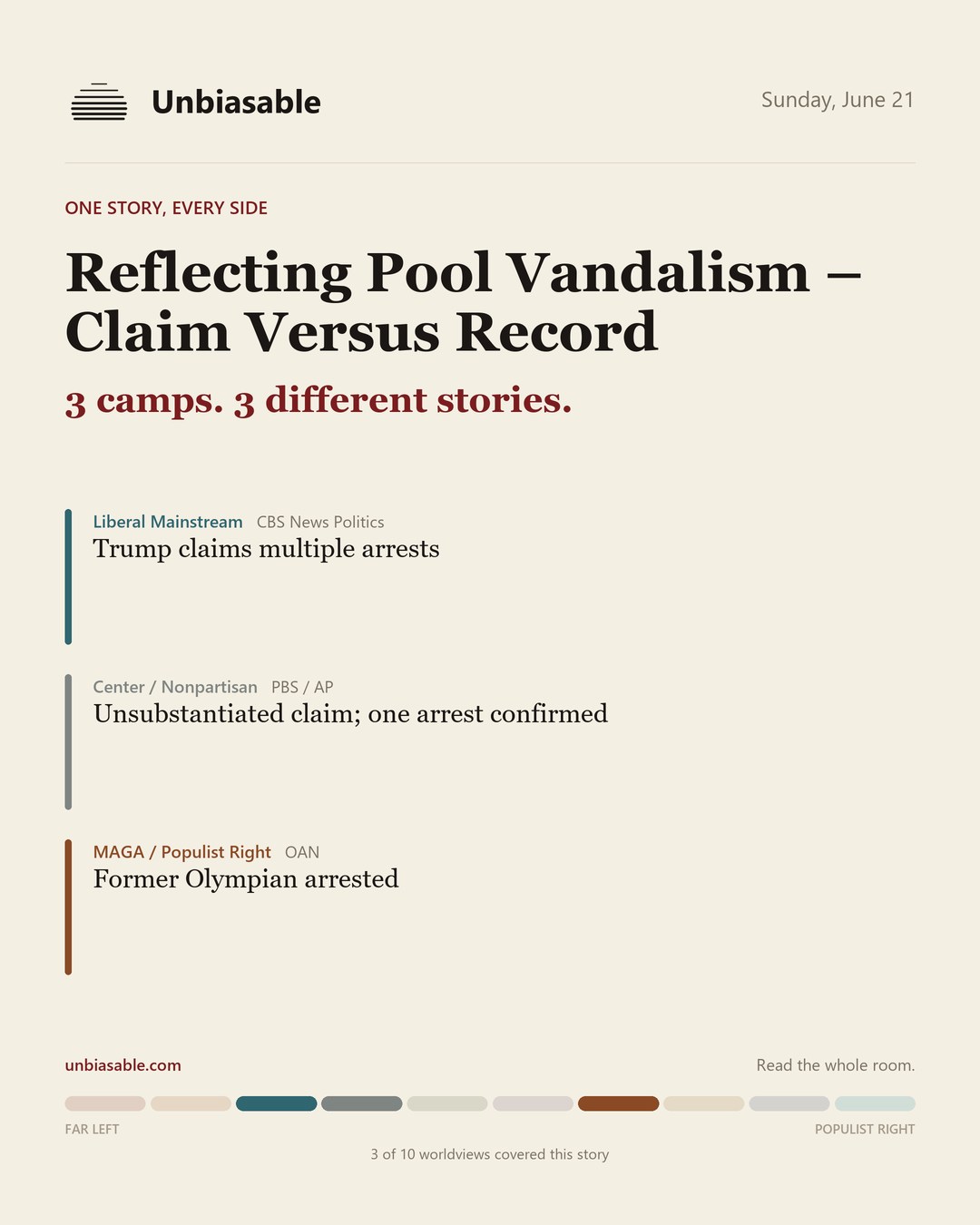
Trump claimed law enforcement made "multiple arrests" in connection with vandalism at the Lincoln Memorial Reflecting Pool. AP confirmed one arrest, a former Olympian named David Hearn, and could not corroborate Trump's broader claim. [81]
04
Russian elites and oligarchs are openly questioning the Ukraine war for the first time since the invasion, PBS NewsHour reported. The shift in elite opinion may signal rising internal pressure on the Kremlin. [117]
ICE agents shot a California man dead during an enforcement operation, NPR reported. The Guardian separately found that 93 percent of street arrests in the New York City area targeted Latino residents, not only undocumented immigrants. [47][57]›
Story Comparisons: the same event, in each side’s words
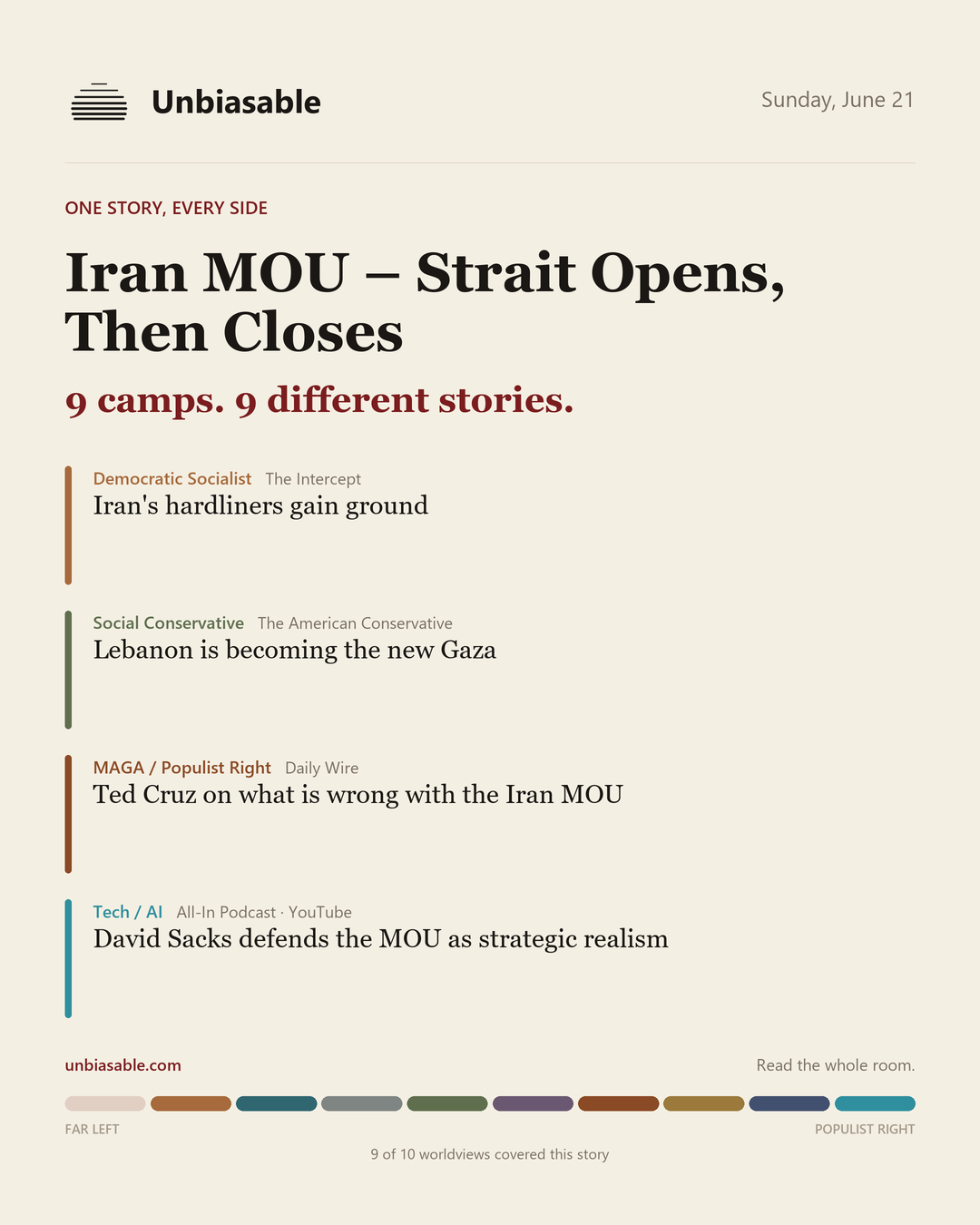
Iran MOU – Strait Opens, Then Closes
The MOU is not a nuclear deal, and the Strait's on-off status is the sentence that describes everything Washington is not saying out loud.
The facts7 pointscorroborated across 9 of 10 lenses · 16 sourcesWidely corroborated
01The US and Iran held a second round of talks in Geneva on June 21. A memorandum of understanding has been discussed but not signed.
02Iran's Islamic Revolutionary Guard Corps re-closed the Strait of Hormuz, citing US military activity in Lebanon as a violation of informal ceasefire terms.
03The US confirmed the talks; Iran confirmed closing the Strait.
Show 4 more factsShow fewer
04JD Vance publicly declared the Strait was open; it was closed within hours.
05DISPUTED: The exact terms of any emerging MOU are contested.
06The Intercept reports leaked text shows the agreement falls short of the JCPOA's verification provisions; the All-In Podcast's David Sacks argues the verification architecture is functionally comparable.
07Both claims remain unconfirmed by a third source.
9 source groups in today’s recordNo relevant coverage found from Communist
How each side framed it
Center“US and Iran hold second round of Switzerland talks”BBC News
The two sides met again in Switzerland. BBC frames this as diplomatic process, names the parties, and records the Strait's closure as a factual event. No characterization of who is winning or losing. The narrative is procedural: talks happened, Strait closed, no deal yet. The framing is as close to a blank factual record as the outlet produces.
"Chaos." NBC leads with the internal incoherence of the US negotiating posture, centering conflicting statements from Trump, Vance, and State Department officials within the same news cycle. The frame is executive dysfunction, not Iranian intransigence. Vance declaring the Strait open while it was closing becomes the emblem of the administration's credibility problem. [35]
The Supreme Leader's public skepticism. The Intercept foregrounds Iranian internal politics, specifically the hardline factions that see the MOU as a trap. The frame is that any US deal which does not fully lift sanctions gives Iranian conservatives exactly the grievance they need. The US is framed as a structurally unreliable negotiating partner whose domestic politics make any agreement fragile.
On paper, the JCPOA had centrifuge limits, snap inspections, and a verification architecture. The MOU has none of that. More Perfect Union walks viewers through the technical differences and frames the MOU as a retreat from the Obama framework that Trump spent years dismantling. The implicit argument: the administration destroyed a working deal, got a war, and is now negotiating its way back to a worse version of the thing it destroyed.
Vance stood at a podium and told the world the Strait of Hormuz was open for business. Four hours later, it wasn't. Cohen foregrounds the embarrassment as the story, treating it as an emblem of the administration's pattern of premature declarations. The frame is political accountability, with Vance's credibility as the unit of analysis.
"Meltdown." The Majority Report uses Fox News coverage as the primary exhibit: hosts who spent years demanding a harder line on Iran now contorting to support a deal they would have called capitulation under Obama. The frame is ideological inconsistency on the right, with the MOU as the stress test that exposed it.
The Vance-Trump dynamic at the G7 and Meloni's open break are threaded together as evidence of an administration losing its grip on allied relationships simultaneously.
Liberal“What we know about the MOU”Pod Save America
The comparisons to the JCPOA are drawn from the Obama Presidential Center opening, lending the critique an air of institutional expertise.
Center-Right“Lebanon is becoming the new Gaza”The American Conservative
Systematic destruction. The American Conservative pulls the camera back from Iran to Lebanon, documenting a conflict the US public is not being shown. The frame is antiwar realism: the MOU is almost beside the point because the military campaign itself has generated a new catastrophe. The piece reads as a direct rebuke to the negotiation focus: a country is being destroyed while diplomats parse terms, and the US press is covering the terms.
"Capitulation." The headline is the frame. National Review's position: any agreement that does not dismantle Iran's nuclear infrastructure is a defeat dressed as diplomacy. The magazine's hawkish tradition reads the MOU as a continuation of what it called Obama-era weakness. The difference this time is that the capitulation is happening under a Republican administration, which the piece navigates without directly naming.
Impossible position. Tucker Carlson frames JD Vance as a man caught between a base that wants to win and an administration that just blinked. The sympathy is for Vance personally; the implicit critique is of Trump for putting him there. Carlson represents the paleoconservative wing of MAGA that was always skeptical of the Iran adventure.
Dangerous lows. Reason leads with logistics: the US has burned through precision munitions faster than the industrial base can replace them. The frame is that the war has a concrete, measurable cost that the administration has not honestly accounted for. Reason does not editorialize on the MOU's merit; it runs the numbers and asks who is going to answer for the depletion.
"We had them on the ropes." Breaking Points surfaces a striking claim from neoconservative commentators: just before the MOU talks began, Iran was at its weakest point in decades and the administration pulled back. The frame is populist skepticism of the foreign policy establishment, arriving at the same anti-deal conclusion as National Review from the opposite direction. Not too soft on Iran but sold out American leverage.
"What Israel's influence actually means." Stuckey frames the MOU as a test of whether the administration will protect Israel's security interests, with Vance as the voice of reassurance. The fact that reassurance is needed signals how much anxiety the MOU has generated in evangelical communities that read US-Israel relations through both strategic and eschatological lenses.
The least-bad option. David Sacks makes a cost-benefit case for the MOU: the US cannot sustain a hot war with Iran indefinitely, and an off-ramp now is better than continued attrition. The All-In frame is techno-realist and anti-neocon, the same skepticism of military adventurism applied to Ukraine now applied to Iran. Sacks does not celebrate the deal; he argues the alternative is worse.
"Day 114." Al Jazeera anchors the day's events in the war's cumulative toll and frames Iran's Strait closure as a response to US behavior in Lebanon rather than Iranian aggression. The Palestinian-Arab standpoint treats the conflict as a region-wide crisis with interlocking fronts; the MOU is secondary to the question of whether the wider conflict de-escalates.
The facts4 pointscorroborated across 2 of 10 lenses · 3 sources
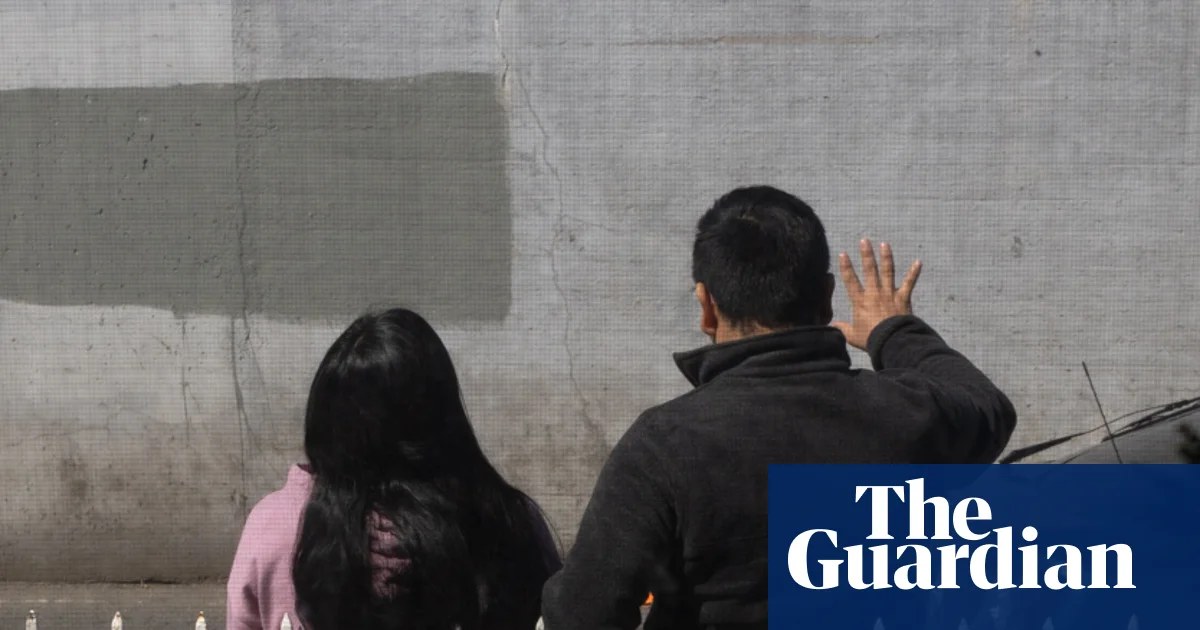
01The Guardian reported its demographic findings on ICE street arrests in the New York City area and specified that the data extended beyond the undocumented population.
02NPR confirmed the California shooting death and documented complaints about medical care from current detainees.
03The Intercept confirmed the cellist's arrest and reported receiving documentation of subsequent FBI contact.
04No second outlet corroborates any of them.
2 source groups in today’s recordNo relevant coverage found from CommunistCenterEstablishmentLibertarianMAGAReligious RightIdentityTech
How each side framed it
Liberal“93 percent of street arrests targeted Latinos”The Guardian
Not only undocumented immigrants. The Guardian's key phrase is the one that repositions the story from immigration enforcement to civil rights enforcement. The data shows ICE is not making distinctions between documented and undocumented Latino residents; that distinction, the piece argues, is the civil liberties fault line the administration has crossed.
Who authorized the shooting. NPR treats the shooting and the detention conditions as two nodes in one story: what happens to people once ICE encounters them. The frame is procedural accountability, focused on due process inside the enforcement system rather than on immigration levels or politics.
Flip her. The Intercept frames the story as political surveillance: the FBI treating an anti-ICE protest as an intelligence target and using an arrest as a lever to recruit informants. The comparison to McCarthy-era tactics is made explicitly. The frame connects the cellist's case to a broader argument that the state is treating immigration dissent as a national security matter rather than a political one.
The facts4 pointscorroborated across 3 of 10 lenses · 3 sources
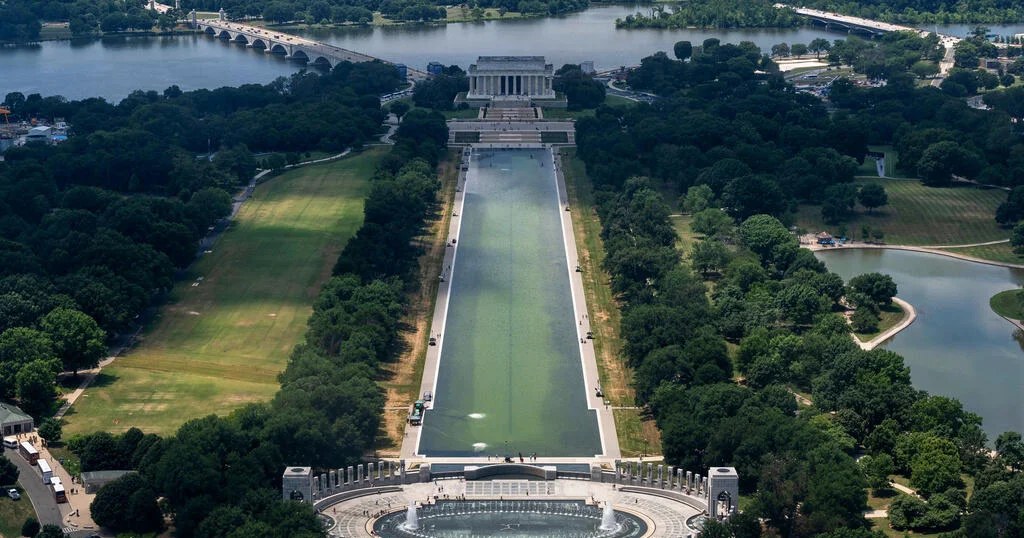
01Trump publicly claimed "multiple arrests" were made in connection with vandalism at the Lincoln Memorial Reflecting Pool.
02AP reporting confirmed one arrest: David Hearn, identified as a former Olympian.
03AP explicitly characterized Trump's broader claim as unsubstantiated.
04CBS News ran the story based on Trump's statement; OAN ran the Hearn arrest as the headline without examining Trump's "multiple arrests" claim or its accuracy.
3 source groups in today’s recordNo relevant coverage found from CommunistDemocratic SocialistEstablishmentLibertarianReligious RightIdentityTech
How each side framed it
Center“Unsubstantiated claim; one arrest confirmed”PBS / AP
The piece is structured around what can be proven, one arrest, one name, one confirmed connection.
"Trump claims." CBS reports the president's statement as the lead. The piece is structured around what Trump said rather than what was confirmed. CBS is here functioning closer to the center wire frame than to active fact-checking; the claim is attributed and treated as the news event, not the accuracy of the claim. [31]
Former Olympian arrested. OAN leads with the Hearn arrest and frames it as a legitimate law enforcement outcome: a named person caught defacing a national monument. The question of whether Trump's "multiple arrests" claim was accurate does not appear. OAN treats the arrest as confirmation of the president's framing rather than as a partial data point against it. [150]
The left has been sounding this alarm for three years. The mainstream financial press is only now catching up, and even then only in the business pages.
The facts4 pointscorroborated across 2 of 10 lenses · 2 sources
01Second Thought and Novara Media both report on the growth of private credit markets and the risks of limited regulatory oversight.
02These are analytical and editorial pieces, not breaking news.
03Both characterize private credit as a systemic risk.
04Both are single-source accounts within the left analytical tradition; neither is independently corroborated by outlets outside the left in today's coverage.
2 source groups in today’s recordNo relevant coverage found from Liberal MainstreamCenterEstablishmentLibertarianMAGAReligious RightIdentityTech
How each side framed it
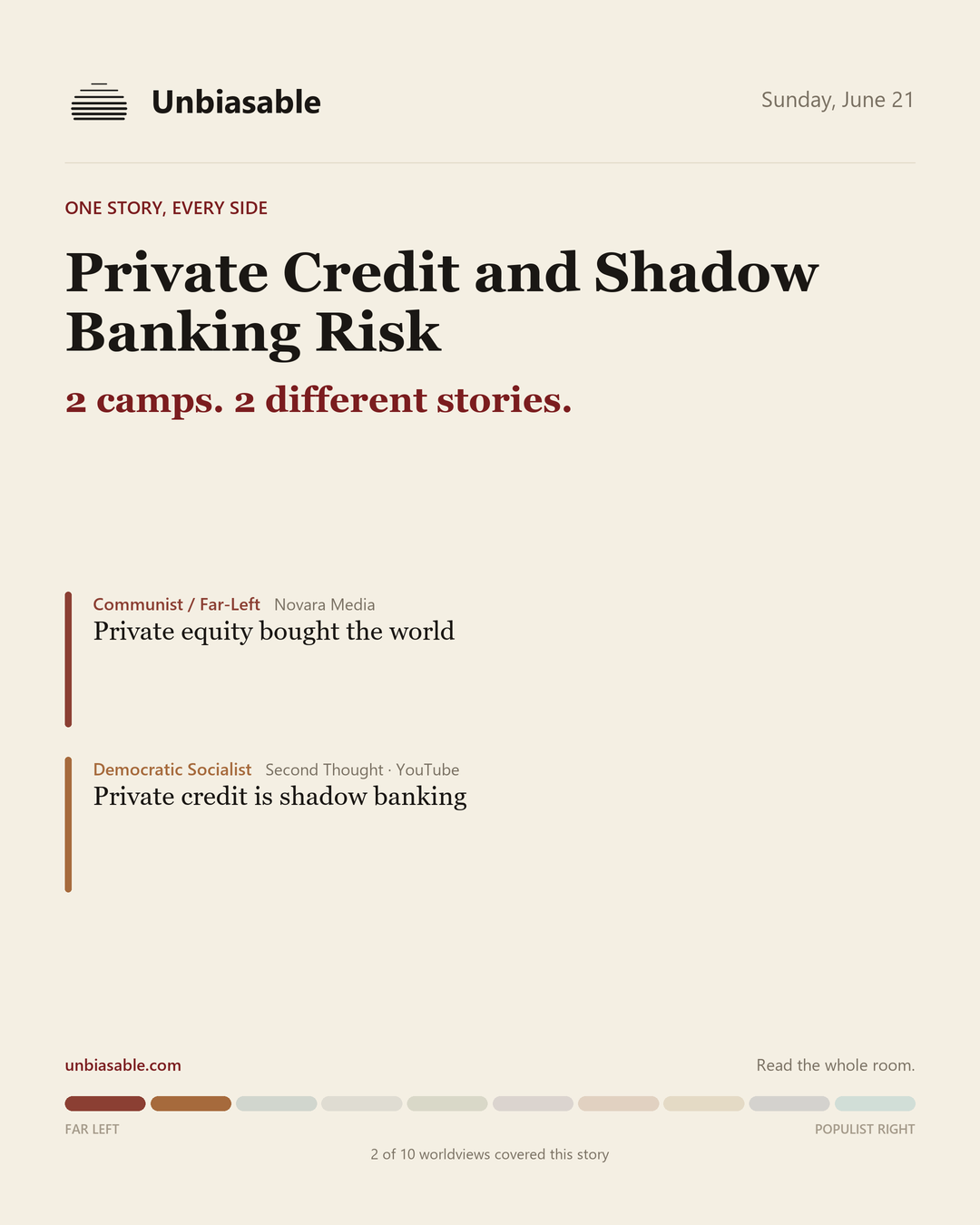
Far Left“Private credit is shadow banking”Second Thought
Shadow banking by another name. Second Thought defines "private credit" for a general audience and argues the rebranding from "shadow banking" to "private credit" is itself a political act, a way of making unregulated lending sound like a feature rather than a bug. The frame is regulatory capture: the financial industry renamed the risk and lobbied the name into respectability. The systemic comparison is to 2008, but the argument is that the leverage is now more opaque.
Who holds the bag. Novara frames private equity not as a financial sector story but as a class story: firms extracted value from productive enterprises, loaded them with debt, and are now attempting to sell into a market that has priced in continued growth. The implicit question is who absorbs the loss when the exits close. Novara's answer is workers, pension funds, and the public sector.
The facts3 pointscorroborated across 2 of 10 lenses · 2 sources
01A minor-league baseball team, the York Revolution, forfeited a scheduled Pride Night game.
02The Officer Tatum reports the DOJ is investigating MLB for alleged religious discrimination related to a player who declined to participate in a Pride Night event.
03Both claims are single-source and appear in no other outlet in today's coverage.
2 source groups in today’s recordNo relevant coverage found from CommunistDemocratic SocialistLiberal MainstreamCenterEstablishmentReligious RightIdentityTech
How each side framed it
Libertarian“York Revolution forfeit Pride Night”Actual Justice Warrior
The backlash is coming. Actual Justice Warrior frames the forfeiture as a principled stand against a coercive cultural agenda: the team is the hero, Pride Night is the imposition. The frame is religious freedom meeting corporate LGBT politics, with the team's forfeit treated as a legitimate act of conscience rather than an organizational disruption.
"Accountability." The Officer Tatum foregrounds the DOJ investigation as the story, the federal government wielding enforcement tools on behalf of religious conservatives. The frame goes further than Actual Justice Warrior's. Where AJW wants teams free to opt out on principle, The Officer Tatum wants the federal government actively enforcing religious accommodation. The DOJ, cast in standard MAGA rhetoric as the villain of prosecutorial overreach, appears here as the corrective to corporate culture-war coercion. [169]
RTX (Raytheon) received a $3.5 billion AMRAAM missile production contract in July 2025 and saw its sales rise 10 percent in the year the Iran war began. RTX has spent $4.49 million lobbying in 2026, and executive compensation rose 26 percent from 2024 to 2025. (OpenSecrets) A signed MOU that ends active missile expenditure is a direct threat to the war-driven revenue growth RTX investors are pricing in. This stake is unaddressed in all 18 sources that covered the Iran story today. [135]›
GEO Group posted a record $254 million profit in 2025, a 700 percent increase driven by new ICE detention contracts. A former GEO Group executive now runs ICE. Investors on GEO Group and CoreCivic earnings calls expressed frustration that detention numbers are not rising faster. (Prison Legal News) The feedback loop, more enforcement, more contracts, more lobbying for more enforcement, was not named in any of today's ICE coverage. [47][57]›
The Supreme Leader of Iran's public skepticism about the MOU [9] is inseparable from internal Iranian political economy: hardline factions control significant economic assets that benefit from sanctions, including black-market premiums and IRGC commercial holdings. A genuine sanctions-lifting deal threatens those interests as concretely as the MOU threatens RTX. Neither the Iranian nor the American financial stakes in prolonged conflict appear in today's coverage.›
National Review's "Iran Capitulation" frame [118] and Ted Cruz's Daily Wire interview [196] share a hawkish donor base that has historically overlapped with defense-industry PAC money. The ideological and financial interests run in the same direction; the current coverage does not examine the connection.›
The American Conservative's Lebanon reporting [123] and Reason's missile-depletion piece [135] are the only articles in today's digest that put a concrete cost on the Iran conflict. Both come from the right. The liberal press, which covered the chaos of the MOU negotiations extensively, did not run the cost analysis.›
Stories Only One Side Covers
Democratic Socialist
“Democratic Socialist only:”
The Intercept documented FBI agents calling a cellist arrested at an anti-ICE protest to recruit her as an informant [10]. The story, that the state is using arrests as levers to cultivate intelligence sources inside protest movements, appeared in no other outlet reviewed today.
Democratic Socialist
“Democratic Socialist only:”
Truthout covered an FTC lawsuit against WPATH (the World Professional Association for Transgender Health) and compared the federal targeting of a medical standards body to McCarthyism [12]. The FTC case itself was not covered outside the left.
Identity
“Identity / Palestinian-Arab only:”
Al Jazeera's framing of "day 114 of the Iran war" [222] is itself an editorial choice no Western outlet makes. The number functions like a casualty counter, insisting on accumulated duration that the US press resets with each diplomatic event.
Identity
“Identity / Palestinian-Arab only:”
Mondoweiss frames the MOU as evidence that US imperial reach in the Middle East has hit a structural wall [267], treating the negotiation not as diplomacy but as managed retreat. The frame, the US as an empire in visible decline rather than a democracy managing a foreign policy setback, appeared nowhere outside the Palestinian-Arab press.
Underreported
“Social Conservative only:”
The American Conservative's Lebanon reporting [123] is the only article in today's digest that explicitly names Lebanon as an active, intensifying conflict zone rather than a secondary front. The piece reads as a direct rebuke to the Iran-MOU focus: the deal is being negotiated while a country is being destroyed, and the US press is not covering it.
Libertarian
“Libertarian only:”
Reason's missile-stockpile piece [135] is the only article that runs specific numbers on US munitions depletion from the Iran war. The argument that the conflict has a concrete, measurable cost to US military readiness appeared nowhere in mainstream or ideological coverage outside Reason.
Communist
“Communist / Far-Left only:”
Novara Media's private equity piece [8] frames financialization as an ongoing class extraction event, not a market cycle. The argument that private equity's current distress is the delayed consequence of decades of asset-stripping appeared in no other outlet reviewed today.
MAGA
“MAGA / Populist Right only:”
The Officer Tatum's report on a DOJ religious discrimination investigation into MLB [200], if accurate, is a significant federal action with no coverage outside MAGA-adjacent YouTube. The investigation, if it proceeds, would establish a legal template for federal enforcement against sports leagues on religious accommodation grounds.
Center
“Center / Nonpartisan only:”
PBS NewsHour's reporting on Russian elites openly questioning the Ukraine war [117] is the only article in today's digest that treats Russia's internal political situation as a live news story. Coverage of who inside Russia is saying what, and at what personal risk, was absent from ideological outlets across the spectrum today.
MAGA
“MAGA / Populist Right only:”
Breaking Points surfacing neoconservative commentators who argue "we had them on the ropes" before the MOU talks began [114] is the only outlet that explicitly names the argument that Iran was at its weakest point and the administration chose that moment to negotiate. That specific counterfactual, the argument that a harder line was achievable, is present only on the populist right.
Libertarian
“Tech / AI only:”
David Sacks's defense of the MOU as strategic realism [315] is the only piece in today's digest that frames the Iran deal through a techno-realist lens, applying cost-benefit analysis to military strategy from a position skeptical of neoconservative assumptions. The tech-right's anti-interventionism, when it surfaces, is analytically distinct from both the paleoconservative antiwar tradition and the libertarian one.
MAGA
“Evangelical / Christian Right only:”
Allie Beth Stuckey's framing of the MOU as a test of US commitment to Israel [217] is the only piece that connects the Iran deal directly to eschatological anxieties in the evangelical community. The pro-Israel foreign policy stance is present in the MAGA outlets too, but Stuckey's framing of it as a question of spiritual fidelity rather than strategic interest is unique to the Evangelical lens.


 “US and Iran hold second round of Switzerland talks”
BBC News
“US and Iran hold second round of Switzerland talks”
BBC News
 “Inside the chaos”
NBC News Politics
“Inside the chaos”
NBC News Politics


 “Obama's JCPOA vs. Trump's MOU”
More Perfect Union
“Obama's JCPOA vs. Trump's MOU”
More Perfect Union


 “Day 114, IRGC closes the Strait”
Al Jazeera
“Day 114, IRGC closes the Strait”
Al Jazeera