The US and Iran signed a 14-point Memorandum of Understanding at the G7 in Versailles, extending the ceasefire 60 days and reopening the Strait of Hormuz to commercial traffic, while leaving ballistic missiles, reconstruction funding, and sanctions relief mechanisms unresolved. Senate Republicans emerged fractured. [152][172]›
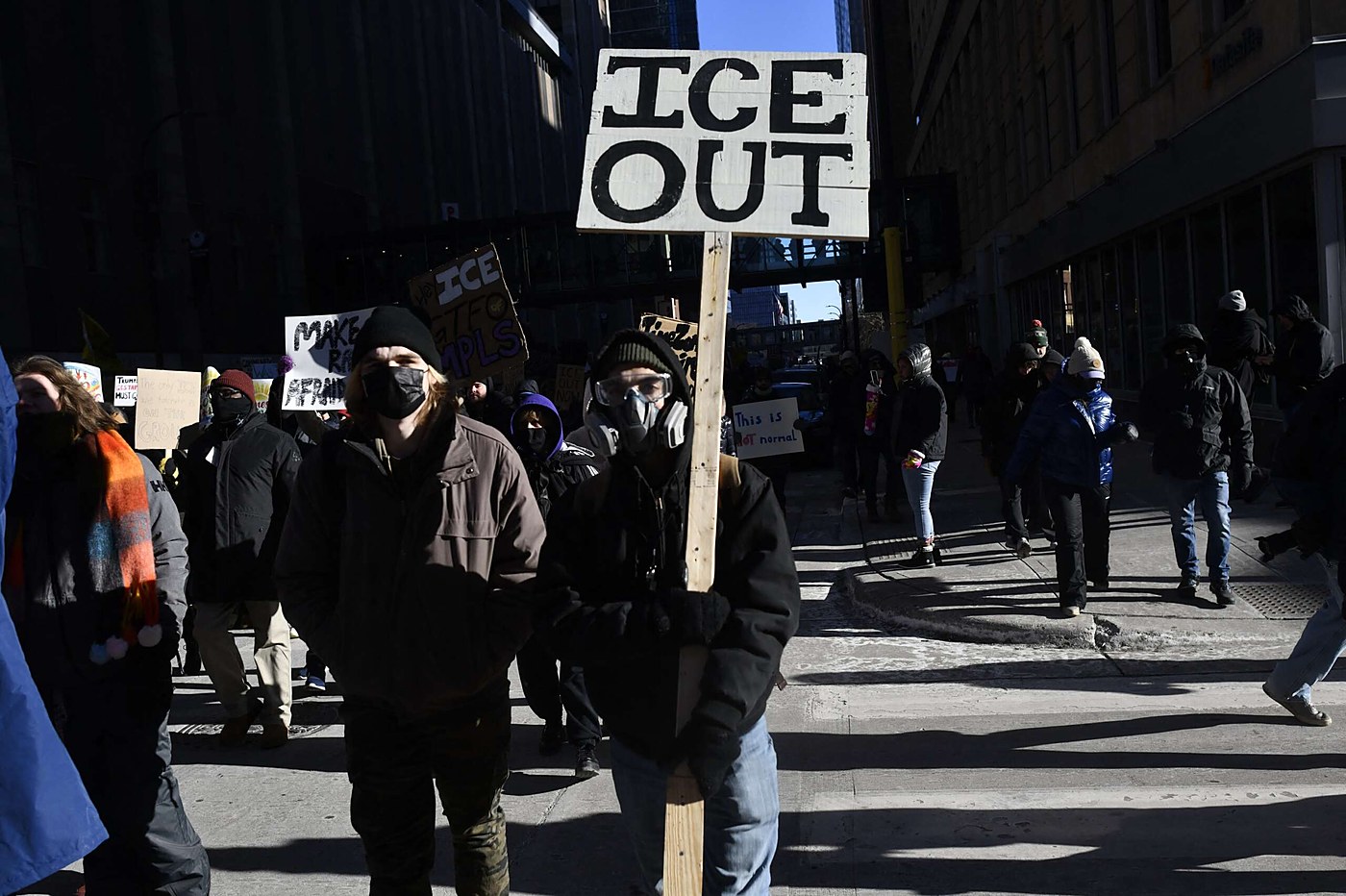
Federal prosecutors charged 15 Minneapolis anti-ICE activists with felony conspiracy, explicitly invoking NSPM-7, Trump's September 2025 national security memo that designates support for immigration as a domestic terrorism indicator. The defendants include trade union members who were acting as legal observers. [226]›
The Education Department transferred special education programs to HHS and civil rights oversight to DOJ, the most substantial dismantling of the agency since Trump took office, leaving millions of disabled students without a clear enforcement home. [144]›
The Fed held rates at 3.75% on Kevin Warsh's first day as chair. Warsh announced a policy review task force rather than an immediate hike, buying time against colleagues who favor tightening as Iran war inflation lingers. [159][180]›
05
Georgia Republican legislative leaders rejected Gov. Kemp's call to redraw congressional maps during the current special session, leaving the Callais redistricting ruling unresolved for 2026 races. [164]
Story Comparisons: the same event, in each side’s words
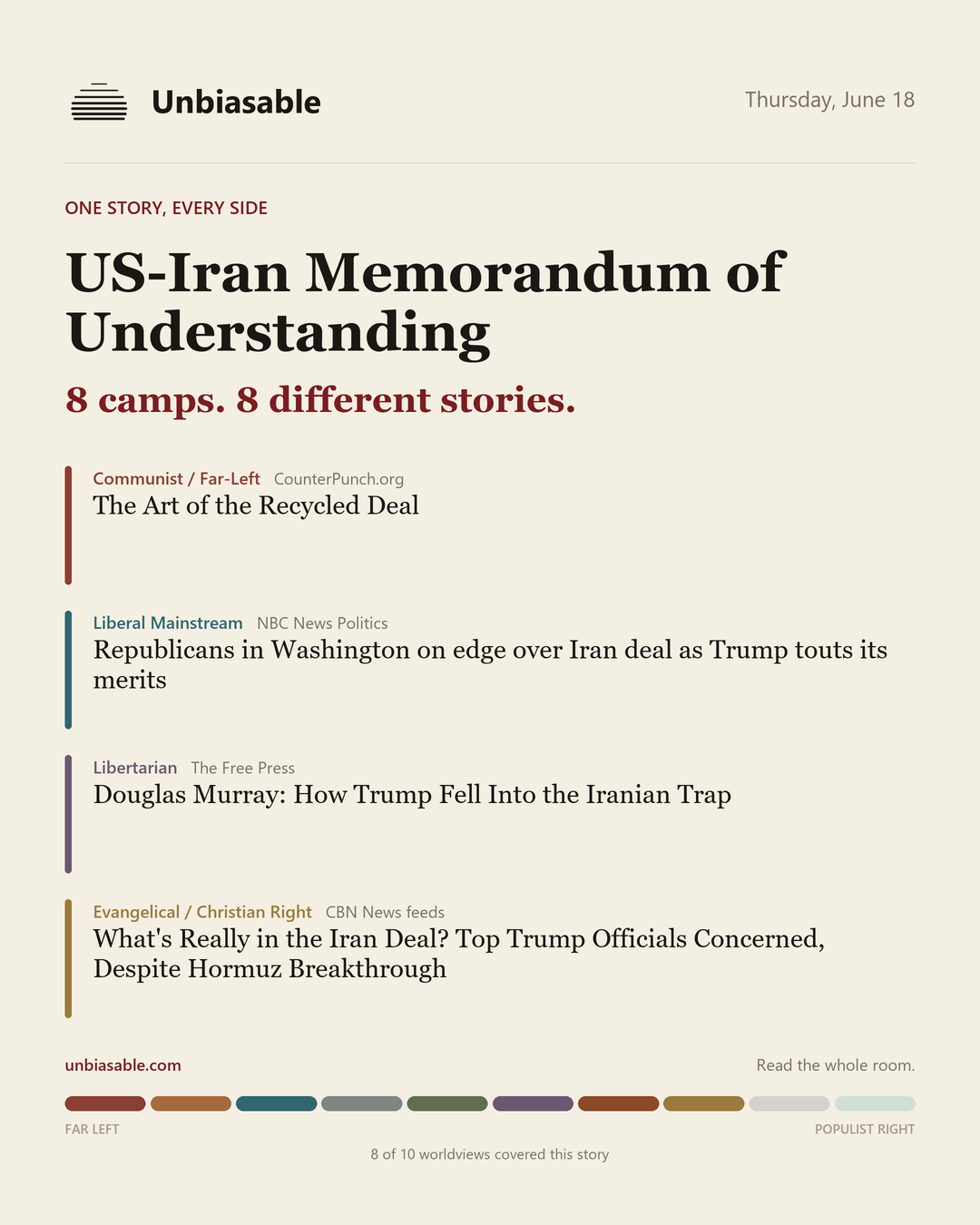
US-Iran Memorandum of Understanding
The Strait is moving again, but Congress was not consulted, the sanctions relief Trump pledged may require a Senate vote he cannot get, and the deal's hardest provisions are deferred to a 60-day window that could simply reopen the war.
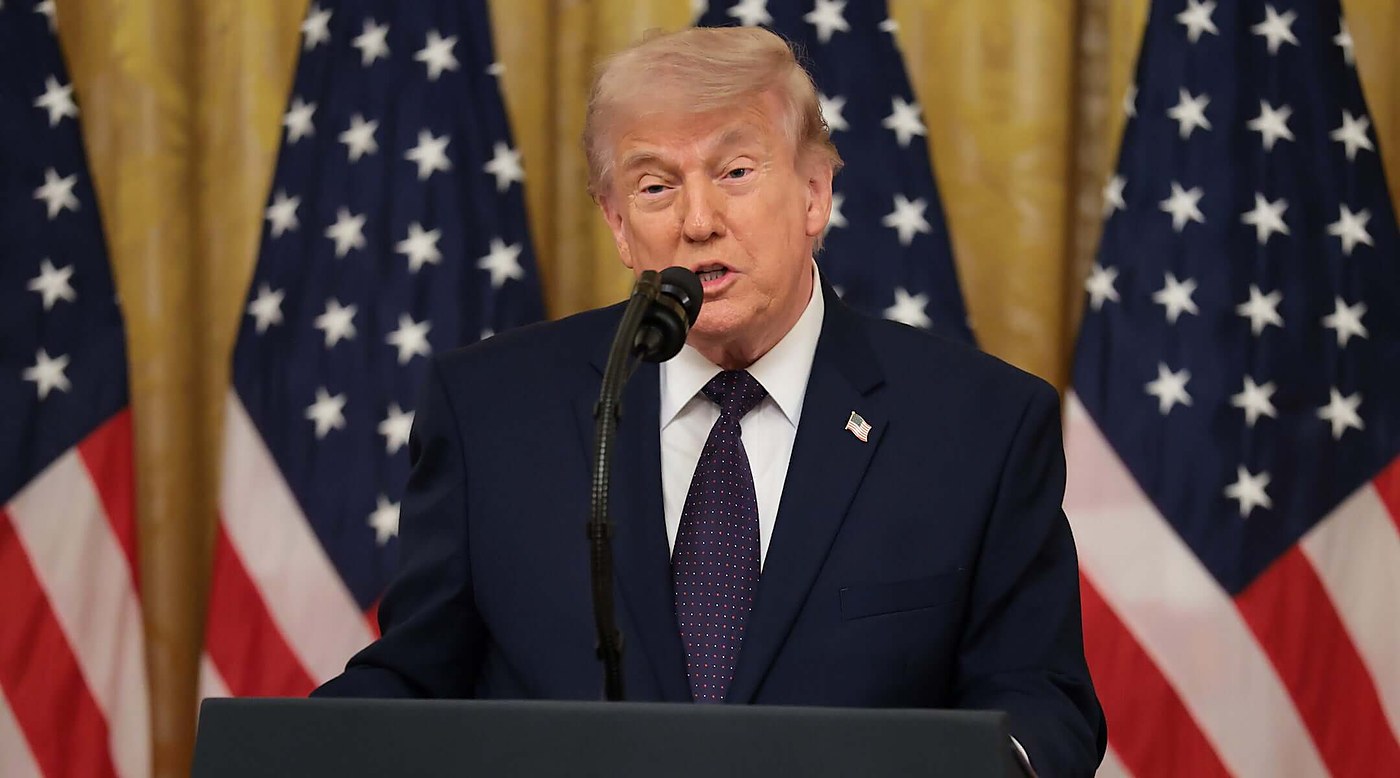
01Trump signed the MOU remotely from the G7 in Versailles on June 17. The 14-point document establishes mutual recognition of sovereignty and territorial integrity, a 60-day negotiating window extendable by mutual consent, and commits Iran to allowing commercial shipping through the Strait of Hormuz "using its best efforts." [152][172] The US agrees to waive some sanctions in return.BBC · wire
02Hezbollah, weakened by battlefield losses in Lebanon, is seen gaining political breathing room from Iran's diplomatic standing. [442] Republican critics include Ted Cruz, Nikki Haley, and Bill Cassidy; Lindsey Graham and Rand Paul support it. [297] Reason's Volokh Conspiracy notes the president is legally barred from waiving CISADA sanctions by executive order alone, making the sanctions-relief pledge potentially unenforceable without congressional action. [239]3 ideologies
7 source groups in today’s recordNo relevant coverage found from Tech
How each side framed it
Dem Soc“Leaked Iran Agreement Contradicts Trump's Claims About $300B Postwar Aid”Truthout
"Contradicts" is Truthout's lead word. The leaked text shows the reconstruction fund is not $300 billion and is not funded by the US. Trump's press conference claims were misleading, and Iran may have signed on different assumptions than the White House represented. [52]
MAGA wanted a winner and got a deal no neocon would have touched. HasanAbi frames the MOU as proof that MAGA ideology is incoherent. The base wanted strength, got a negotiated withdrawal, and is now rationalizing it. The deal exposes that MAGA had no actual Iran policy beyond the aesthetics of confrontation. [57]
Anti-war voices on the left predicted the war would end in a deal no better than what Iran offered before the bombing started. The war cost thousands of lives and achieved nothing a diplomatic track couldn't have. [60]
NBC frames this as an institutional crisis. Congress was not consulted, senators were blindsided, the text was released only after public pressure, and the deal lacks Senate ratification. The focus is on process violations and Republican anxiety rather than on whether the deal is sound policy. [84]
Pod Save America uses "defeat" without hedging. The war began with US strikes, ended with US withdrawal under terms Iran offered before hostilities, and extracted no meaningful concession on missiles or regime behavior. A defeat dressed as a deal. [140]
BBC inventories what's in and what's out, without a verdict. Ballistic missiles: absent. Nuclear timeline: vague. Reconstruction: unresolved. Strait reopening: conditional on gradual implementation. Many of the hardest questions remain. [152]
AP profiles Vance as the internal champion of the deal, the face of the anti-interventionist strand within the administration. His involvement signals ideological consistency with his pre-VP position, even as the hawkish faction fumes. [148]
Iran played the negotiation perfectly: absorbed US strikes, preserved its core military capabilities, got sanctions relief, and signed a deal that recognizes its legitimacy as a regional power. "Trap" is the operative word. Iran got what it could not have gotten from Obama. [260]
Ferguson's counterpoint: the deal ends a war costing the US economy $40 billion a month in Strait disruption; the 60-day framework gives diplomats a genuine window; calling it surrender is premature. The test is whether the full agreement holds. [262]
"The war is lost" means the moral and strategic case for starting it has been fully discredited. The US bombed a sovereign country, failed to achieve regime change, and accepted terms that leave Iran's nuclear program and missiles intact. [270]
Fox gives prominent space to critics inside the coalition: senators and analysts who call the deal weaker than Obama's JCPOA and argue Iran gave up nothing real. The fracture runs between Trump and his hawkish allies, playing out inside MAGA. [322]
Tucker reframes the deal as a defeat for Netanyahu and the neoconservative war faction, not a defeat for Trump. The heroes are anti-war populists who pushed Trump toward peace; the villains are the Bibi faction who wanted endless war to serve Israeli interests. [377]
CBN's read is cautious. The Strait breakthrough is real, but top Trump officials privately expressed concern about the nuclear and ballistic missile gaps. The deal is a work-in-progress, with the 60-day window as the real test. [383]
The split cuts across the spectrum: war faction vs. peace faction, in unusual company. Tucker Carlson and HasanAbi both call the deal a defeat for the neoconservative war caucus, one celebrating it as peace and one as proof of MAGA's incoherence. The American Conservative and Truthout both called the war reckless before it started and are both vindicated today. The collective blind spot: not one outlet is asking what happens in 60 days when sanctions relief requires a Senate vote unlikely to pass and Iran's ballistic missiles remain unaddressed. Nobody is writing about the implementation mechanism.
Minneapolis ICE Protest Indictments under NSPM-7
This is the first federal prosecution to invoke a national security memo designating opposition to immigration enforcement, anti-capitalism, and support for immigrants as domestic terrorism indicators, and the defendants include trade union members who were legal observers.
"Frame-up" and naked political repression. WSWS argues the indictments are designed to criminalize any organized opposition to ICE operations. NSPM-7 is characterized as a blueprint for criminalizing class-based dissent. These defendants are the opening example; the intended scope is any labor or community group that resists deportation. [26]
Truthout emphasizes the labor angle: the defendants include trade union members acting as legal observers of ICE enforcement, not as agitators. Prosecuting union members for witnessing deportations, not resisting them, marks an escalation from enforcing immigration law to criminalizing its documentation. [55]
"Spaghetti against the wall." The Intercept characterizes the charges as legally weak, stringing together several federal statutes to maximize apparent severity. The how-to-fight-it framing turns the story into a guide for future resistance rather than a verdict on the case. [38]
The surveillance question may be more consequential than the charges themselves. How did prosecutors access Signal messages that were supposed to be end-to-end encrypted? A device seizure, a cooperating witness, or an undisclosed capability, each has different implications for every organization in the country that uses encrypted communications. [39]
Straight news, procedural framing. The charges are legitimate enforcement of federal law against people who conspired to obstruct immigration officers. The NSPM-7 invocation is not questioned. The tone is procedural rather than celebratory. [226]
Left outlets see a political prosecution designed to chill organized opposition to ICE. Social conservatives see legitimate enforcement. The gap is what's missing: Reason and the libertarian press, which cover civil liberties consistently, are absent. Liberal mainstream is absent. The legal and constitutional questions are being processed entirely within ideological silos, with no voice bridging them. The Intercept's surveillance question is the story that should be getting broader attention.
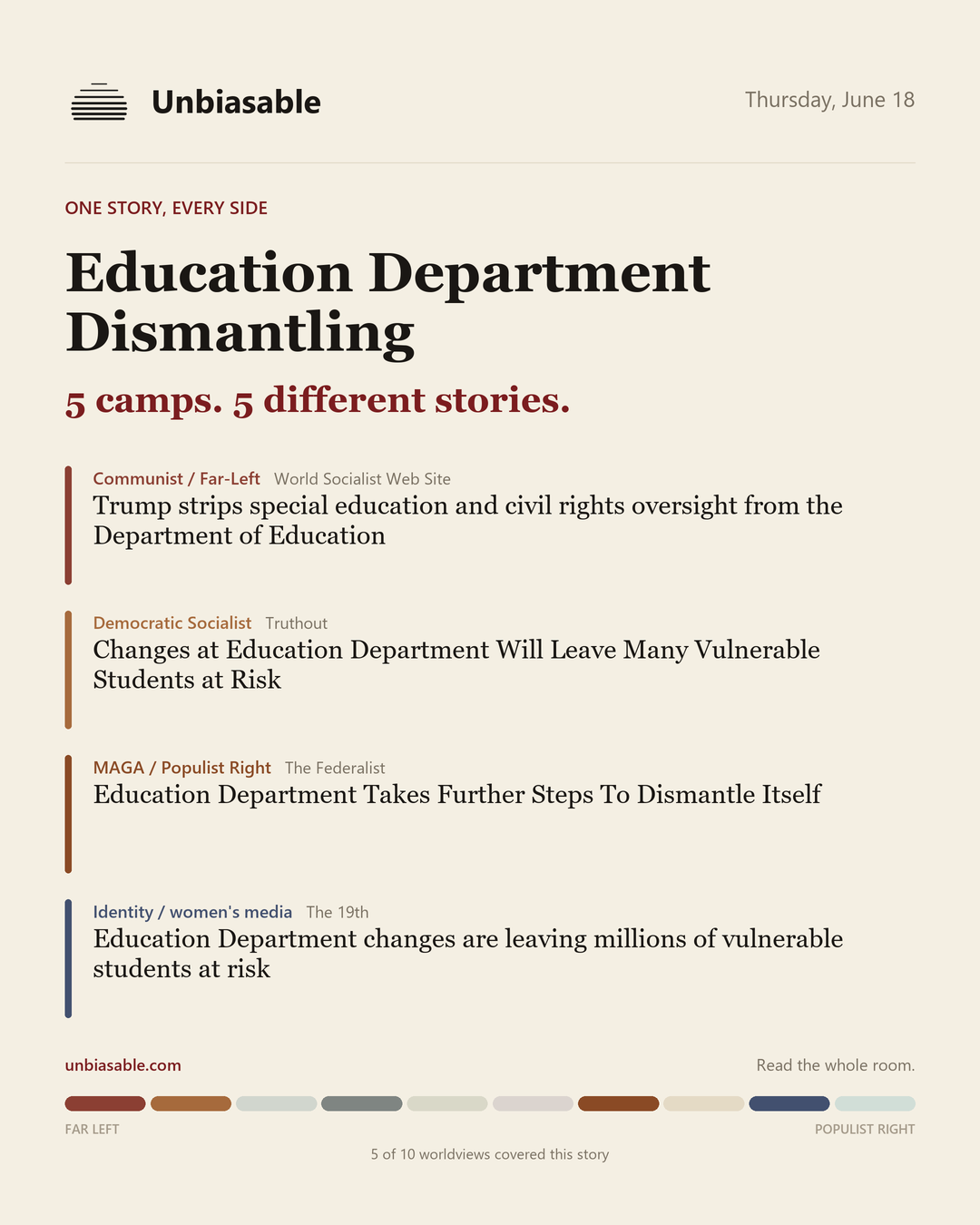
Education Department Dismantling
Moving civil rights enforcement to the Justice Department and special education oversight to HHS is functional abolition dressed as efficiency.
01IDEA requires the Education Department to maintain management and leadership, meaning a full transfer may face legal challenge. [144][48] Disability advocacy groups warned the move risks coordination gaps and enforcement lapses for millions of disabled students. [144][480]3 ideologies
5 source groups in today’s recordNo relevant coverage found from Liberal MainstreamEstablishmentLibertarianReligious RightTech
How each side framed it
Far Left“Trump strips special education and civil rights oversight from the Department of Education”World Socialist Web Site
"Strips" is the operative word. WSWS frames the move as class warfare against disabled and minority students, a deliberate dismantling of federal protections designed to benefit private schools and weaken public education's legal infrastructure. [28]
Truthout focuses on concrete harm: IDEA compliance requires an education-specific enforcement apparatus. Putting special ed oversight in HHS and civil rights in DOJ breaks institutional knowledge and proximity to schools. The welfare framing centers students at risk rather than rights being stripped. [48]
AP's framing is notable for its qualifier: "a flawed system." The existing special education enforcement was already imperfect. Families are worried, but not because the current system was working well. The AP treats this as a genuine policy question rather than a pure attack, centering it differently than every other outlet. [144]
The 19th centers mothers and families as the primary affected communities, women who have spent years navigating IEPs and 504 plans and now face an enforcement chain crossing two agencies. Human cost told through family impact rather than institutional analysis. [480]
"Takes further steps to dismantle itself" is framed as progress. The Federalist presents the transfers as fulfillment of the conservative promise to reduce the federal education bureaucracy. The driving argument is that the federal government has no business running education at all; disabled student outcomes are secondary to that principle. [366]
The category split is welfare versus rights versus bureaucracy reduction. Left outlets frame this as an attack on vulnerable populations; the center asks whether the existing system was worth defending; the right celebrates promised downsizing. Liberal Mainstream, Social Conservative, and Libertarian outlets, three ideologies with stakes in both federal education bureaucracy and disability rights, are largely absent. The 19th's family-centered framing stands apart from all others in making the human cost concrete rather than abstract.
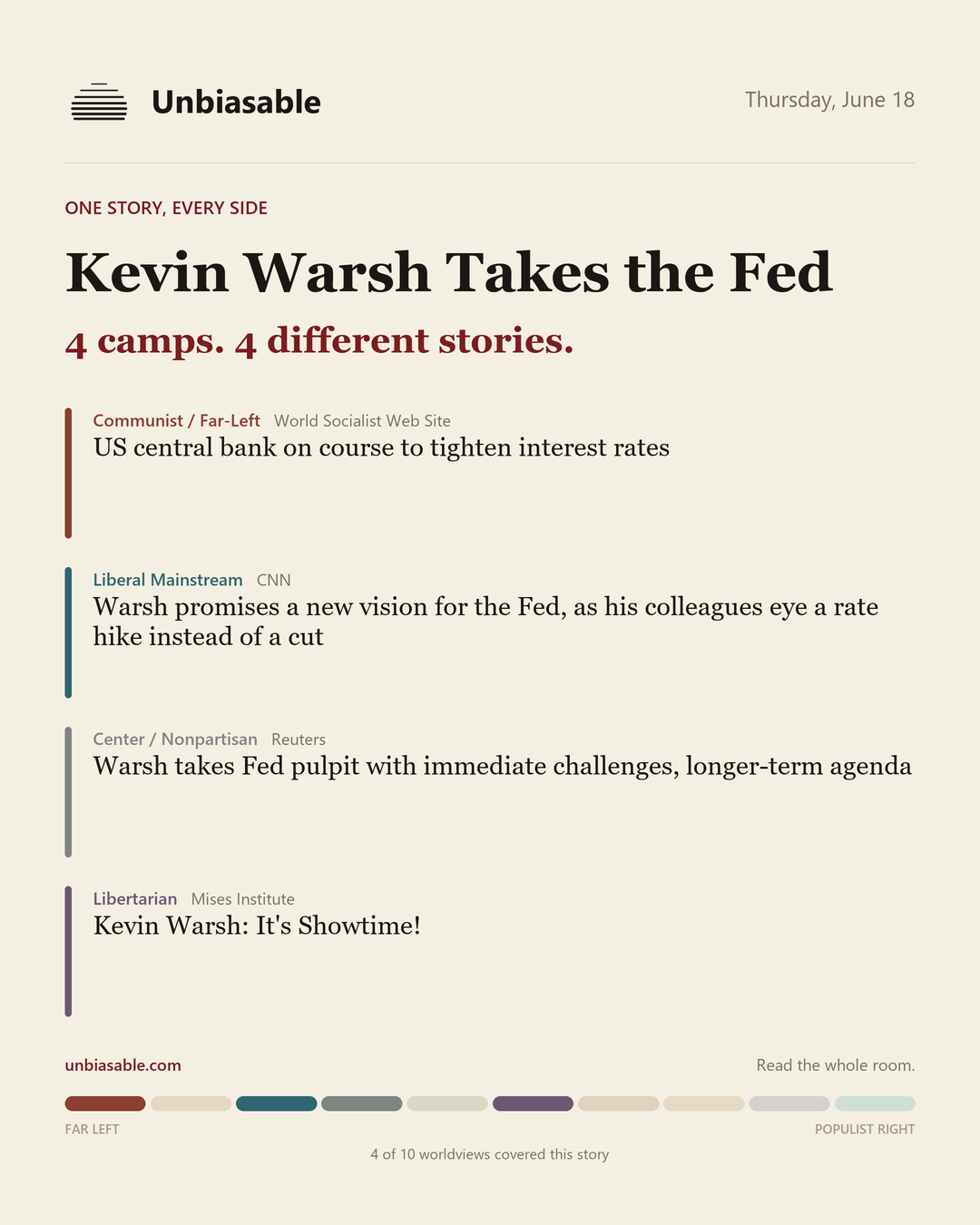
Kevin Warsh Takes the Fed
The new chair is buying time. His colleagues want to hike, his task force is delay theater, and the Supreme Court has a case pending this term that could end the Fed's operational independence entirely.
01Regional Fed presidents have signaled preference for a rate hike given post-Iran war inflation persistence. [159][180][194] The Supreme Court has a case pending this term on Fed independence. [92]2 ideologiesBBC · wire
3 source groups in today’s recordNo relevant coverage found from Democratic SocialistEstablishmentReligious Right
How each side framed it
Liberal“Warsh promises a new vision for the Fed, as his colleagues eye a rate hike instead of a cut”CNN
CNN frames this as internal institutional conflict: Warsh signals no immediate hike while the rest of the committee leans hawkish. "A new vision" versus "his colleagues" sets up a tension story rather than a policy story. The procedural drama is the frame. [71]
Warsh inherits a complex moment. His longer-term agenda involves reviewing the 2% inflation target and Fed communication practices. His first vote reflects tactical caution rather than strategic direction. No verdict. [180]
Mises frames Warsh's arrival as a stress test for the institution. "Showtime" means the task force is either the beginning of genuine monetary reform or a stalling mechanism. Mises wants a commodity-anchored system; Warsh is not that, but he is an opening. [234]
This is almost entirely a center-libertarian story. The left frames it as class policy; the center frames it as institutional transition; libertarians frame it as the opening act of a long-overdue reform. MAGA's silence is notable given Trump's history of Fed attacks. The structural story, the pending Supreme Court case that could end the Fed's independence, is the thread no outlet is pulling.
MLB Pride Night, Bible Verses, and the Christian Players
When Giants players wrote Bible verses on their Pride Month caps instead of the logo, the league reprimanded them. Every outlet covering this story is on one side of it.
Pure culture-war victory framing. The players held their ground, the league eventually backed down, Christians won the day. The Bible verse is an act of resistance against forced ideological compliance. [373]
CBN leads with the reprimand as a compelled-speech problem. The league is forcing Christian athletes to endorse a message their faith prohibits, and the reprimand is institutional suppression of sincere religious expression. [379]
The Christian Post uses Wiener's word "defaced" to illustrate the cultural shift: a California legislator framing a Bible verse as property damage. The juxtaposition is the story. [389]
This story exists almost entirely inside the right half of the spectrum. Liberal, center, and left outlets are not covering it; LGBTQ identity outlets are not covering the MLB incident specifically, focusing instead on WPATH, bathroom bans, and Idaho. The Identity split that would be most revealing, how LGBTQ media and evangelical media frame the same event, is absent today. What's present is a victory narrative on the Christian right, with National Review's more cautious institutional framing as the outlier within the cluster.
The Iran MOU Through the Identity Lens, Jewish-Palestinian Split
Jewish American and Palestinian/Arab American outlets are reading the same 14 points and finding different documents. Both are right, within their own frame.
The facts2 pointscorroborated by 4 sources within Identity
01Algemeiner quotes former Trump officials and security analysts saying the deal leaves Iran's nuclear pathway and regional power intact. [437] The Forward notes the ballistic missiles are explicitly outside the agreement's scope. [486] Iran's Speaker Ghalibaf said talks "delivered more results than war."
02Netanyahu continued bombing Lebanon in defiance of ceasefire terms, drawing Trump's public rebuke. [428][477] Hezbollah, weakened militarily, is seen gaining political legitimacy from Iran's diplomatic survival. [442] Over 1,000 people have been killed in Gaza during the ceasefire period, per AP. [147]
Within Identitythe internal split · 6 standpoints
The standpoints
Jewish American“Experts, Former Trump Officials Slam US-Iran Agreement”Algemeiner.com
"Slam." The frame is Israeli security: the MOU leaves Iran's ballistic missiles intact, gives it sanctions relief, and potentially resources Hezbollah's rebuilding. Former Trump officials who supported the war now call the outcome worse than what Iran had before hostilities began. [437]
Forward reads the deal as a tradeoff: Iran keeps its missile program, the delivery system for any future weapon, gets financial relief, and gives up the weapon itself. With what verification? The framing is strategic-skeptical rather than politically aligned. [486]
Mondoweiss frames Netanyahu's defiance as self-defeating. By continuing Lebanon strikes after the ceasefire, he antagonized the one patron that could protect him. The domestic revolt reflects Israeli public exhaustion with a war Netanyahu pushed for and the US is now ending over his objections. [477]
The axis is: who is the deal's real loser, Iran or Israel? Jewish American outlets read it as a threat to Israeli security because it resources Iran's regional allies without resolving the nuclear question. Palestinian/Arab outlets read it as Netanyahu's defeat and Iran's diplomatic survival. Both readings are coherent within their own frame; neither is propagandistic. The blind spot both share: Gaza itself has been "disappeared from the news" by the Iran narrative, as CounterPunch notes [8], while 1,000 more people have died there. Neither the Algemeiner nor Mondoweiss is covering that number today.
Tech/AI, Anthropic vs. the White House, and a Public That's Checked Out
The White House wants AI it can control. Anthropic said no. And 84% of Americans think AI is either harmful or irrelevant to their lives.
The facts2 pointscorroborated by 3 sources within Tech / AI
01The White House pressured Anthropic to modify its "Fable" AI model for government use.
02Anthropic declined on safety grounds, triggering a public dispute over whether AI companies owe government clients custom models on demand. [557] Separately, Anthropic discovered it was subject to AI export control rules that are unclear and unevenly applied, potentially limiting international deployment of its models. [554] New polling shows only 16% of Americans believe AI will have a positive impact on society, and two-thirds think it is advancing too quickly. [544][555]
Within Tech / AIthe internal split · 6 standpoints
The standpoints
hype-critical“Vibe-decoding the White House-Anthropic fight over Fable”The Verge
The fight is less about Fable's technical merits and more about whether the White House expects AI companies to behave as government contractors, building what they're told rather than what they think is safe. Anthropic's refusal is unusual because the industry norm has been to accommodate government requests. The Verge's "vibe-decoding" signals they read this as a cultural negotiation as much as a policy one. [557]
Gary Marcus's frame: the administration doesn't understand what it's asking. The "control" it wants over AI behavior is not achievable with current architectures. The fight is happening in a conceptual vacuum where policymakers believe AI safety is a dial that companies are simply refusing to turn. [526][554]
The geopolitical view: other governments want access to US-built AI but demand assurances that Washington can't use it as a kill switch. The export control issue and the Anthropic fight are both symptoms of the same tension. AI has become a strategic asset that no other country wants to depend on without autonomy guarantees. [538]
The most underreported number in tech media today. Only 16% positive. An industry whose business model depends on public trust is watching that trust erode in real time. None of today's AI-company coverage engages with why. [544]
The internal Tech/AI split today: hype-critical outlets (The Verge, Futurism, 404 Media, Marcus) see a governance crisis where policymakers don't understand the technology and the public has stopped trusting it. Optimist outlets (Slow Boring on housing, TechCrunch on geopolitics) see the same landscape as a set of solvable policy problems. The public opinion numbers are the pivot point both sides are avoiding. A technology can't be a liberation story while 84% of Americans are skeptical or hostile, but that is where the industry currently is.
Power & Interests
The Iran MOU's sanctions relief provisions are legally constrained by CISADA, which requires congressional approval that a fractured Senate is unlikely to provide. Arab Gulf states, rather than US defense contractors, were the primary lobbying force against resuming military operations: their oil infrastructure and Strait economics gave them more leverage over the timeline than the domestic war lobby. (ABC News) [239]›
The $300 billion reconstruction pledge Trump cited publicly is not supported by the leaked MOU text. [52] Iranian negotiators may have understood the deal differently than the White House represented it, a gap that could destabilize the 60-day window before formal negotiations begin.›
ICE's new detention regulations, released this week, explicitly benefit for-profit prison companies by expanding criteria for holding detainees in private facilities. [46] The Minneapolis indictment, announced the same week, fits a coordinated pattern: legal observers and organizers are charged under statutes designed for violent interference, not presence and documentation, while detention industry profits expand.
The Education Department transfers do not reduce federal spending. They move functions to agencies with weaker enforcement track records for education law. [48][144] The beneficiaries are states and districts seeking to avoid IDEA compliance scrutiny, and the administrative diffusion makes accountability harder to trace.›
Truthout reports the Trump administration admitted in a federal court filing to using Grok AI in operational Iran targeting decisions. [54] If accurate, this is the first known admission of AI-assisted targeting in a US military operation. No other outlet has picked it up today.





 “IS THIS THE END OF MAGA?”
HasanAbi
“IS THIS THE END OF MAGA?”
HasanAbi
 “Republicans in Washington on edge over Iran deal as Trump touts its merits”
NBC News Politics
“Republicans in Washington on edge over Iran deal as Trump touts its merits”
NBC News Politics
 “What's in the US-Iran agreement?”
BBC News
“What's in the US-Iran agreement?”
BBC News
 “Vance, skeptical of foreign wars, becomes the face of Trump's tentative deal to end war with Iran”
Associated Press
“Vance, skeptical of foreign wars, becomes the face of Trump's tentative deal to end war with Iran”
Associated Press

 “Gingrich Applauds Trump's Iran Agreement”
Breitbart News
“Gingrich Applauds Trump's Iran Agreement”
Breitbart News


 “What's in the agreement to end the U.S. war in Iran, according to a U.S. official”
PBS NewsHour - Politics
“What's in the agreement to end the U.S. war in Iran, according to a U.S. official”
PBS NewsHour - Politics