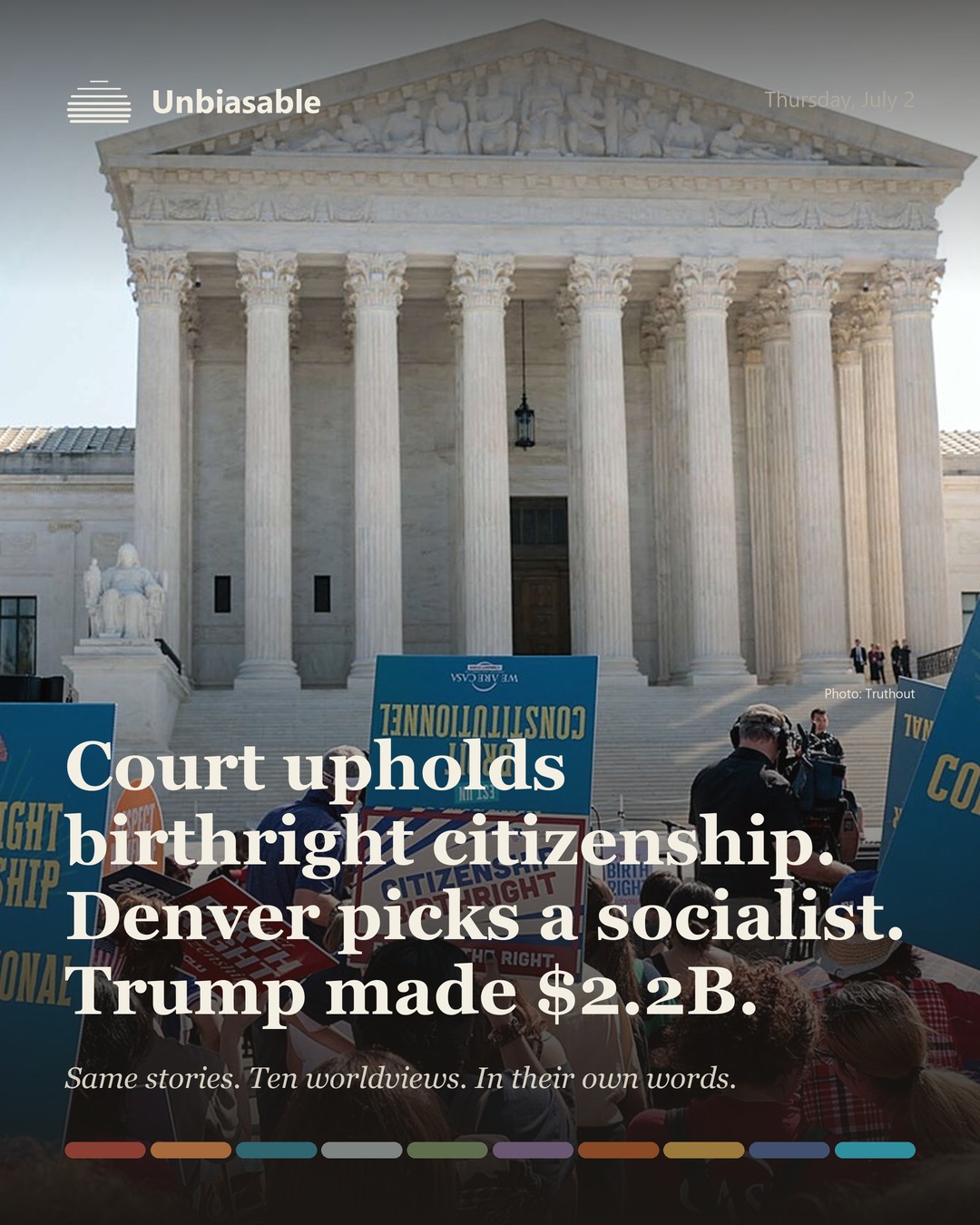
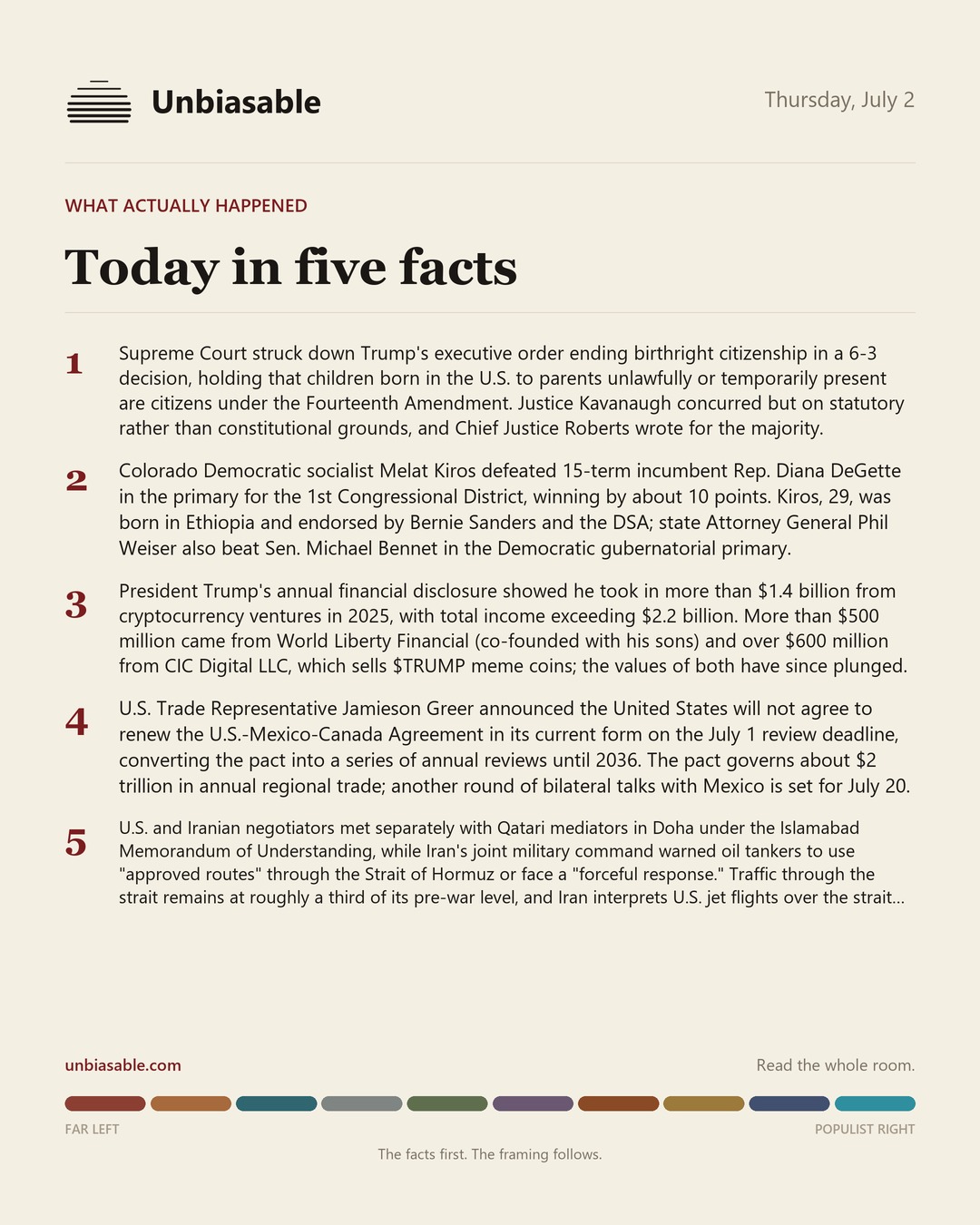
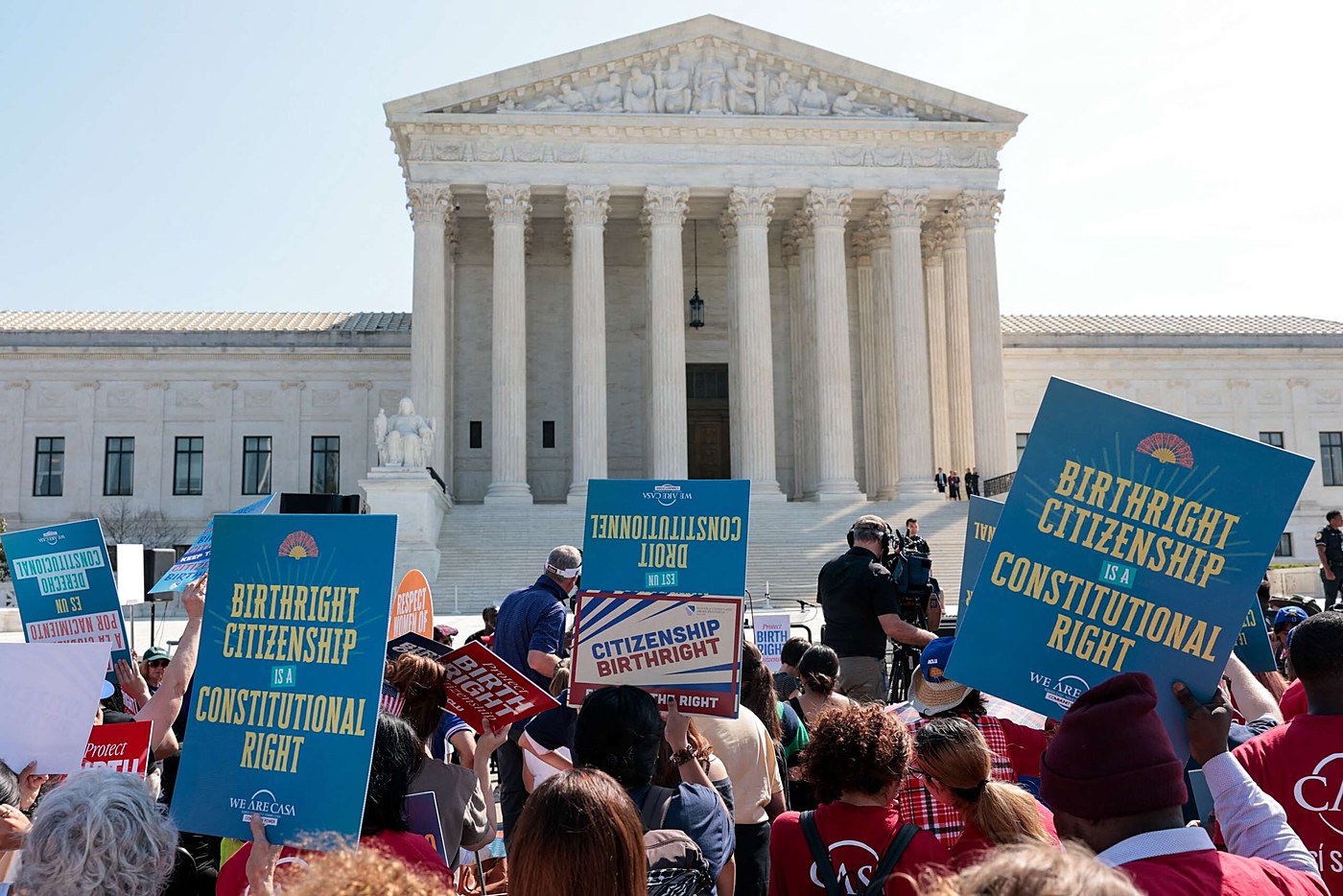
“But fear and politics, it seems, drove the specious legal reasoning of the “conservatives” who joined the court’s three liberals in killing President Donald Trump’s executive order ending squatter rights citizenship.”
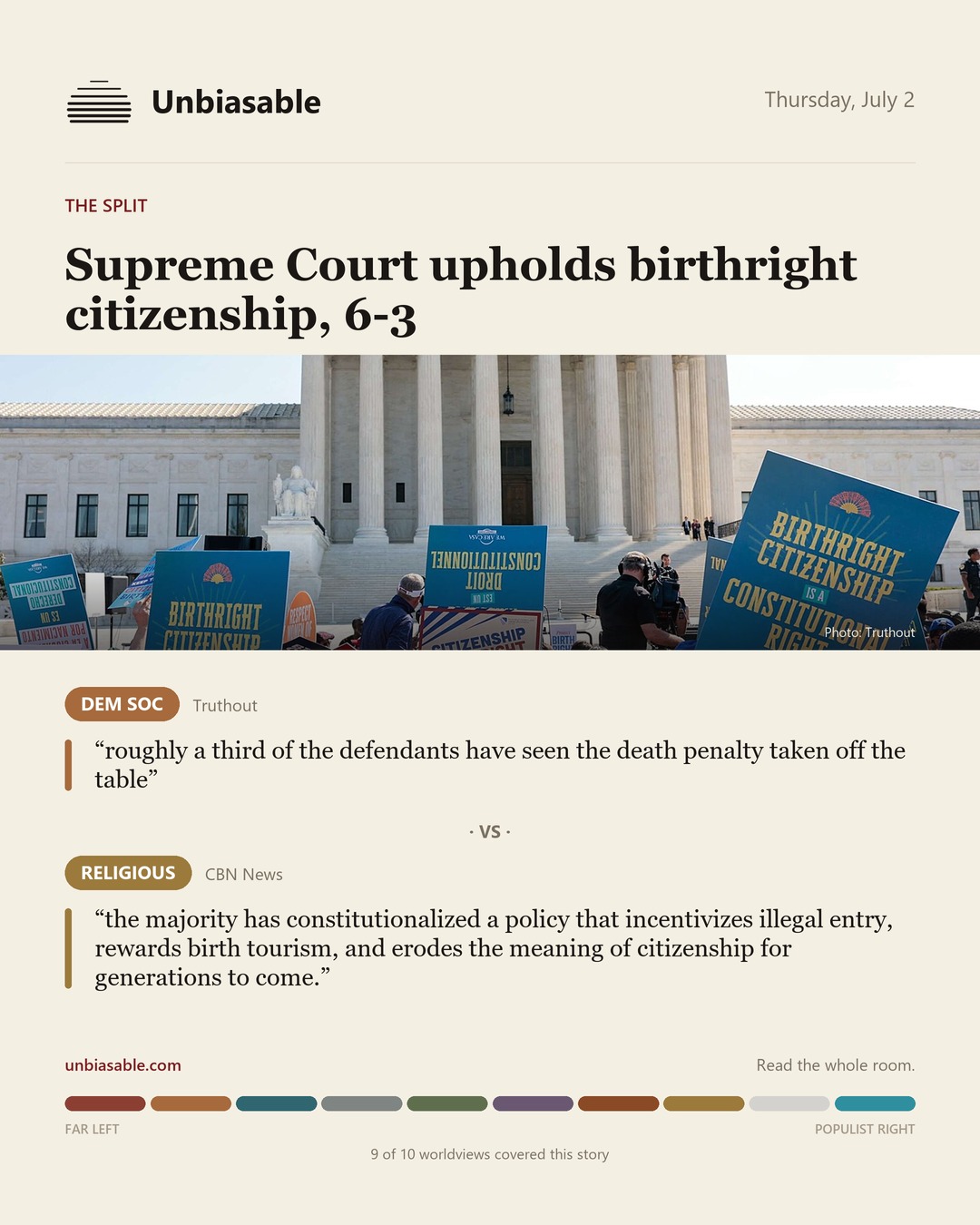
The story Supreme Court upholds birthright citizenship, 6-3
The split MAGA outlets called the ruling a "legal abomination" driven by "cowardice" from Roberts, while liberals called it "the promise" that "every free-born person in this land" would have "the right to have rights". - The through-line: Five justices affirmed that the plain text of the Fourteenth Amendment guarantees citizenship to nearly everyone born on U.S. soil, and neither Congress nor the president can override that reading by executive order, the current fight has moved to enforcement and to future legislative and constitutional efforts. ---
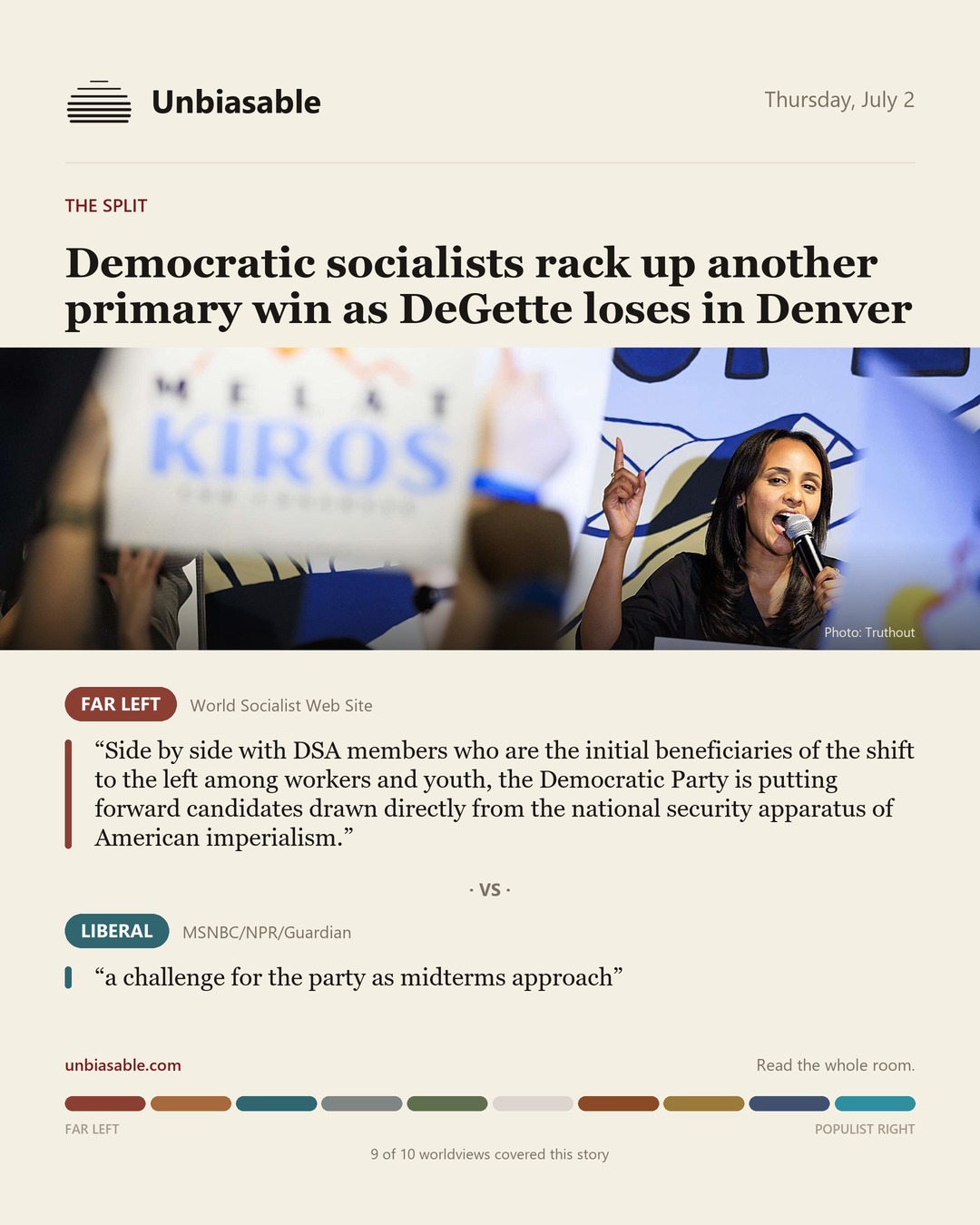
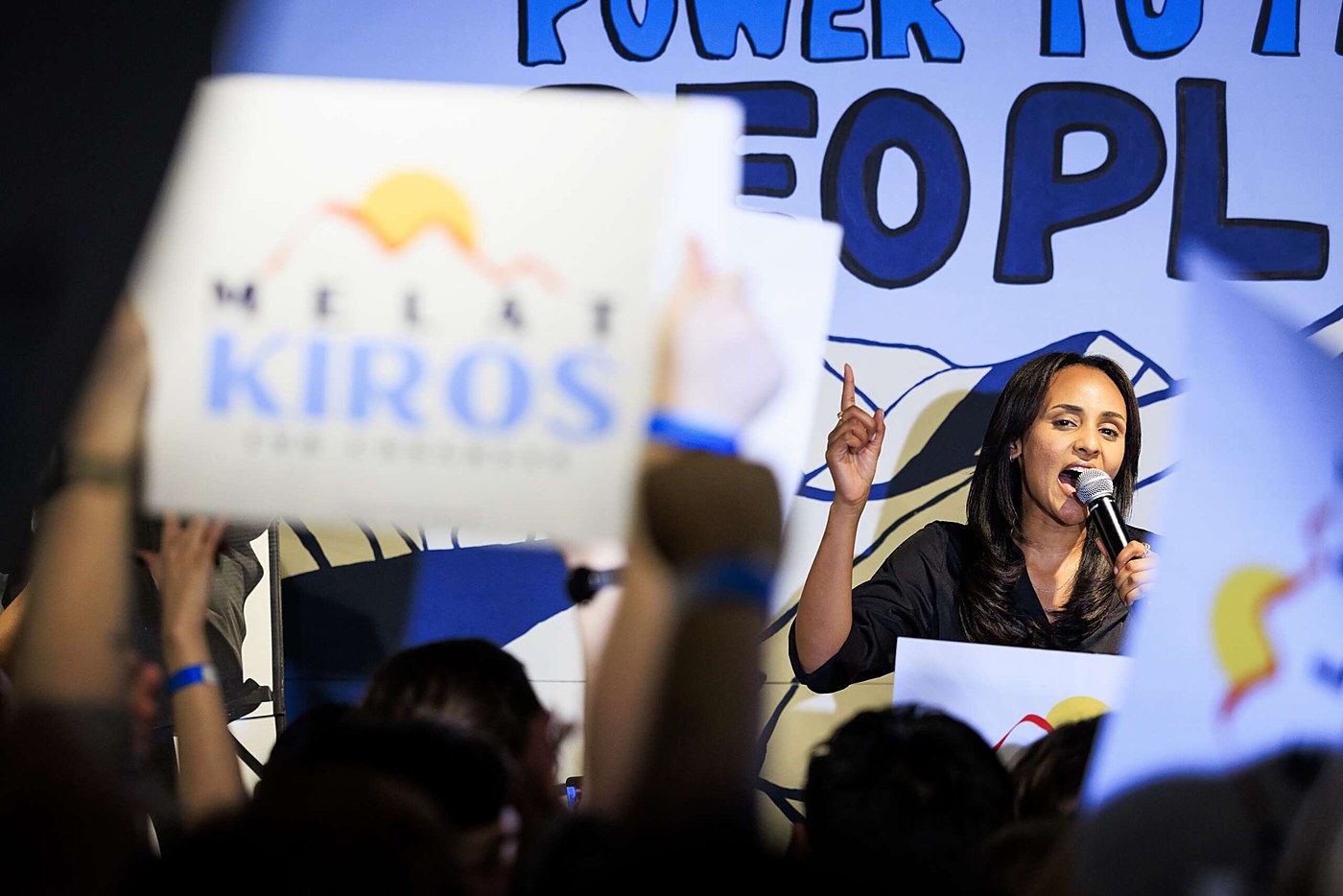
The insurgent left is now taking down safe-seat Democrats who have voted progressive for decades, and party leaders have no clear response.
The split Democratic socialists called the wins a "movement" against "the oligarchy"; the Republican right called them proof that "the Democratic Party is being taken over by a wing that includes the effective defenders of the attacks on the United States on 9/11"; establishment liberals mostly declined to attack the winners while insisting the results don't apply nationally.
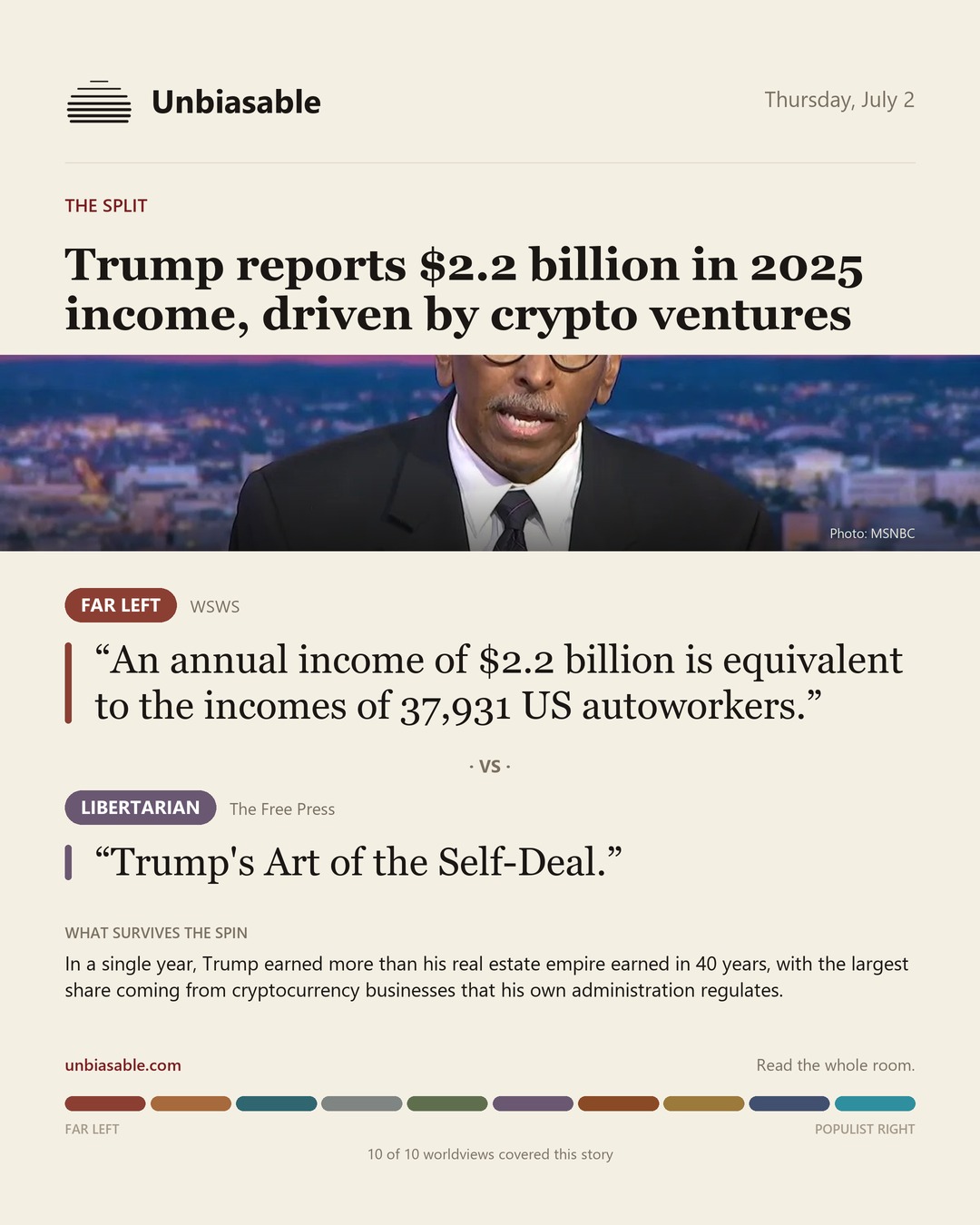
The scale of the president's crypto haul dwarfs his real estate empire, and much of it comes from businesses his own administration regulates.
The split Liberal outlets called it "the biggest grift in American history" and corruption pure and simple; center outlets called it "quaint" compared to Teapot Dome, but noted the sheer scale of the enrichment; MAGA outlets did not engage with the specifics.
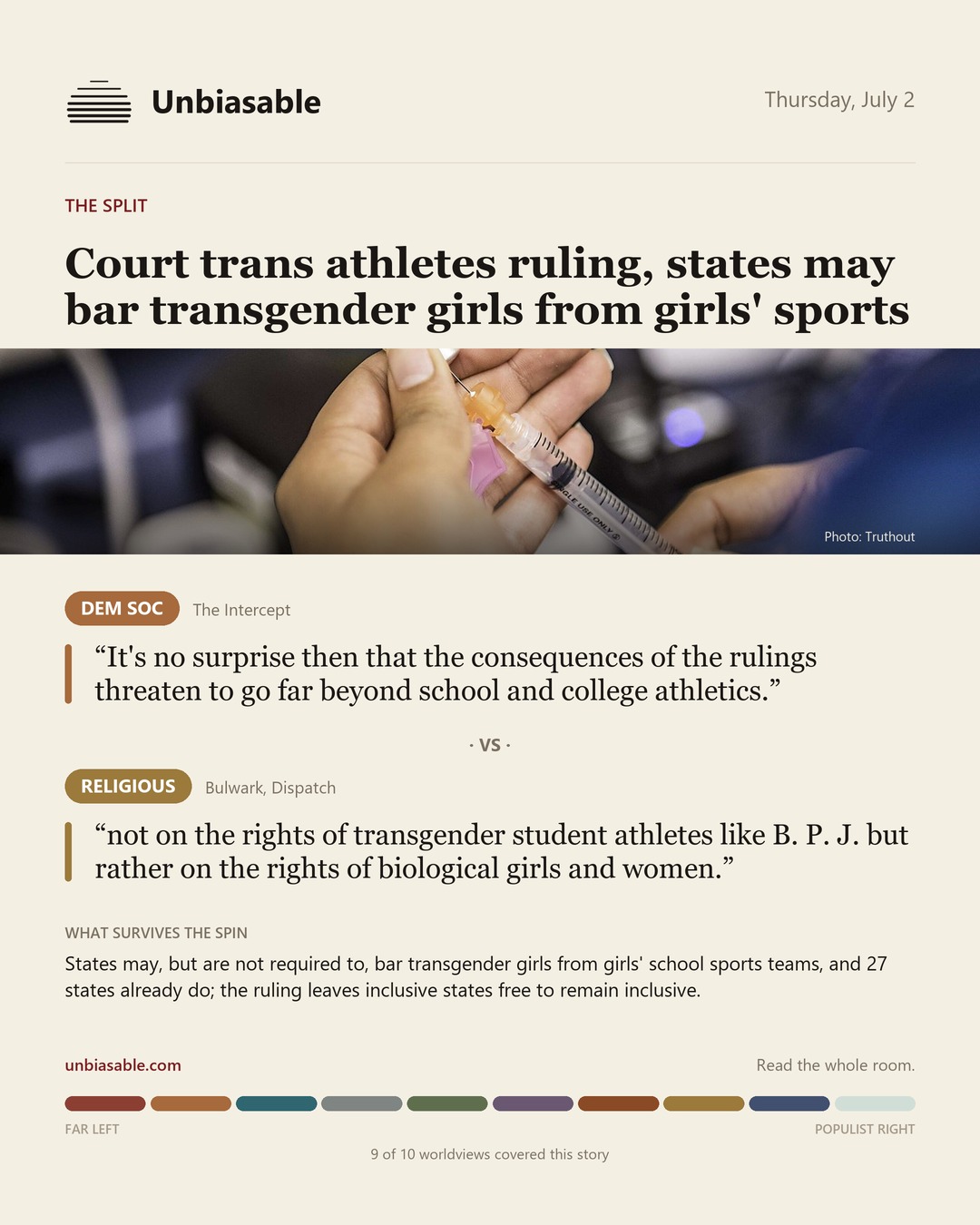
The Court kept its ruling narrow but stripped a legal shield that had protected trans students in more than two dozen states.
The split The Religious Right and Center-Right called the ruling "a landmark victory for common sense"; LGBTQ outlets said Kavanaugh's plea not to "ostracize or vilify" trans kids was contradicted by "the entire weight of a ruling that just told the country, in the clearest terms possible, that these children are different enough to be legislated out of the gym".
Diplomats met with mediators but not directly; meanwhile Israeli officials threatened a "third preemptive strike" and Trump reviewed options for renewed U.S. bombing.
The split Liberals called the MoU "a mess" that might work through Iranian economic pressure; libertarians and socialists said Vance admitted the goal was to "refill" markets before another round; Israel said it may attack Iran a "third time."
The 32-year North American trade project is not dying, but it just entered permanent annual review.
The split Trump called the USMCA "the fairest, most balanced" trade agreement in 2020 in 2026; Mexico's economy minister said "there is no difference between Mexico, the United States and Canada that is so big that we cannot resolve it". - The through-line: The USMCA is now on annual life support until 2036, and the U.S. is pursuing bilateral deals with Mexico first, a structural change that leaves Canada exposed. ---
The 6-3 ruling in NRSC v. FEC effectively erased contribution limits between parties and their own candidates.
The split Liberal Mainstream outlets called the ruling "a win for both parties, and wealthy donors"; MAGA outlets celebrated the removal of "post-Watergate" restrictions.
The IDF is expanding territorial control despite a signed ceasefire; Katz threatens Iran; Palestinians mark 1,000 days.
The split the religious right led with "Netanyahu visits IDF troops in Lebanon."; the democratic-socialist left led with "A predatory state."; . - The through-line: Despite a signed October 2025 ceasefire, the IDF continues to expand territorial control in Gaza and remain in Lebanon, and Israeli officials are openly saying the goal is 100% control. ---.
Stories: what happened, what was argued, and who said it
New today
Supreme Court upholds birthright citizenship, 6-3
The Court's conservatives split, one wing decided the case, another dissented, leaving the outcome secure but the doctrine unsettled.
The split MAGA outlets called the ruling a "legal abomination" [421][435] driven by "cowardice" from Roberts [435], while liberals called it "the promise" that "every free-born person in this land" would have "the right to have rights" [100][234]. - The through-line: Five justices affirmed that the plain text of the Fourteenth Amendment guarantees citizenship to nearly everyone born on U.S. soil, and neither Congress nor the president can override that reading by executive order, the current fight has moved to enforcement and to future legislative and constitutional efforts. [234][391] ---
Missing from all 99 sources we read todaysustained engagement with why 100,000+ Chinese and Russian "birth tourism" babies represent a comparably tiny share of a phenomenon that overwhelmingly involves working-class families of migrants from Latin America.
7 source groups in today’s recordNo relevant coverage found from Tech
The facts7 points
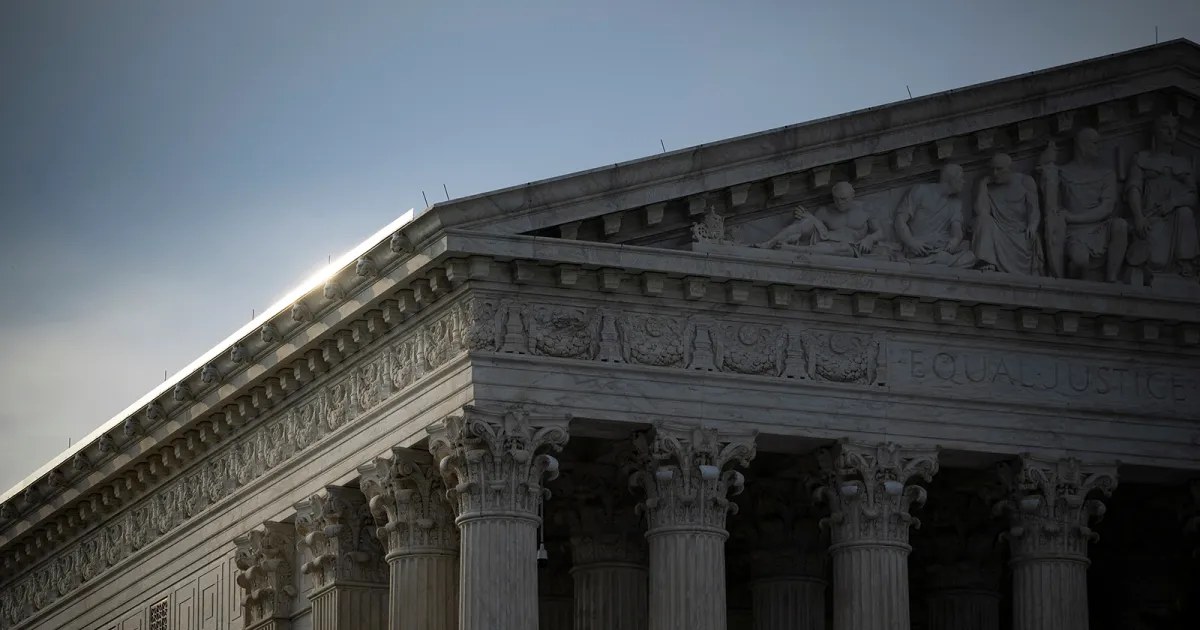
01The Supreme Court decided Trump v. Barbara, No. 25-365, on June 30, 2026, striking down Executive Order 14160, which sought to deny citizenship to children born in the U.S. to parents unlawfully or temporarily present; the vote was 6–3 (Supreme Court slip opinion).
02Chief Justice John Roberts authored the majority opinion on Fourteenth Amendment grounds, joined by Justices Barrett, Sotomayor, Kagan, and Jackson; the majority held that such children are "subject to the jurisdiction" of the United States and are citizens at birth under the Fourteenth Amendment's Citizenship Clause (Supreme Court slip opinion; Constitution Center).
03Justice Kavanaugh concurred in the judgment only on statutory grounds, concluding the executive order violated 8 U.S.C. §1401(a) (the Immigration and Nationality Act of 1952), but explicitly declined to join the constitutional holding and wrote that Congress could, consistent with the Fourteenth Amendment, legislate new exceptions to birthright citizenship (Supreme Court slip opinion; Constitution Center).
Show 4 more factsShow fewer
04Justices Thomas, Alito, and Gorsuch each wrote separate dissenting opinions; Alito called the decision "a serious mistake" and warned of "grotesque results" including encouragement of "birth tourism" (The Hill).
05The executive order, signed January 20, 2025 (Trump's first day in office), was designated Executive Order 14160 (Wikipedia – Trump v. Barbara).
06Following the ruling, Trump posted on Truth Social: "The Supreme Court upheld Birthright Citizenship, which is too bad for our Country, but we can easily make it up in Congress through Legislation" (CBS News).
07The Justice Department issued a memo directing federal prosecutors nationwide to prioritize investigation and prosecution of "birth tourism schemes," citing potential federal crimes including visa fraud, wire fraud, money laundering, identity theft, and healthcare fraud (The Hill).
ContextChief Justice Roberts's majority reaffirmed the 1898 precedent in United States v. Wong Kim Ark, which established that children born on U.S. soil to non-citizen parents are U.S. citizens (PBS).
How outlets handled it7 source groups · original passages and links▾
“The Trump regime's attack on migrants, refugees, and undocumented people has been the central political strategy of the MAGA movement to activate and mobilize white nationalism, to tear down the existing legal architecture of past civil rights gains, and to weaponize the state to attack political opponents and repress popular resistance.”Truthout · arguing the birthright ruling is one battle in a longer campaign to dismantle civil rights infrastructure, not a final defeat of that project
“The defeat of his effort is attributable not to the public opposition from Democrats, who remain tacit and on the sidelines of the issue, but from within the ranks of the Republican Party itself.”Truthout · indicting Democrats as complicit bystanders while crediting Republican defection, not liberal resistance, for the ruling
Truthout framed the ruling as a partial reprieve that changes little about the machinery of deportation, arguing that Trump was "banking on a majority right-wing Supreme Court" and will now "set the stage for ending birthright citizenship under more favorable conditions" through judicial appointments.
“Its case against birthright citizenship was always an unconstitutional shot in the dark, a bad-faith reading of the 14th Amendment motivated by two things: racism and xenophobia.”MSNBC · framing the Trump administration's legal theory not as a contestable interpretation but as bad-faith racism from the start
“If this country one way or another doesn't end birthright citizenship, this country doesn't have a future. Citizenship has to be sacred and precious.”Stephen Miller, White House deputy chief of staff, quoted by MSNBC · signaling the administration will pursue further challenges despite the ruling, casting the fight as existential
“We're fighting for rights for all Americans because these are fundamental rights.”Norman Wong, great-grandson of Wong Kim Ark, quoted by PBS NewsHour · arguing the ruling protects constitutional rights for all Americans, not only immigrants or any single ethnic group
“Everyone who believes in the rule of law, believes in the U.S. Constitution — its durability, its strength, its potency — should breathe a little easier today”Rob Bonta, California Attorney General, quoted by PBS NewsHour · welcoming the ruling while warning that attacks on constitutional protections for immigrants will continue
The center reported the ruling procedurally, giving substantial voice to Norman Wong: "I don't consider this stuff a personal victory. It's an obligation and a duty for every American to care about this because ultimately we're not fighting for the rights of Chinese or Japanese or whatever.
Wong Kim Ark's great-grandson explicitly cast the case as a defense of "the right to have rights" for all Americans regardless of ancestry, and California AG Bonta noted he had "heard from 'hundreds' of people born in the U.S. who have been worried about being stripped of their citizenship because of a parent's immigration status.
“the second-order effects could have been catastrophic for democracy”The Bulwark · arguing that overturning birthright citizenship would have endangered democratic governance far beyond its immigration effects
The Bulwark treated the ruling as important but insufficient, warning that "the threat against birthright citizenship isn't entirely gone" and calling the second-order effects "catastrophic for democracy" if the court had gone the other way.
“the imposition of birthright citizenship takes foreign nationals—who may be in the United States for non-political economic reasons such as employment—and turns those foreign nationals into political actors”Mises Institute · arguing birthright citizenship converts private economic migrants into political participants, inflaming rather than resolving immigration conflict
“citizenship is really about the legal prerogative to participate in politics. Citizenship is about voting.”Mises Institute · reframing the debate away from rights and toward the claim that birthright citizenship is fundamentally a transfer of political power, not a humanitarian protection
"Contrary to what some self-proclaimed libertarians might say, support for private-property rights does not require support of the widespread granting of citizenship." Mises rejected both maximalist positions, arguing that granting automatic citizenship "turns foreign nationals — who may be in the United States for non-political economic…
“Roberts has sacrificed judicial courage at the twin altars of comity and continuity”The Federalist · framing Roberts' pattern of siding with liberals as a systemic character flaw across multiple landmark rulings, not a one-off judgment call
MAGA outlets treated the ruling as a betrayal by Roberts and Barrett of first principles. The Federalist argued Roberts "shows little interest in compelling originalist arguments, instead issuing shallow and misapplied but noble-sounding platitudes" and mocked his citation of "the tie created by birth" in 1688 England as ahistorical.
“What is left here is a decision for the country as to whether it wants to examine a constitutional amendment. Some countries that have had birthright citizenship got rid of it, because many of us believe it's an incredibly ill-considered policy.”Jonathan Turley, constitutional expert, quoted by CBN News · framing the ruling not as settled law but as an opening for legislating birthright citizenship out of existence entirely
“I'm sure the conclusion from this opinion is going to be that you've got to amend the Constitution to fix that. ... I think it subjects the country to serious challenges going forward, and we'll have to deal with it as a Congress”Mike Johnson, House Speaker, quoted by CBN News · signaling Republican acceptance of the ruling as a loss while pivoting immediately to a constitutional amendment strategy
The insurgent left is now taking down safe-seat Democrats who have voted progressive for decades, and party leaders have no clear response.
7 source groups in today’s recordNo relevant coverage found from Tech
The facts8 points
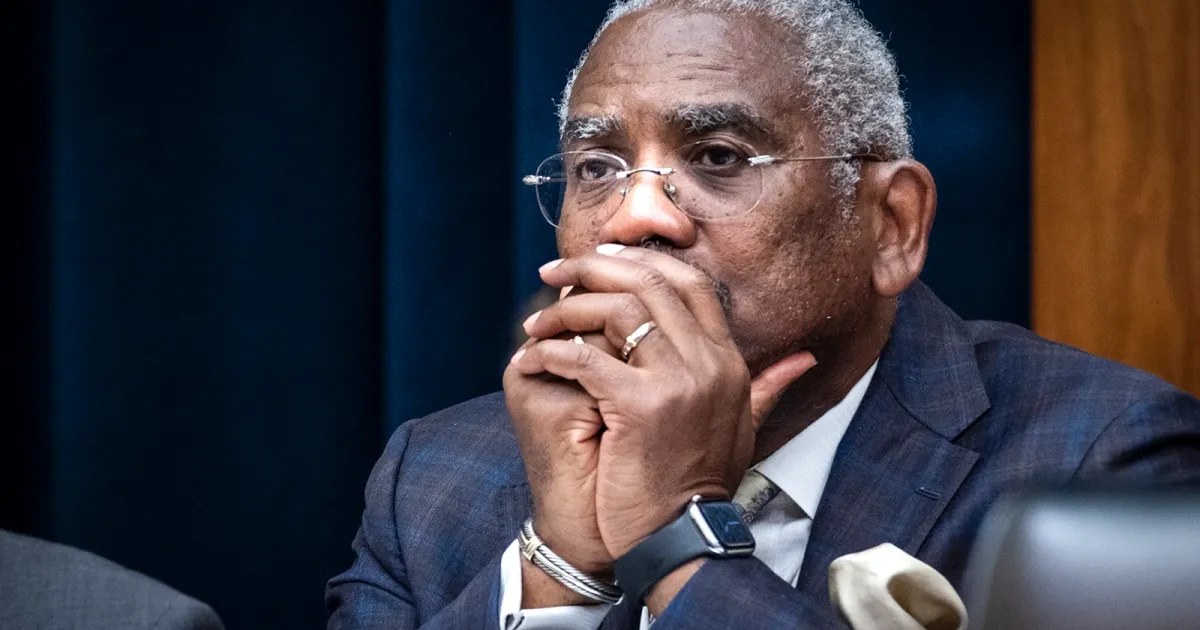
01Melat Kiros, a 29-year-old Democratic socialist and first-time candidate, defeated 15-term incumbent Rep. Diana DeGette in Colorado's 1st Congressional District Democratic primary on June 30, 2026. (Colorado Sun)
02As of noon June 30, Kiros led with approximately 51.3% to DeGette's 41.7%, with a third candidate, University of Colorado Regent Wanda James, receiving approximately 7%; the AP called the race on election night. (Colorado Newsline)
03Kiros was born in Addis Ababa, Ethiopia; her family immigrated to the United States in 1998 and she was raised in Denver. (Wikipedia)
Show 5 more factsShow fewer
04Kiros was endorsed by Bernie Sanders, Justice Democrats, and the Democratic Socialists of America. (Colorado Newsline)
05DeGette was first elected in 1996 and had served 15 terms representing Colorado's 1st District, which covers Denver. (Colorado Sun)
06State Attorney General Phil Weiser defeated U.S. Sen. Michael Bennet in the Democratic gubernatorial primary, with Weiser leading approximately 55% to 45%. (CPR News)
07Sen. John Hickenlooper defeated state Sen. Julie Gonzales in the Democratic U.S. Senate primary, with Hickenlooper receiving approximately 55.3% to Gonzales's 44.7%. (Colorado Sun)
08State Rep. Manny Rutinel won the Democratic primary for Colorado's 8th Congressional District, the state's only competitive swing seat, with approximately 61% of the vote; he will face Republican incumbent Rep. Gabe Evans in November. (CPR News)
ContextKiros is the seventh incumbent Democrat to lose a primary this cycle and the third in seven days, following two Mamdani-backed upsets in New York last week (The Guardian).
How outlets handled it7 source groups · original passages and links▾
Where each side stood today
Far LeftDSA wins prove mass radicalization, but Democrats will never become a socialist party1 source
“The victory of Kiros in Denver was the clearest expression of the growing radicalization from below which the Democratic Party is seeking desperately to restrain.”World Socialist Web Site · arguing that the party apparatus is actively working to absorb and neutralize the leftward surge rather than channel it
“This is one of the twin parties of the capitalist ruling class in America, indissolubly linked to Wall Street and the military-intelligence apparatus.”World Socialist Web Site · warning DSA voters that electing socialists into the Democratic Party cannot change its fundamental class character
WSWS treated Kiros's win as further evidence of "a shift to the left among workers and young people," but warned that the DSA is being used to channel that radicalization back into the Democratic Party.
[46] The Intercept and Truthout framed it as a repudiation of establishment Democrats who have failed to meet the moment: "party leaders are facing a surge in public frustration with their brand and a cascade of voters who say they don't wield power effectively." [46] Truthout emphasized the win as part of a national wave [63], and…
LiberalDSA string of wins creates structural tension for Democrats' path back to House majority8 sources
MSNBC/NPR/GuardianJul 2
Trying to process a wave of progressive victories. [123] Liberal outlets treated the wins as a warning to leadership but split on whether to embrace or resist.
“We're not going to flip this seat now.”anonymous Democratic strategist affiliated with a Colorado race, quoted by The Bulwark, National Review, Commentary · warning that nominating a far-left candidate in a swing district the party needs to take the House forfeits the general election
[150] The Atlantic (via Bulwark-adjacent framing) argued that "Democratic voters appear drawn to the candidates who most radiate disdain for the status quo" rather than any specific ideology.
“We are winning from coast to coast, from every level and office. We are taking back our party and our country!”Melat Kiros, Colorado Congressional Candidate, quoted by PBS NewsHour · claiming the DSA wave is a national realignment, not an isolated district result
[230] PBS covered the results as a data point, quoting Kiros's supporters and treating the win as part of a broader anti-incumbent, anti-Washington cycle. It reported the mixed results in Colorado without framing them as ideological victory: Hickenlooper survived, Weiser won not from the left but on Trump-resistance grounds.
In choosing socialists over "mainstream" Democrats, Democrats are proving that Third-World communism is the party now, writ large.Blaze News / Daily Wire / Federalist / Breitbart · outlet's own conclusion that the primaries end any remaining distinction between Democratic mainstream and socialist fringe
“A world without borders — just like a world without prisons or police — is possible, necessary, and the only moral way forward.”Darializa Avila Chevalier, DSA congressional candidate (New York), quoted by Blaze News, Daily Wire, Federalist, Breitbart · cited alongside Kiros to argue the socialist wave holds positions that were fringe across both parties a generation ago
[428] The Federalist explicitly celebrated the Democratic drift, arguing "the string of socialist victories across the country shows that the ideas many thought were once confined to the fringe of the Democratic Party are no longer fringe." [428] Blaze News framed Kiros as "Mamdani-like" [356], and the Daily Wire zeroed in on her 9/11…
In a single year, Trump earned more than his real estate empire earned in 40 years, with the largest share coming from cryptocurrency businesses that his own administration regulates. [229][75]
The split Liberal outlets called it "the biggest grift in American history" [331] and corruption pure and simple [105]; center outlets called it "quaint" [28] compared to Teapot Dome, but noted the sheer scale of the enrichment [229]; MAGA outlets did not engage with the specifics.
Missing from most of the 99 sources we read todayany serious examination of how the $500 million UAE investment intersects with U.S. chip export policy.
5 source groups in today’s recordNo relevant coverage found from LibertarianMAGAReligious RightIdentity
The facts7 points
01Trump's 2025 annual financial disclosure, filed with the U.S. Office of Government Ethics (OGE) and released June 30, 2026, totals 927 pages and reports more than $2.2 billion in income for calendar year 2025, up from $622 million reported for 2024. (OGE filing) (NBC News)
02Crypto-related income totaled at least $1.4 billion, making it the largest single income category in the filing; it includes approximately $635 million in meme-coin royalties via CIC Digital LLC and over $500 million from World Liberty Financial (WLFI) token and equity sales. (NBC News) (CNBC)
03World Liberty Financial was co-founded with Donald Trump Jr., Eric Trump, and Barron Trump listed as co-founders; Trump is listed as "co-founder emeritus." (Forbes)
Show 4 more factsShow fewer
04A firm linked to the UAE government purchased a 49% stake in World Liberty Financial for $500 million in a deal signed by Eric Trump on January 16, 2025, days before Trump's inauguration. (The Hill)
05Trump's golf resorts and clubs reported more than $500 million in combined revenue for 2025, a roughly 15% increase; Mar-a-Lago alone reported $77.5 million, and Trump National Doral reported $122 million. (CNBC)
06The filing acknowledges late-filing fees were paid for previously undisclosed transactions and states that licensing agreements covering Trump-branded watches, sneakers, and fragrances were "inadvertently omitted" from his prior annual report. (JURIST)
07The WLFI token declined approximately 75–91% from its peak trading price; the TRUMP meme coin declined approximately 91% from its peak, per exchange data. (MEXC)
ContextTrump's 2025 income of over $2.2 billion is more than three times what he reported in 2024, when he made $622 million (PBS NewsHour).
How outlets handled it5 source groups · original passages and links▾
The source record
Far Left“An annual income of $2.2 billion is equivalent to the incomes of 37,931 US autoworkers.”2 sources
“In the same year, labor's share of the national income fell to its lowest level since records began.”WSWS · juxtaposing Trump's income explosion against the steepest recorded collapse in workers' share of national income, framing them as two sides of the same transfer
“An annual income of $2.2 billion is equivalent to the incomes of 37,931 US autoworkers, according to the Bureau of Labor Statistics' estimate of the average autoworker's wage, based on a 40-hour workweek.”WSWS · translating the abstract figure into a class-ratio to argue Trump's enrichment comes directly at workers' expense
[28] WSWS placed the disclosure in the context of "labor's share of the national income" falling to its lowest since records began (53.8% in Q3 2025 vs. 70% in 1947), calling Trump "the U.S.
LiberalMethodical audit of Trump crypto scale and vanished ethics guardrails, foregrounding undisclosed buyers5 sources
CNN, MSNBC, BBC, NBC, NPR, GuardianJul 2
“The speed is breathtaking.”Bernard Condon, AP journalist, quoted by CNN, MSNBC, BBC, NBC, NPR, Guardian · summarizing that Trump earned more from crypto in roughly one year than from decades of property development, signaling the unprecedented pace of presidential self-enrichment
“any sort of reluctance to strike a deal that could seem like he's profiting off the presidency is gone”Bernard Condon, AP journalist, quoted by CNN, MSNBC, BBC, NBC, NPR, Guardian · contrasting Trump's second term against his own first-term self-imposed ethics limits, arguing all guardrails have been abandoned
[75] The BBC's approach was inventory-focused, the "Six Takeaways" listed the perfumes, guitars, and Bible sales as though Trump were a lifestyle brand [215].
“it is really intensely tied up with a foreign government. And the president is profiting from that foreign government's investment in his own business at the same time as he is acting as commander in chief and working with that foreign government to negotiate a war in the Middle East.”Eric Lipton, investigative journalist, The New York Times, quoted by PBS NewsHour · arguing Trump's World Liberty Financial stablecoin, half-owned by UAE, creates a direct conflict while he mediates Middle East diplomacy
“We just -- there's nothing like this in American history.”Eric Lipton, investigative journalist, The New York Times, quoted by PBS NewsHour · characterizing the breadth of income sources flowing to a sitting president as historically unprecedented
chips previously restricted on national security grounds, and to the pardon of Binance's Changpeng Zhao. [229] The Center-tier coverage did not editorialize but presented the pattern: policy decision, then business benefit.
States may, but are not required to, bar transgender girls from girls' school sports teams, and 27 states already do; the ruling leaves inclusive states free to remain inclusive. [503][598]
The split The Religious Right and Center-Right called the ruling "a landmark victory for common sense" [455]; LGBTQ outlets said Kavanaugh's plea not to "ostracize or vilify" trans kids was contradicted by "the entire weight of a ruling that just told the country, in the clearest terms possible, that these children are different enough to be legislated out of the gym" [505].
Missing from most of the 99 sources we read todayengagement with the reality that fewer than 10 collegiate athletes are openly transgender per NCAA testimony to Congress in late 2024. [136]
7 source groups in today’s recordNo relevant coverage found from CommunistTech
The facts8 points
01The Supreme Court ruled 6-3 on June 30, 2026, that states may bar transgender girls and women from competing on girls' and women's school sports teams, upholding laws from West Virginia and Idaho. (SCOTUSblog)
02The decision consolidated West Virginia v. B.P.J. (No. 24-43) and Little v. Hecox; the official opinion was issued June 30, 2026. (Supreme Court)
03Justice Kavanaugh wrote the majority opinion, joined by Chief Justice Roberts and Justices Thomas, Alito, Gorsuch, and Barrett; Justices Sotomayor, Kagan, and Jackson dissented. (SCOTUSblog)
Show 5 more factsShow fewer
04The majority held that states' sex-based classification limiting women's and girls' sports to biological females is "substantially related" to the state interests of safety and competitive fairness under Equal Protection analysis. (Supreme Court opinion)
05Kavanaugh wrote that "no student-athlete on either side of the issue, whether a biological female or transgender, deserves to be ostracized or vilified." (NPR)
06The ruling permits but does not require states to impose such bans; states without bans, such as Illinois, stated they will continue to allow transgender students to participate consistent with their gender identity. (WBEZ)
0727 states had enacted laws restricting transgender athletes from competing on teams consistent with their gender identity at the time of the ruling. (NPR)
08NCAA President Charlie Baker said the NCAA does not plan to change its current rules, which already align with the Trump administration's standard. (CBS News)
ContextThe 6-3 ruling in West Virginia v. B.P.J. and Little v. Hecox affirms sports bans already on the books in 27 states; the Court did not require states to adopt such bans (Advocate).
How outlets handled it7 source groups · original passages and links▾
The source record
Democratic SocialistThe Intercept argued the concurring opinion by Sotomayor accepted the premise that biological sex justifies separate teams, and that this concession will be…1 source
[49] The Intercept argued the concurring opinion by Sotomayor accepted the premise that biological sex justifies separate teams, and that this concession will be used in future cases. "It's no surprise then that the consequences of the rulings threaten to go far beyond school and college athletics."
LiberalNCAA already complies with federal standard; state variation is a separate matter4 sources
Liberal outlets emphasized the 6-3 pattern and the term's overall drift on trans issues, noting that lower courts had ruled against these bans. Coverage focused on the ruling's practical effect in the 27 states with existing laws and the political trajectory since the Trump executive order.
PBS, CBSJul 2
“the most important thing about it is to have a clear policy and to have one that is consistent with federal policy, because that eliminates … all the gray with respect to how this should be dealt with.”Charlie Baker, NCAA President, quoted by PBS, CBS · explaining why the ruling changes nothing for the NCAA, which aligned its policy with Trump's executive order the day after he signed it
The center emphasized the narrowness and the institutional response. CBS quoted NCAA head Baker: "our national standard is going to be what we expect our schools to use with respect to eligibility issues for college sports.
“Allowing a biological male athlete to compete on a girls' team necessarily displaces or disadvantages a female athlete—replacing her on the roster, knocking her out of the starting lineup, reducing her playing time, depriving her of a medal and the like”Justice Brett Kavanaugh, quoted by Reason · majority opinion naming the concrete competitive harms to female athletes that justify state bans under Title IX and the Equal Protection Clause
“This strikes me, more broadly, as a win for fairness.”Liz Wolfe, Reason · endorsing the ruling on competitive-fairness grounds while acknowledging other libertarians may reach a different conclusion
[323] Reason's Liz Wolfe endorsed the ruling but noted "other libertarians' mileage may vary." She emphasized the epistemic problem: "much of the case ... hinged on the meaning of biological male."
MAGARuling triggers red-state bans and blue-state pledges, creating a national patchwork2 sources
Breitbart, CBS, BlazeJul 2
“When a law bars every transgender girl regardless of age, hormones, or physiology, it isn't about competitive fairness. It's about keeping transgender kids out.”Jennifer Levi, senior director of transgender and queer rights at GLAD Law, quoted by Breitbart, CBS, Blaze · arguing the ruling's blanket bans go beyond competitive fairness to categorical exclusion of trans students
“This is a monumental victory for every female athlete who has ever competed, or dreamed of competing, on a fair and safe playing field.”J.B. McCuskey, West Virginia Attorney General, quoted by Breitbart, CBS, Blaze · framing the ruling as restoring fairness for girls rather than targeting trans students
Sarah McBride's admission that Trump's "they/them" ad worked because we remained silent. [368]
Religious RightCourt rightly protects biological female athletes; Christians must uphold God's design while loving trans neighbors5 sources
Bulwark, DispatchJul 2
“We can and should remain firmly committed to the truth of God's design for men and women, plainly and without equivocation.”Daniel Bennett, author, quoted by Bulwark, Dispatch · calling Christians to treat the ruling as confirmation of biblical sex categories while still treating transgender people with dignity
[457] The Dispatch's Daniel Bennett argued that the Court is now "prepared to confront these thorny issues head-on" and framed the ruling as centered "not on the rights of transgender student athletes like B. P.
“Every trans kid in West Virginia is able to play sports under this law. This is not a ban on sports. This is a law that makes sure that all of the participants are provided with a fair and safe place to play.”J.B. McCuskey, West Virginia Attorney General, quoted by CBN, Christianity Today · reframing the law as inclusive fairness rather than anti-transgender exclusion
“Had the Court read gender identity into Title IX, faith-based organizations across the country would have been dragged into court for their beliefs.”Laura Wolk Slavis, counsel at Becket Fund for Religious Liberty, quoted by CBN, Christianity Today · connecting the sports ruling to a broader religious freedom stake rarely raised in secular coverage
[455] CBN quoted West Virginia AG McCuskey: "It is not anti-trans.
IdentityKavanaugh's hollow decency language launders deliberate, foreseeable cruelty toward trans children3 sources
Advocate, Washington BladeJul 2
Asking the public to be kind to a group you just whacked in the head isn't protection. It's the legal equivalent of taking something away and saying "no hard feelings" on the way out the door.The Advocate, quoted by Advocate, Washington Blade · contending Kavanaugh's compassionate language actively obscures and enables the harm his vote caused
[505] The Advocate's John Casey called Kavanaugh's plea not to "ostracize or vilify" trans kids "the legal equivalent of taking something away and saying 'no hard feelings' on the way out the door." [505] The Advocate emphasized that the ruling does not create a nationwide ban and that "many states have developed thoughtful…
Diplomats met with mediators but not directly; meanwhile Israeli officials threatened a "third preemptive strike" and Trump reviewed options for renewed U.S. bombing.
Missing from most of the 99 sources we read todayany serious examination of whether Iran's nuclear program is actually being wound down or being reconstituted covertly.
7 source groups in today’s recordNo relevant coverage found from Tech
The facts8 points
01U.S. and Iranian negotiators held two days of indirect talks in Doha, Qatar, meeting separately with Qatari mediators rather than directly with each other; Qatar described the talks as showing "positive progress," and both sides agreed to resume after funeral ceremonies for Ayatollah Ali Khamenei (scheduled July 4–9). (CNN, Al Jazeera)
02The Wall Street Journal reported that Trump held discussions with Defense Secretary Pete Hegseth and Joint Chiefs Chairman Gen. Dan Caine about options for resuming full-scale strikes on Iran, but decided to continue diplomacy. (Times of Israel, Jerusalem Post)
03Israeli Defense Minister Israel Katz said on July 1, 2026 that Israel "attacked twice with proactive, preemptive strikes in Iran and, if necessary, will strike a third time as well." (Antiwar.com, News.az)
Show 5 more factsShow fewer
04Iranian Foreign Minister Abbas Araghchi stated on X that "POTUS has committed the US to muzzling its pets in Tel Aviv" under the Islamabad MoU, and warned Iran would "school" Israel if it threatened Iranian leadership. (Jerusalem Post, Middle East Eye)
05The IRGC has declared that ships transiting the Strait of Hormuz must use routes designated by Iran and maintain contact with the IRGC Navy; as of July 1, 2026, only approximately 5 ships per day were transiting versus roughly 93 per day under pre-crisis conditions. (Al Jazeera, NBC News)
06Brent crude was priced at approximately $72.25 per barrel on July 1, 2026, down roughly 24.7% over the prior month. (Trading Economics)
07July 2, 2026 marks the 1,000th day of war in Gaza since the Hamas-led attack on Israel on October 7, 2023. (WTOP/AP)
08Gaza's Health Ministry reported 1,053 Palestinians killed since the October 10, 2025 ceasefire took effect, and a total of 73,066 killed since October 7, 2023. (NPR)
ContextThe US-Iran Memorandum of Understanding signed June 17 established a 60-day window for further negotiations; oil prices have returned to pre-war levels, but Strait of Hormuz traffic remains at about a third of pre-war averages (Al Jazeera).
How outlets handled it7 source groups · original passages and links▾
Where each side stood today
Far LeftIran pause is trivial episode in Trump's endless, unwinnable global war habit1 source
“what happens with the future of Cuba is in the hands of the president of the United States and the leadership of Cuba. No matter what, the Department of War is going to be prepared and postured for any possible contingency.”Pete Hegseth, US Secretary of Defense, quoted by CounterPunch · cited to show the administration's military posture extends well beyond Iran, threatening multiple countries simultaneously
“I want to be clear: This is not just some fluke. It is a feature of a rigged economy.”Senator Elizabeth Warren, quoted by CounterPunch · on Elon Musk becoming the world's first trillionaire, used to argue that war-spending and wealth concentration are systemic, not accidental
[10] CounterPunch's Michael Klare treated the war as a continuation of imperialist adventure and mocked Trump's shifting targets: "What country will Donald Trump attack next?" The related piece by Melvin Goodman on the New York Times argued that "American exceptionalism", the idea that "the United States [is] the 'indispensable nation'"…
Liberal“The 14-point "Memorandum of Understanding" is among the oddest international agreements in recent memory.”3 sources
CNN, MSNBCJul 2
The 14-point "Memorandum of Understanding" is among the oddest international agreements in recent memory.CNN · opening the analysis by benchmarking the MOU as historically anomalous, setting up the case that the deal lacks enforceable substance
“Trump gave up the game when he said the alternative to the MOU was a global depression.”Brett McGurk, CNN global affairs analyst · arguing Trump's own words reveal he needed the deal as much as Iran did, undercutting any claim of US negotiating strength
[78] CNN's Brett McGurk detailed the internal contradictions, Iran and the U.S.
CenterIran threatens tankers in Hormuz after US reaffirms free-passage commitment2 sources
AP, PBSJul 2
“Any failure to comply, deviation from the designated route, or disregard for the navigation protocols of the Islamic Republic of Iran in the Strait of Hormuz will be met with an immediate and forceful response from the armed forces, endangering the security of the violating vessels”Khatam al-Anbiya military command, Iran's joint military command, quoted by AP, PBS · Iran asserting sovereign control over Hormuz routing, directly contesting the US position that passage must remain free and uncharged
[203] The AP reported factually: Iran will treat U.S. jets over the strait as a threat, oil tankers must use approved routes or face "forceful response." PBS explored the Vance-Rubio split within the administration: "Vance and Rubio take different approaches as Iran tests their 2028 prospects" [233].
LibertarianVance admits MOU is an oil-replenishment pause with war resumption still openly on the table3 sources
Secular Talk, Young Turks, David PakmanJul 2
“I think what the president has told us to do is use this MoU to sort of refill the world's oil economy, to refill some stocks, and then to see where the hand is”JD Vance, US Vice President, quoted by Secular Talk, Young Turks, David Pakman · framing the ceasefire as a tactical economic reset, not a settlement, leaving military options explicitly open
“Will Israel restart the war with Iran before the October elections? This is the consensus view emerging within Iran's internal national security debate over the past week”Trita Parsi, executive vice president of the Quincy Institute for Responsible Statecraft, quoted by Secular Talk, Young Turks, David Pakman · arguing that both Vance's remarks and Israeli electoral timing have convinced Tehran that renewed war is likely
[304] The socialist podcasts foregrounded Vance's admission as evidence that the U.S. never intended to make peace but rather to buy time for another round.
“If we go and bomb — which we could do very easily if we want, and we spend another two or three weeks bombing — they'll have nothing left whatsoever. But you won't have the strait open for months”Donald Trump, US President, quoted by Antiwar.com · admitting military escalation would destroy Iran but fail the core strategic objective of restoring Hormuz commerce
attacks in themselves are a violation of the agreement, which states each party pledges "not to initiate any war or any military operation against each other, and to refrain from the threat or use of force against each other."Antiwar.com · outlet's own framing, pointing out that Trump's 'limited strikes' option contradicts the MoU he is simultaneously defending
[300] Antiwar's coverage foregrounded the WSJ report that Trump held talks with Hegseth and Caine about restarting the war. The libertarian read: the MoU was always temporary.
“This agreement is another sign to our enemies that the bond between us is stronger than ever, stronger than any threat.”Gideon Saar, Israeli Foreign Minister, quoted by Algemeiner · casting a real-estate agreement as a geopolitical signal of deterrence directed at Iran and adversaries during wartime
“Israel is indispensable to the United States and to its interests throughout this region.”Gideon Saar, Israeli Foreign Minister, quoted by Algemeiner · asserting mutual indispensability to make the case that US support for Israel serves American strategic interests, not just moral ones
The Algemeiner did not lead with the negotiations but with the U.S.-Israel embassy land agreement in Jerusalem, framing it as evidence of enduring alliance regardless of any diplomatic distance created by the MoU. [531] The framing suggests the U.S.-Israel bond is above the day-to-day negotiations.
“I expect crude to continue grinding lower until the backlog of stranded barrels has cleared, and prices could even swing into oversold territory”Vandana Hari, founder of Vanda Insights, quoted by Al Jazeera · flagging that the price drop may overshoot fundamentals before supply-demand balance is recalibrated post-war
The strait continues to be a lifeline choked by U.S. adventurism.
The split Trump called the USMCA "the fairest, most balanced" trade agreement in 2020 in 2026 [156]; Mexico's economy minister said "there is no difference between Mexico, the United States and Canada that is so big that we cannot resolve it" [156]. - The through-line: The USMCA is now on annual life support until 2036, and the U.S. is pursuing bilateral deals with Mexico first, a structural change that leaves Canada exposed. [237][216] ---
Missing from most of the 99 sources we read todayany engagement with the actual auto content requirements the U.S. is demanding and how they would restructure supply chains.
3 source groups in today’s recordNo relevant coverage found from CommunistMAGAReligious RightIdentityTech
The facts8 points
01On July 1, 2026, the USMCA joint review deadline passed; the U.S., Mexico, and Canada did not agree to extend the agreement for a new 16-year term, triggering annual reviews under the agreement's sunset provisions until 2036. (USTR)
02U.S. Trade Representative Jamieson Greer issued a formal statement declaring "The United States did not agree to renew the USMCA in its current form. As a result, the USMCA is not renewed." (USTR)
03The USMCA remains in force pending resolution of outstanding issues or until the agreement expires on July 1, 2036. (USTR)
Show 5 more factsShow fewer
04A third round of U.S.-Mexico bilateral USMCA negotiations is scheduled for the week of July 20, 2026, in Mexico City. (USTR)
05Canada has not yet entered bilateral USMCA review negotiations with the U.S.; talks with Ottawa have not begun, with the U.S. dealing separately with Mexico. (CNBC)
06The U.S. goods trade deficit with Mexico was $197 billion in 2025; with Canada, $46 billion, according to the U.S. Bureau of Economic Analysis. (Washington Times)
07The USMCA governs approximately $2 trillion in annual goods and services trade among the three countries. (CNBC)
08The Trump administration is seeking that 50% of a vehicle's components be made in the United States as a condition for reduced tariff rates under a renegotiated agreement. (CNBC)
ContextThe USMCA covers about $2 trillion in annual regional trade; without renewal, the pact remains in force but faces annual reviews rather than a six-year cycle until it expires in 2036 (Reuters via CBS).
How outlets handled it3 source groups · original passages and links▾
The source record
LiberalTrump rejects renewal of his own landmark deal, risking North American trade stability4 sources
CBS, MSNBC, BBC, USA Today, GuardianJul 2
“fairest, most balanced, and beneficial trade agreement we have ever signed into law”Donald Trump, US President (first term signing statement), quoted by CBS, MSNBC, BBC, USA Today, Guardian · his own 2020 words now ironically contrast with his refusal to renew the same deal
“We don't need anything that Canada has. We don't need anything that Mexico has, but they need everything that we have. And they have to treat us better”Donald Trump, US President, quoted by CBS, MSNBC, BBC, USA Today, Guardian · framing USMCA leverage as pure US dominance, undercutting the mutual-benefit rationale of the pact
[156] The Guardian's Anna Betts led with Trump's about-face: in 2020 he called the USMCA "the fairest, most balanced, and beneficial trade agreement we have ever signed into law." CBS emphasized the annual review structure now imposed [145]. BBC noted that Canada felt sidelined during the discussions.
“only 1 in 5 Mexican and Canadian cars imported into the United States would currently meet the 50% standard”Marcos Carias, economist at credit insurer Coface, quoted by PBS NewsHour · quantifying how disruptive the US's proposed domestic-production requirement would be to existing supply chains
[237] PBS emphasized the practical stakes, auto manufacturers, agricultural producers, workers, and the specific U.S. demand that could "effectively force Canada and Mexico to surrender some automaking production to the United States." PBS interviewed Patrick Childress, a former U.S.
Parties may now coordinate directly and unlimitedly with their candidates, replacing the independent expenditure system that has dominated American politics since Citizens United. [106][246]
The split Liberal Mainstream outlets called the ruling "a win for both parties, and wealthy donors" [106]; MAGA outlets celebrated the removal of "post-Watergate" restrictions.
Missing from most of the 99 sources we read todayengagement with the practical effect on the ability of small-dollar donors to compete with mega-donor coordination.
4 source groups in today’s recordNo relevant coverage found from CommunistDemocratic SocialistReligious RightTech
The facts8 points
01The Supreme Court ruled 6-3 on June 30, 2026, in National Republican Senatorial Committee v. Federal Election Commission (No. 24-621) that federal limits on political party spending coordinated with candidates violate the First Amendment. (SCOTUSblog)
02Justice Brett Kavanaugh authored the majority opinion, joined by Chief Justice Roberts and Justices Thomas, Alito, Gorsuch, and Barrett. (SCOTUSblog)
03Justice Elena Kagan wrote the dissent, joined by Justices Sotomayor and Jackson. (SCOTUSblog)
Show 5 more factsShow fewer
04The coordinated party expenditure limits struck down were enacted as part of the Federal Election Campaign Act (FECA), amended in 1974 in the aftermath of Watergate. (Congress.gov CRS)
05The ruling overturns FEC v. Colorado Republican Federal Campaign Committee (Colorado II, 2001), which had upheld these same limits. (The Conversation)
06The original plaintiffs were the NRSC, NRCC, then-candidate JD Vance, and then-Congressman Steven Chabot, who filed suit in 2022 in the Southern District of Ohio. (Wikipedia)
07As of May 2026 FEC filings, the RNC held approximately $125.5 million cash on hand with no debt; the DNC held approximately $14.9 million with over $18 million in debt. (FEC.gov / The Hill)
08For Senate committees, the NRSC ended 2025 with $19.3 million cash on hand versus the DSCC's $21.7 million; both House committees (NRCC and DCCC) began 2026 with approximately $50 million each. (Ballotpedia)
ContextThe FEC had previously limited coordinated party expenditures to about $65,000 in House races and up to $4 million in Senate races; the Court's decision strikes those caps under the First Amendment (Reuters).
How outlets handled it4 source groups · original passages and links▾
The source record
LiberalReframes ruling as party power restored against super PACs, not GOP victory3 sources
Guardian, MSNBCJul 2
“If party committees can then spend unlimited sums in direct coordination with candidates, large donors may see party contributions as a more valuable way to help particular candidates.”Guardian/MSNBC (outlet) · arguing the ruling reopens a circumvention route around individual contribution limits, the core anti-corruption rationale Congress used to justify the law
“this case is a win for all political parties in their fight to regain power after the Supreme Court's 2010 decision in Citizens United v FEC ushered in the era of super PACs”Guardian/MSNBC (outlet) · reframing the ruling as a bipartisan shift in leverage between official party committees and outside spending groups, not a partisan outcome
[106] The Guardian's Anna Massoglia argued the ruling favors both parties structurally but favors Republicans in the short term due to their fundraising advantage.
Reason has generally supported similar rulings on First Amendment grounds, though today's coverage was limited.
MAGAMAGA outlets celebrated the ruling as removing "post-Watergate" restrictions and expanding parties' ability to compete against super PACs. An unexpected…1 source
MAGA outlets celebrated the ruling as removing "post-Watergate" restrictions and expanding parties' ability to compete against super PACs. An unexpected convergence: both Liberal Mainstream and Center-tier outlets emphasized the same structural fact, the RNC has roughly 8x more cash on hand than the DNC, while framing it differently.
The takeaway
--
Day 15Israeli operations continue in Gaza and Lebanon amid ceasefire "framework"since Jun 7Full timeline ›
Israeli operations continue in Gaza and Lebanon amid ceasefire "framework"
The IDF is expanding territorial control despite a signed ceasefire; Katz threatens Iran; Palestinians mark 1,000 days.
Missing from most of the 99 sources we read todayany serious engagement with why so few Palestinian journalists are surviving to document these events.
8 source groups in today’s recordNo relevant coverage found from Tech
The facts8 points
01The Gaza Ministry of Health reported 1,005 Palestinians killed in Gaza between the ceasefire announcement of October 10, 2025, and June 17, 2026; OCHA cited the same figure in its June 2026 humanitarian situation report. (NPR) (OCHA)
02The IDF holds operational control over approximately 70% of Gaza as of late June 2026, up from approximately 53% at the time of the October 2025 ceasefire. (Jerusalem Post) (Times of Israel)
03Israeli Energy Minister Eli Cohen, a member of the security cabinet, said in an interview that Israel's control of Gaza "will only continue to expand until reaching 100%." (Arutz Sheva/Israel National News)
Show 5 more factsShow fewer
04Israeli Defense Minister Israel Katz, speaking at a July 1, 2026 memorial, said Israel had already launched two preemptive strikes on Iran and "if necessary, we will strike a third time as well." (Antiwar.com)
05An Israeli strike in northern Gaza on July 1, 2026 killed at least three Palestinians, according to reporting on the incident. (Al Jazeera)
06The House rejected Rep. Rashida Tlaib's (D-MI) Lebanon war powers resolution on June 30, 2026 by a vote of 189–235; 22 Democrats voted against the measure while two Republicans (Massie and Boebert, who later said her vote was an error) voted for it. The prior Lebanon war powers vote in early June 2026 drew 91–92 Democratic yes votes. (CBS News) (House Clerk roll call)
07Israel, Lebanon, and the United States signed a framework agreement on June 26, 2026 conditioning future IDF withdrawals from southern Lebanon on verifiable disarmament of Hezbollah rather than a fixed timetable; no pilot-zone IDF withdrawal date has been set. (Times of Israel) (Times of Israel – annex conditions)
08The UN Secretary-General's 2026 conflict-related sexual violence report (S/2026/321) added Israel to its monitored list, citing 31 documented cases of sexual violence by Israeli forces against Palestinian detainees from Gaza and the West Bank. (UN/UNISPAL) (OHCHR)
ContextThe October 2025 ceasefire required Israel to hold its current position; since then, the IDF has expanded from about 53% to more than 70% of Gaza and Israeli officials say the goal is 100% (Al Jazeera).
How outlets handled it8 source groups · original passages and links▾
Where each side stood today
Far Left“The Spanish Civil War and Revolution: a reading list”2 sources
The Communist far-left treated Israeli operations as imperialist proxy war and connected Gaza to Iran, Ukraine, and other fronts. An unexpected convergence: Antiwar (libertarian) and Novara (democratic socialist) reached identical conclusions about Israeli plans for Gaza and Lebanon despite opposite ideological starting points.
“This violence is not an anomaly or an excess of war, it is a method of Israel's colonial project.”Loubna Qutami, Palestinian Feminist Collective, quoted by Novara, Intercept, Guardian · arguing Israeli sexualized violence is institutional policy, not battlefield excess, making it a crime of genocide
“a system of domination, oppression and erasure”Francesca Albanese, UN Special Rapporteur for the Occupied Palestinian Territories, quoted by Novara, Intercept, Guardian · characterizing the full pattern of sexualized and gendered violence as a coherent state system, not isolated incidents
[43] Novara reported on Israeli intelligence blackmailing LGBTQ Palestinians and on remotely-operated machine guns installed on Gaza City rooftops [42]. The Intercept documented how Democratic members of Congress are shifting: 187 Democrats voted for the Tlaib resolution in July compared to 92 in June [48].
“Where is this ceasefire they keep talking about?! Shame on them”Wisal Abu Khater, Palestinian civilian, quoted by AP · reacting to a deadly strike after the ceasefire took effect, naming the gap between official declarations and lived reality
“Much more needs to be done so that even a semblance of normality can come back, and we are far, far away from this”Nicolas von Arx, ICRC regional director, quoted by AP · assessing humanitarian conditions on day 1,000, with aid blocked and reconstruction not started
[211] AP marked the anniversary factually: over 73,000 Palestinians dead per Gaza Health Ministry, ceasefire negotiations stalled, aid stuck at closed crossings. AP reported both sides' positions on ongoing violence without editorializing.
“I assume you will speak to me [again] in a few months – our control of the territory will only continue to expand until we reach 100%”Eli Cohen, Israeli Energy Minister and Security Cabinet member, quoted by Antiwar · confirming deliberate ongoing territorial expansion beyond what the ceasefire agreement explicitly permits
“As long as an armed Hezbollah remains here, threatening us, we will stay”Benjamin Netanyahu, Israeli Prime Minister, quoted by CBN · declaring the condition under which IDF forces will remain in southern Lebanon, defying ceasefire pressure
“Linking the fronts saved Hezbollah...perhaps even (from) its collapse.”Israel Katz, Israeli Defense Minister, quoted by CBN · arguing that US pressure to pause operations across fronts rescued Hezbollah from military defeat
[454] CBN reproduced Netanyahu's language: "As long as an armed Hezbollah remains here, threatening us, we will stay." CBN reported the ongoing Israeli operations approvingly.
“Today is another historic day for the US-Israel relationship as the US receives the property that will be the future home of the new US Embassy complex — deepening and expanding our presence in Jerusalem — the eternal capital of Israel”Mike Huckabee, US Ambassador to Israel, quoted by Algemeiner, Forward · asserting Jerusalem's status as Israel's eternal and undivided capital as settled US policy, not a contested claim
“This agreement is another sign to our enemies that the bond between us is stronger than ever, stronger than any threat.”Gideon Saar, Israeli Foreign Minister, quoted by Algemeiner, Forward · framing the embassy deal as a strategic deterrence signal directed at Iran and Hezbollah
The Algemeiner treated the day's news primarily through the lens of continued alliance and diplomatic wins, the Jerusalem embassy land deal signed by Rubio and Saar was a major story [531]. The Forward focused on domestic antisemitism and campus issues rather than Gaza operations directly [529][567].
Al Jazeera and other Arab-American outlets emphasized the humanitarian scale and Israeli territorial expansion, reporting Cohen's 100% goal as evidence that the war never ended. Palestinian-Arab outlets consistently framed Israeli actions as apartheid or genocide.
15 days of coverage · since Jun 7 · 112 sources
JunJul
Chapter 2 · Jun 29 – today · 4 days
The World Cup Pulls Audiences in Opposite Directions
41 articles · 8 of 10 sides
TodayIsraeli operations continue in Gaza and Lebanon amid ceasefire "framework"
7 days of coverage · last new coverage Jun 29 · 3 days since new coverage
The whole file ›
Power & Interests
Crypto industry direct benefit to Trump family. Trump's $1.4 billion in 2025 crypto income traces directly to his own administration's regulatory actions: the January 2025 SEC letter freeing meme coins from oversight, the July stablecoin legislation, and the pardon of Binance's Changpeng Zhao [72][128]. The UAE government-linked $500 million purchase of World Liberty stake in January 2025 preceded Trump's decision to relax chip export controls to the UAE [75][229]. Justin Sun, the Chinese crypto billionaire, spent $275 million on Trump crypto products; an SEC fraud case against him was paused after Trump took office and settled for $10 million (SEC filings via NPR reporting). [128]›
Oil markets and the Iran MoU as a temporary reprieve. Vice President Vance explicitly told podcast host Michael Knowles that the administration is using the MoU to "refill" global oil reserves before considering further military action [304]. Oil prices have fallen to pre-war levels (~$71 Brent), giving the administration cover for domestic economic concerns. Trump has publicly complained about gasoline prices and threatened DOJ investigations of oil companies [322].›
Data centers and thefts. Cargo theft is up 60% year-over-year to nearly $725 million in 2024 [614], driven partly by copper theft targeting AI data center construction. AI cloud provider revenue is surging: Together AI reported $1.15 billion annualized run-rate (Together AI reports); Venice AI became a unicorn with $70M ARR at $1B valuation from crypto-adjacent AI users [634]. Meanwhile, Meta announced it will sell excess compute [638], and SpaceX confirmed its first Air Force One flight while investors reassess its $2 trillion valuation [611].
The DSA's donor base and Israel lobby response. Kiros's win in Colorado came despite roughly $2 million in outside spending backing DeGette, much of it from AIPAC-affiliated groups [63]. The pattern of AIPAC losing safe-seat primaries while retaining swing-district influence is now consistent across Colorado, New York, and California; the pro-Israel donor community is publicly discussing whether to shift to general-election spending rather than primary interventions [575].›
The trans athletes ruling's downstream effect on youth healthcare. The 6-3 ruling in West Virginia v. B.P.J. was narrowly drawn but Justice Thomas's concurrence, which cited "biological reality," is expected to be invoked in pending cases on Medicaid coverage for gender-affirming care and in the Trump administration's directive to institutionalize people with disabilities [235]. State AGs affiliated with RAGA are already using the ruling to push new restrictions [503].›
Identity / Jewish American[533], Documents a Democratic California state senator, Scott Wiener, being harassed and driven from a San Francisco Pride event over his views on Israel; frames it as evidence of a new ideological purity test that mainstream progressive coverage has ignored.
Democratic Socialist[42], Reports that Israel has installed 23 cranes with remotely-operated machine guns to shoot at Gaza civilians, including two children. No U.S. mainstream outlet is covering this.
Identity / Jewish American[534], A historical essay on the ancient Roman Jewish community's persecution and creativity, offering context for current debates about ethnic nationalism.
Communist / Far-Left[31], Details how the outbreak has now killed 401 people amid 90% cuts to WHO and USAID surveillance funding under Trump. Center-tier coverage (Al Jazeera, [525]) reported the outbreak but not the U.S. funding connection.
Identity / Black[578], Elii Emeghebo alleges his image was AI-modified to make his skin lighter and features more Eurocentric.
Liberal Mainstream
“Sister Leticia Ugboaja, ICE arrest of nun in southern Texas”
MSNBC, NCR
Liberal Mainstream / Religious Right[96][490], Both liberal outlets and Catholic outlets covered this arrest as an ICE overreach story; a rare cross-lens outrage.
Identity / Asian American[563], A Japanese-American community paper's coverage of cultural exchange as an alternative to the political nationalism dominating other coverage.
Tech
“Palantir, World's Weepiest Eye of Sauron, Sues Mayor of London”
Futurism
Tech / AI (hype-critical)[608], Palantir CEO Alex Karp's meltdown on CNBC captured by Futurism as evidence of AI bubble instability; National Review's [283] and others treated it differently.
Identity / LGBTQ[499], A response to a New York Times op-ed by Matthew Vines arguing gay men should distance themselves from the "queer" identity; frames Vines as promoting a survival strategy of assimilation that has always failed for minority groups.
Identity / Asian American[537], Sandra Wong, great-granddaughter of the case's namesake, describes waking up on decision day and processing the ruling as it came down. Only Asian American outlets carried this personal dimension.
Identity / Palestinian-Arab[562], Documents how El-Sayed's Michigan Senate campaign benefited from anti-Israel critique, including his rallies with Hasan Piker.
Identity / Jewish American[573], Reviews two plays, The Zionists and Birthright, that dramatize the post-October 7 fracture in American Jewish communities.
Identity
“Colorado man gets 1 year in jail time for 2023 death of pro-Israel protester”
Forward
Identity / Jewish American[565], The ADL condemned the light sentence as "a slap on the wrist." Jewish American outlets alone treated this as major news.
Libertarian[318], Aaron Brown's book Wrong Number argues that mainstream media distorts research to push alarm; a libertarian counterweight to consensus coverage.
Identity / Jewish American[529], Alleges anti-Israel materials in workspaces and retaliation against a Jewish intern who reported them. This healthcare-industry story is not being covered outside Jewish-American outlets.
Religious Right[478], Documents Amir Peter's death in a Pakistani jail after a false blasphemy accusation. Center-tier outlets rarely cover Christian persecution abroad.
Voices: who spoke today, in their own words
They clash
Trump's crypto haul and denial of ethical concerns
“"I don't get involved in my personal — we have funds that run my money"”
TTrump (via White House)Dem SocMore Perfect Union
“"How is it possible? We write those. That's that's"”
“"Inevitable in the sense that we destabilized a lot of the Middle East, which led people to believe that another act of violence was the only response" | Local Denver news”
MMelat KirosDem Soc
“"This is a 90-10 issue"”
HHasan Piker (via Piker interview with Left)Dem SocMichael Knowles
They clash
The Supreme Court's birthright ruling, what's next?
“"It's a preposterous ruling, and the absurdity of that outcome suggests why the Supreme Court should have went the other way"”
JJD VanceMAGAOAN (Ingraham)
“"Roberts declared Trump's order challenging birthright citizenship facially unconstitutional in its entirety — the judicial equivalent of nuking it from orbit and salting the rubble" | Bulwark newsletter”
AAndrew Egger (via Bulwark)Center-Right
They clash
Israel in Gaza, genocide or self-defense?
“"Israel is doing the opposite of a genocide to Palestinians. So you just hallucinated that they killed that they they reduced 80 to 90% of Gaza to rubble"”

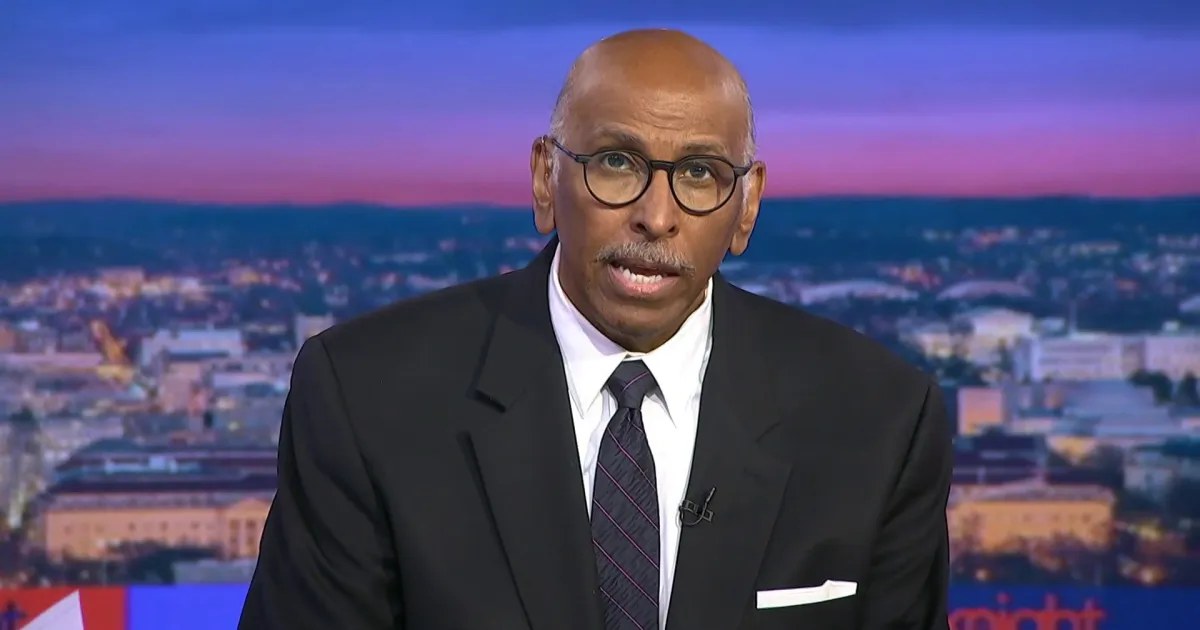


 via Center coverage of Norman WongJul 2